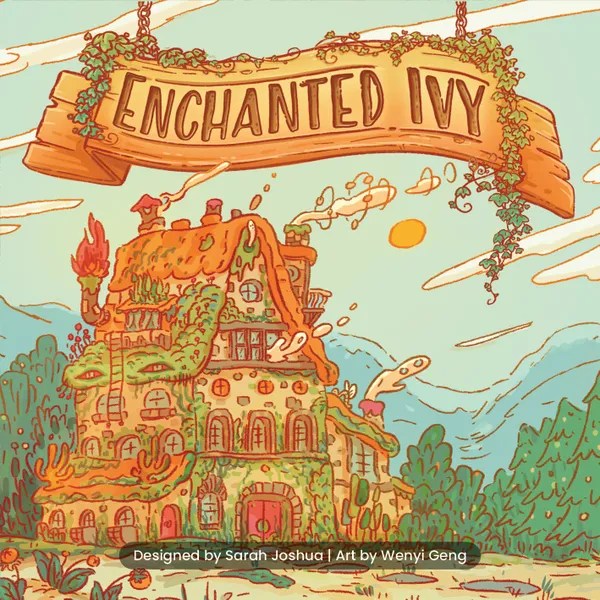
Image taken from https://boardgamegeek.com/image/9329057/enchanted-ivy
Designer: Sarah Joshua
Publisher: Allplay
Artists: Snow Conrad, Wenyi Geng
I’m starting this one off with a hot take: this game is very good and has many strengths and is quite fun, but I don’t think it’s as amazing as many reviews have advertised/made it out to be. I have likely only seen a small percentage so I could be totally incorrect, but previous to playing, looking at previews and early reviews, many people called it one of their favorite solo games ever, and I just can’t agree with that even though it is a great game.
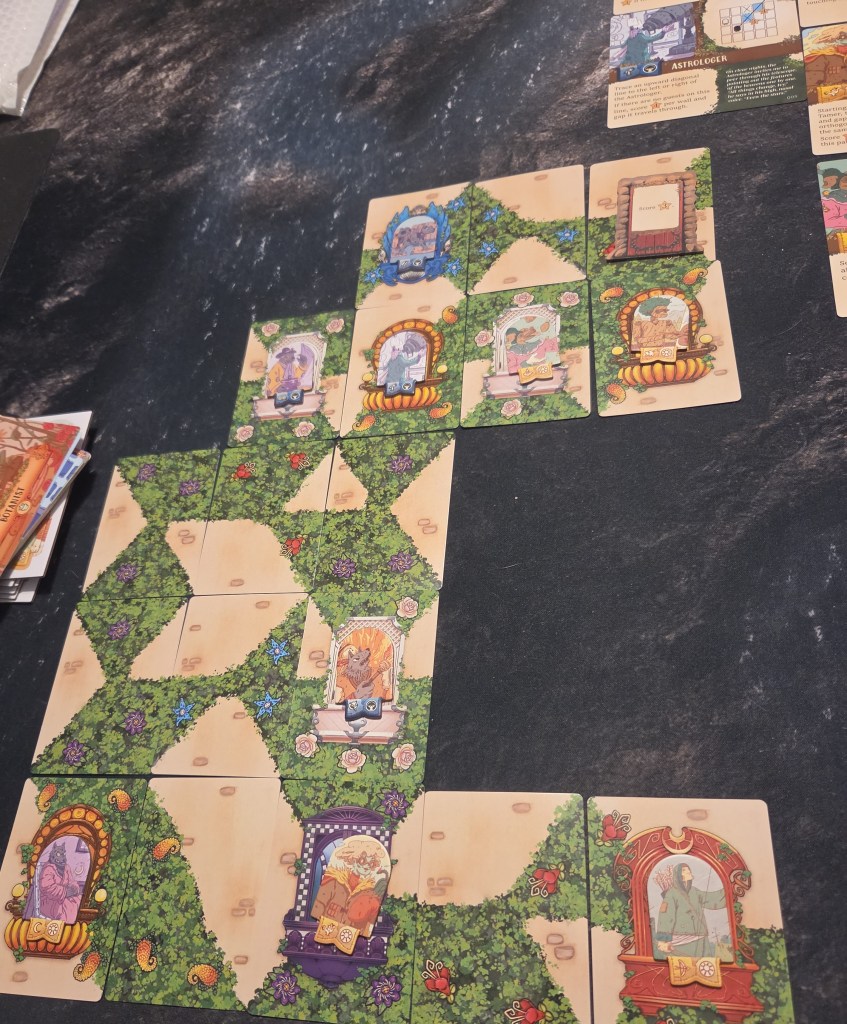
The mechanics of this game are simple and straightforward in a good way. Each round, the player places two cards and one character – one card is placed with the window side up, the other with the ivy side up, and then the character gets put on the window card. The player only has two cards to use but they do have two characters to select from each round. As you can imagine, each character has certain scoring conditions, plus each scenario provides a specific layout for all the cards that must be created, and there are also points to gain from forming a continuous wall of ivy versus multiple separate groups. The game ends once all cards create a tableau in the required shape.
Let me start off with some serious pros:
- The artwork is nice and it has a pleasant aesthetic overall. The gameplay time is also perfect (in that 15-20 minute range).
- There is a high degree of replayability which I love. Not only is there a solid ten-chapter campaign, but each of those scenarios has different scoring goals as well as unique character missions to strive for. In addition, if you don’t want to commit to the campaign, you could play any chapter as a one-off, and they also include an “endless mode” where you can just play games with different character combinations (completely unrelated to the campaign). On top of all of that, the game itself has quite a bit of randomness which provides some inherent variability. Each character is also rather unique, so that also provides variety.
- In relation to #2, all the provided modes and scenarios and things play well. I don’t feel like anything was an afterthought or add on even though the story is the main focus. I also appreciate that each scenario provides base total point goals but also has those unique character options as well to facilitate lots of different approaches, strategies, and experimentation. The goals throughout the campaign lead to acquiring some secret doors and things as well, which is a fun motivator and again provides even more replayability.
- In terms of game design, I enjoy the optimization element with character scoring. The player often has to make tough decisions including sacrificing the scoring of one character to maximize points from another.
- The mini expansion is the perfect mini expansion. It provides a small amount of additional content but not too much and not too little (two extra characters and one extra scenario).
Here are some things that could be considered both good and/or bad:
- The game box is small and portable, which is always nice. However, the box is a little bit too shallow for the actual game content. My lid floats a little, and I don’t even have the mini expansion in the main box.
- I love a good solo campaign game (especially those that have an optional campaign but can also be one offs) and I appreciate the story element to this one, but I could honestly take or leave the actual story itself. It’s fine, I like it, it’s not too long, and it does introduce the characters in a clever way, but I don’t feel it’s entirely necessary.
And then there are a few things I’m not a huge fan of:
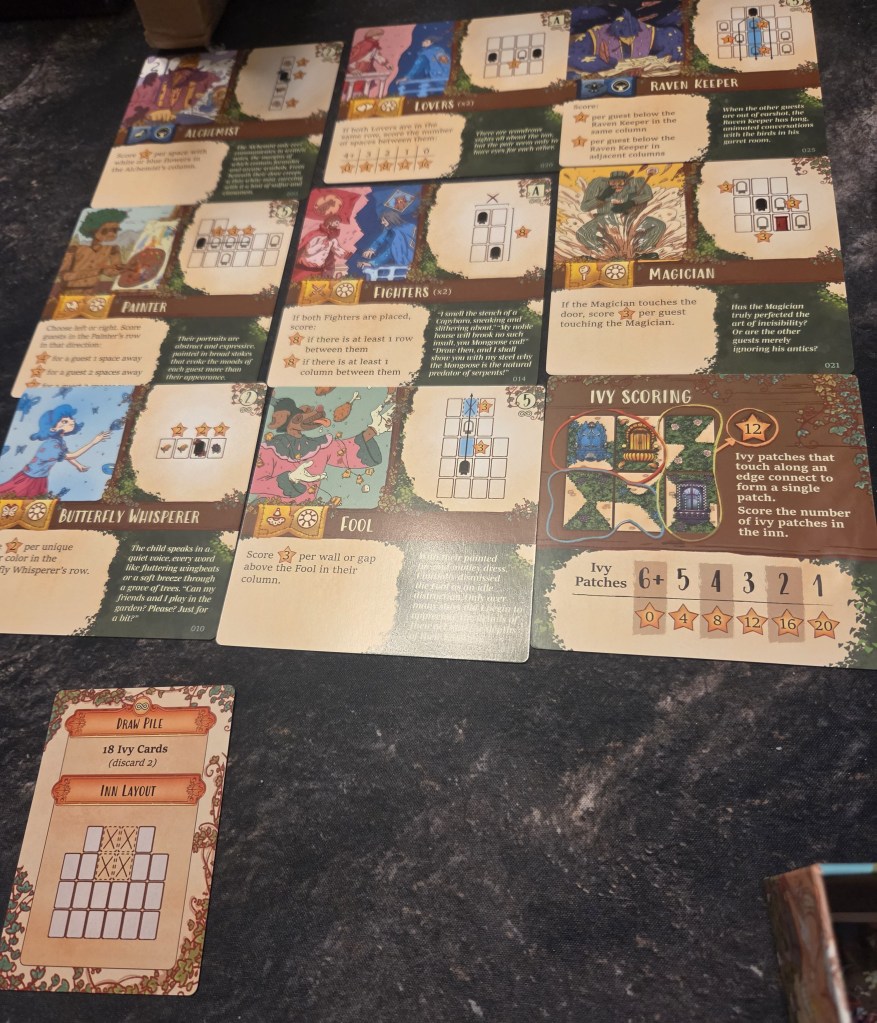
- The character cards are unnecessarily large and take up a lot of table space. I suppose it’s possible to stack them so that only their scoring condition shows, but there are so many, I needed the pictures visible every game to remind myself who is who.
- Despite the simplicity, there is a lot to keep up with. I should caveat and say this isn’t entirely negative as I love a good brain burning game, but the combination of eight or more characters (with some of them likely being new to you), a very specific layout, the ivy scoring, the overall scoring goals, and the scenario specific challenges – it’s just a little too much. I understand the scenario specific challenges are optional, but I’m an overachiever and I had to at least try for one of them each game.
- My biggest complaint and why I feel I have such an issue with #2 is the luck factor. I think my statement above would be more positive than negative if the luck of the draw in terms of cards and characters wasn’t so influential. For example, one scenario could have a requirement for X character, but if you don’t draw that character until the very end, you have almost no chance at succeeding with that specific goal unless you get SUPER lucky or have intentionally been focusing on that one aspect. Along the same lines, you can easily get messed up early in the game if you get multiple ivy cards that don’t fit well together. The goal relating to the group(s) of continuous ivy cards carries a huge percentage of the end game points that not having good options early on with those cards can really mess things up.
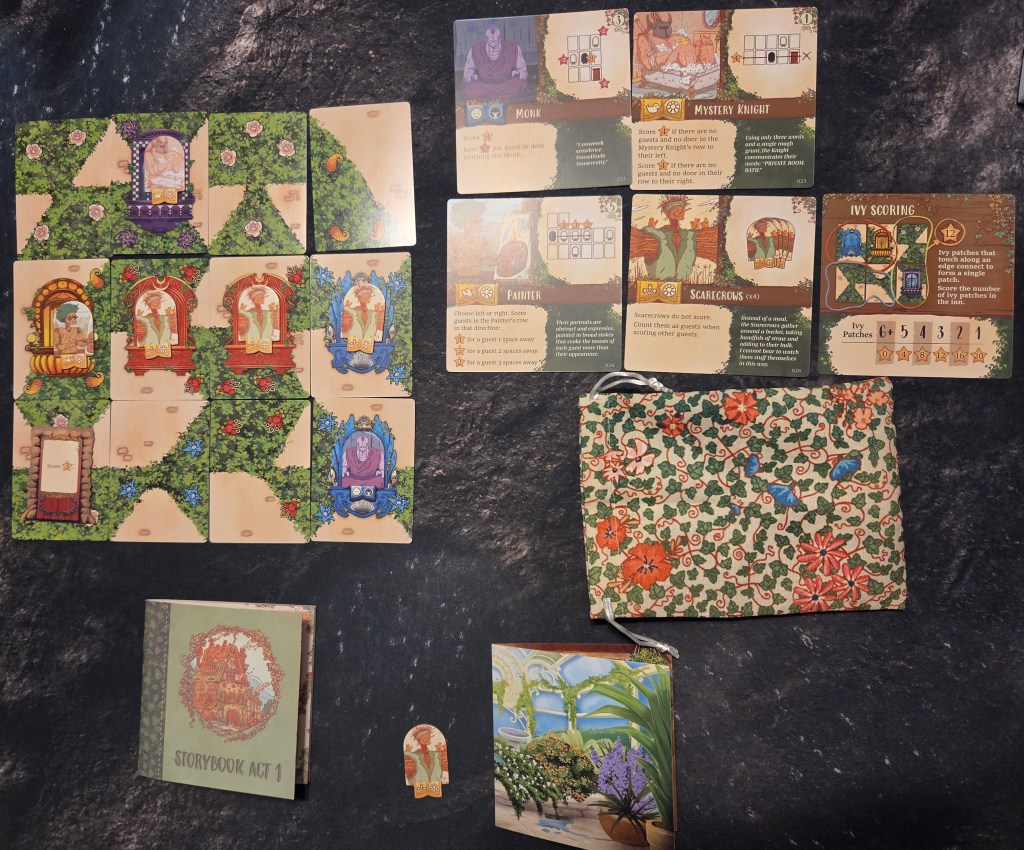
There’s no doubt in my mind that this will stay in the collection for a long time and that it will see many plays. There is an astronomical amount of gameplay and variety so no two games will ever be the same, and it’s also simple to get into in terms of setup/take down and rules overhead making it easy to whip out any time. That said, for me, it’s not perfect and that’s okay! I’m really glad that other people are thoroughly enjoying it and that it’s getting the exposure and credit it deserves.


Leave a Reply