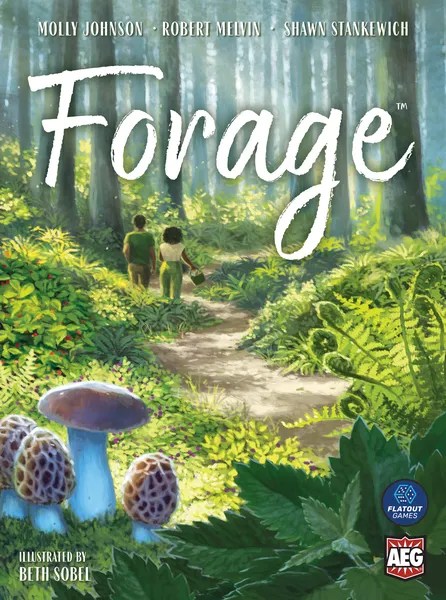
Image taken from https://boardgamegeek.com/image/9225193/forage
Designers: Molly Johnson, Robert Melvin, Shawn Stankewich
Publishers: AEG, Flatout Games
Artist: Beth Sobel
Forage is a quintessentially cozy roll and write game that plays quickly, has a lot of variety, and provides interesting optimization decisions. Building on that, it also has a solid player count range (1-6), and even more importantly, the solo mode is great!
A round of Forage starts with a step called “roll and walk” which essentially equates to revealing a journey tile (we will come back to these), which also acts as a round tracker, and then rolling all the foraging dice. Once the foraging dice are rolled, the special foraging die gets placed on the “foraging basket card” and then all other dice are separated based on whether any other rolled dice match, not including the special die. Matching dice go on one side of the basket card and unique dice on the other side.
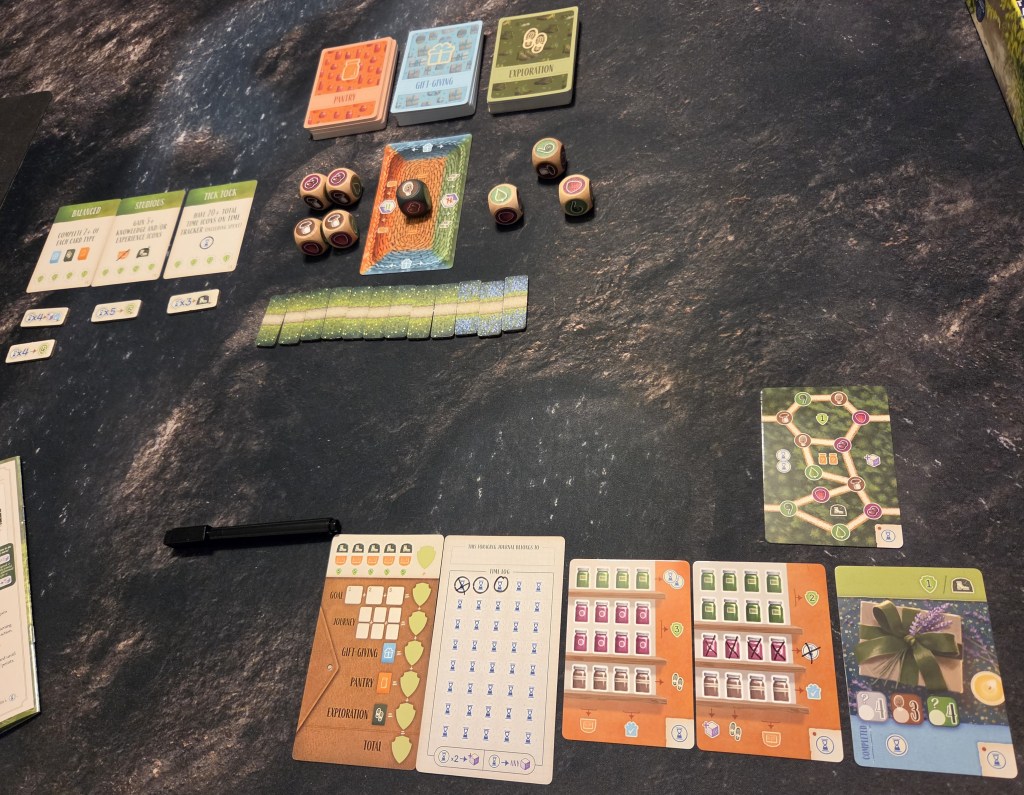
Once the round setup has taken place, the dice action phase begins. There are three main actions: store, explore, and gift. For storing, using any group of matching dice, the player marks off corresponding jars on their pantry card. Certain rows and columns provide additional bonuses when completed. The explore action allows the player to adventure in the forest by utilizing the unique dice and crossing off corresponding symbols. If a bonus gets entirely encircled by completed symbols, the bonus becomes available to use that turn. Gifting also requires the use of the grouped matching dice, and this action allows a gift to be crossed off on a gift foraging card. At any point during a turn, a player can cross off one time symbol to add any dice to their action, and/or they can mark off two time symbols to take a bonus action that uses dice other than those utilized for their main action.
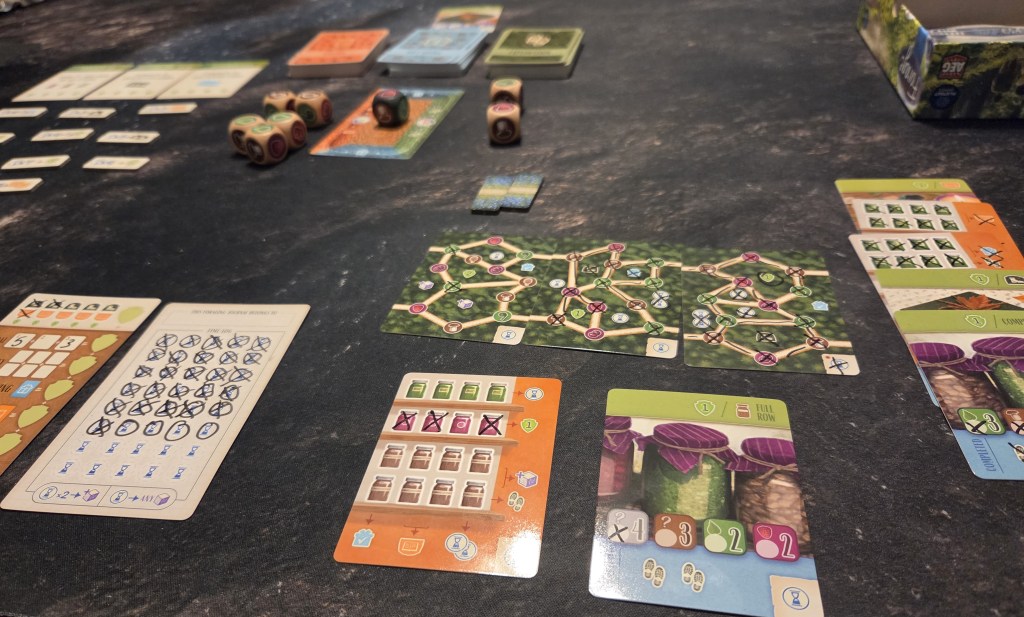
Anytime during a round, players can also cross off time symbols to complete journey tiles which provide bonuses or benefits. They’re often quite powerful but it’s sometimes challenging to convince yourself it’s the best use of your limited time. Also, if at any point a pantry, exploration, or gift-giving card is completed, the player gains one time and gains the completion bonus if it’s a gift-giving card. Finishing a gift-giving card also affords a new, personal scoring opportunity.
The last main aspect of the game is the goal cards. Three of these are revealed at the start of each game and provide race objectives that can provide a substantial number of points if completed quickly.
In the solo game, the gameplay remains exactly the same (showing that this is a very multiplayer solitaire experience) except for the goal cards since there isn’t another player to race against. For solo players, a certain number of points are scored for each goal card depending on the round in which the card is completed. It’s simple but effective.
I really enjoy the solo mode in this one. There is zero upkeep, so you just get to explore and have fun and try diverse strategies and experiment with different cards and things.
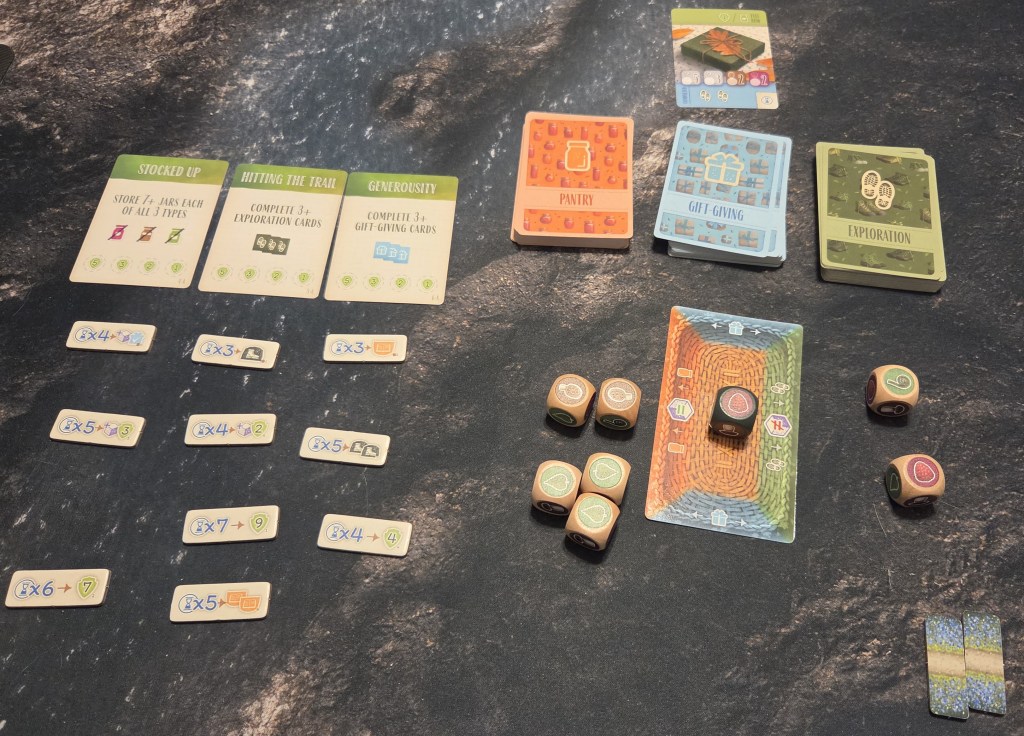
I also really appreciate the replayability in this game. There are a lot of different goal cards, varying starting cards, and numerous foraging cards of each type, no two games will ever be the exact same. As with all recent AEG/Flatout games, there is also an achievement list in the rulebook which I sincerely appreciate as it aids in that variability factor.
My two critiques are pretty small honestly. The first is that the theme is a little weak for me. The dice in combination with the foraging cards help showcase the theme, but the gameplay itself is quite similar to any other roll and write where you’re crossing things off and trying to get awesome combinations. The second is that, while they truly are amazing and I would not ask for them to be changed, the dry erase cards were a serious pain in the neck to separate and shuffle on that first play. I actually (obviously unintentionally) ended up bending one card because it got caught at a weird angle and it made me sad.
Overall, Forage is a solid addition to our roll and write collection as well as our AEG/Flatout collection. There are a few small things that could be improved but it’s a fun, enjoyable game that’s not too complicated, plays pretty quickly, has a lot of variability, and has a simple solo mode. It’s also a reasonably sized box, doesn’t take up much table space, and has functioning dry erase markers and zero waste in terms of player sheets since everything is reusable. Truthfully, what more can we ask for these days?!


Leave a Reply