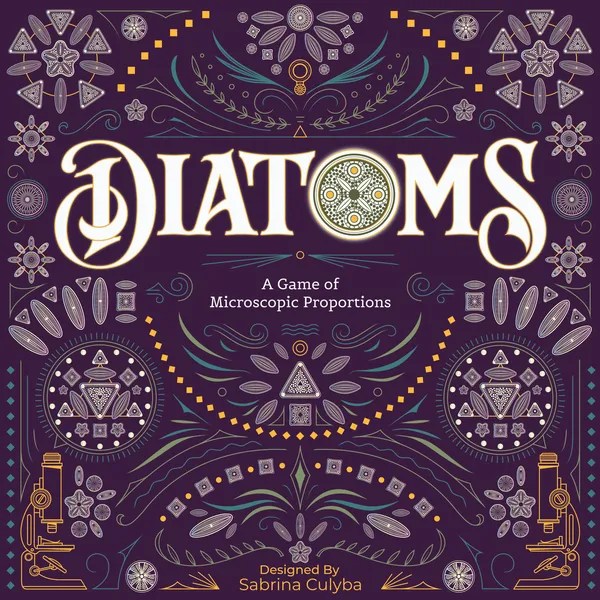
Image taken from https://boardgamegeek.com/image/8518419/diatoms
Designer: Sabrina Culyba
Publishers: Ludoliminal, 25th Century Games
Artist: Nim Ben-Reuven
Diatoms is an abstract (but thematically abstract?) game focusing on tile placement and pattern building. There are two main solo game play modes: “commissions” and “private tutor”. The commissions variant provides precise patterns that need to be constructed in a certain amount of time, and the private tutors is a little more like the multiplayer game with certain additional scoring criteria. I did try the private tutors version but almost all my plays focused on the commissions.
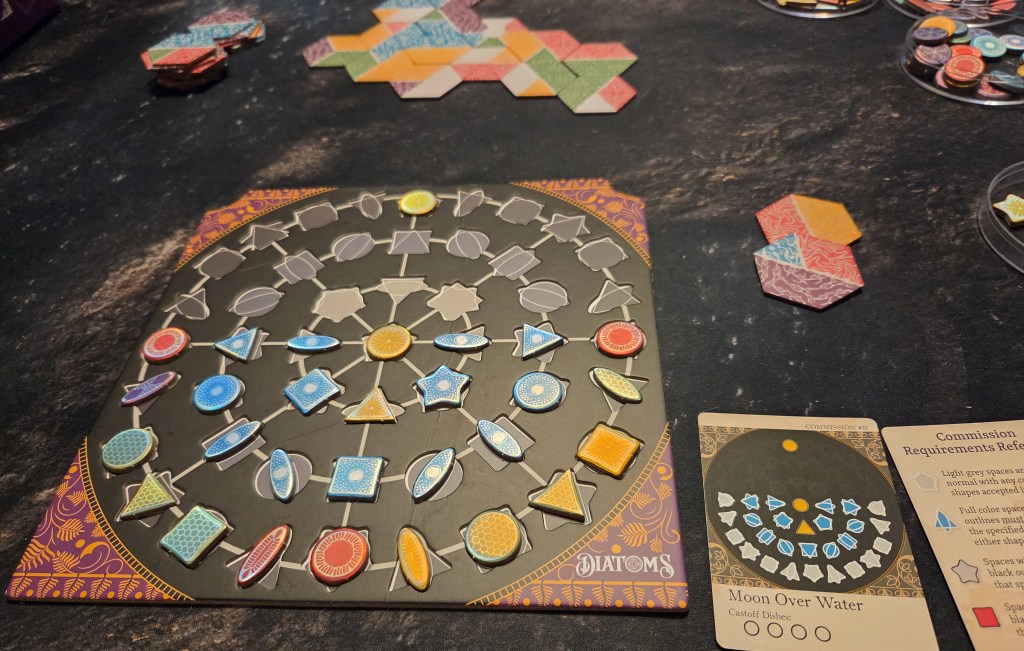
In the solo game, the player places tiles with varying colors so that each tile (besides the first two) forms a three-tile hexagon (see pictures for reference). Then, based on the number and color of each triangular segment of that hexagon, the player acquires certain shaped tiles. For example, a single triangle provides a circular diatom, two triangles next to each other create an oblong shape, etc. Once those diatom pieces are collected, they get placed on corresponding spots on the player board. In the solo game, the goal is to match the pattern and there are usually stipulations in terms of colors and/or shapes. If a piece cannot be placed on the board, it goes into one of the “overflow” petri dishes. Each dish can hold a certain number of pieces, and each commission has a specific number of available petri dishes. If at any point the player cannot place a piece and has no room left in any petri dishes, the commission is failed, which can also occur if there is ever a turn where the player places a tile and isn’t able to collect any diatoms. Otherwise, the player wins once the pattern is complete.
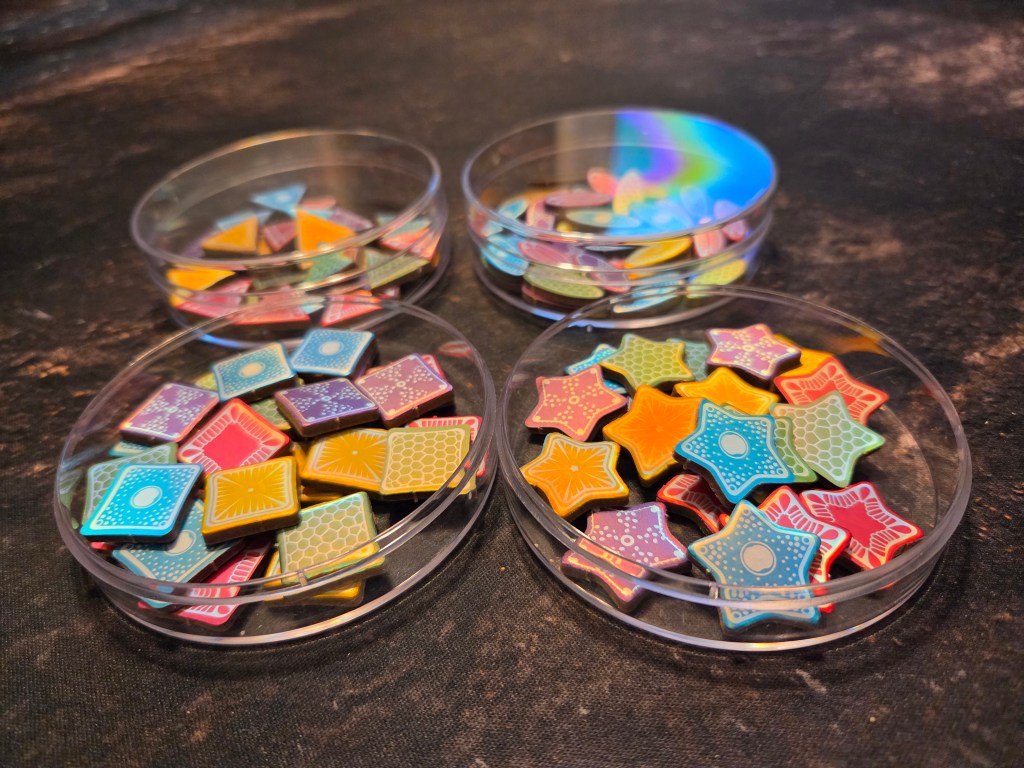
First of all, the componentry and storage solution in this game is great. The petri dishes function as holders and storage for all different shaped pieces, and there are perfect holes in the organizer in the box for everything to fit. The shiny diatom pieces are also cool, but it can be a little challenging to differentiate color on occasion. They’re all patterned differently which helps, but I still had a few issues.
The gameplay itself is very easy and straightforward but there is definitely strategy in terms of placing the tiles to gain the diatoms and then the placement of the diatoms themselves. That said, there is some luck in terms of which tiles are available and which diatoms you need. In a normal game, I don’t think this would be as big an issue, but some of the commissions can require a lot of one or two specific color(s), and if no tiles available have that color, it’s challenging to succeed.
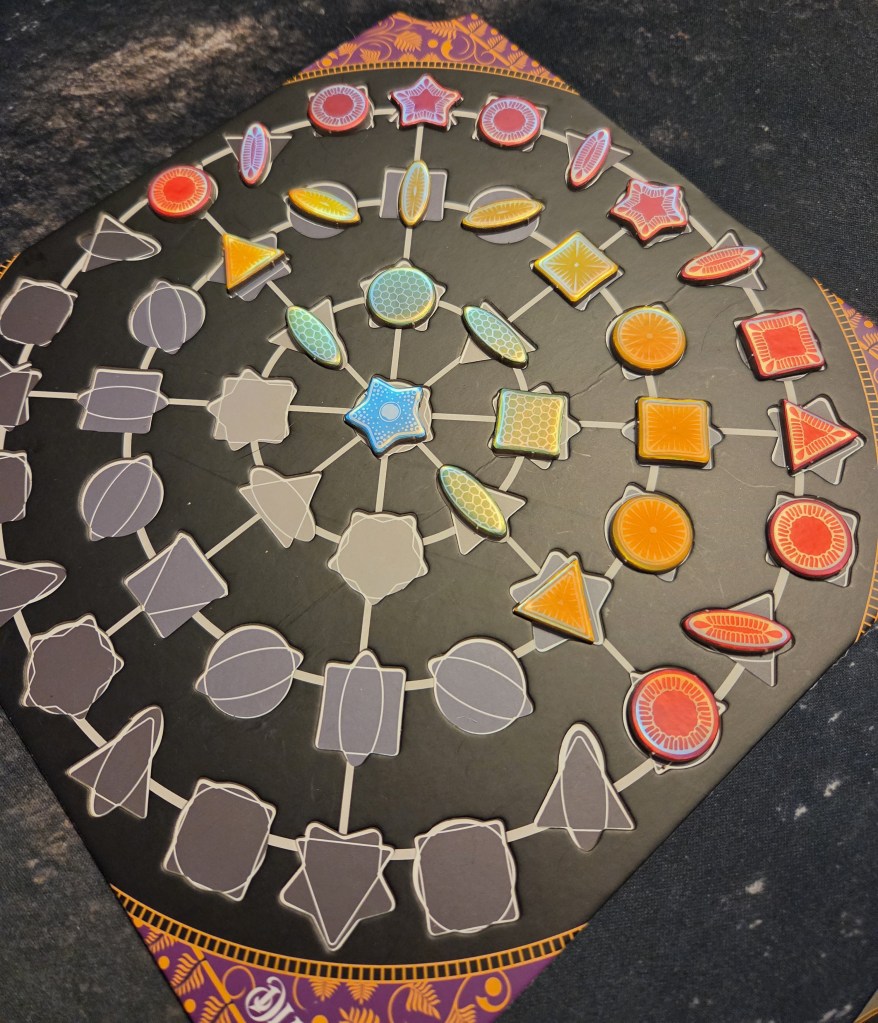
I also really like that the game plays quickly; the solo games lasted 15-20 minutes. My favorite type of solo mode is one with no opponent to keep up with and with scenarios, and this one fits both of those and does it well. There are many commissions (over 30) which provide a lot of replayability. Starting around the 24th or 25th commission, they become “free form” meaning each piece isn’t in an actual inlet on the board, but the back is used (which is flat) and the player places the diatoms as best as they can to match the pattern. I was not a fan of this, but I still appreciate it was included and I’m sure others like it!
Overall, Diatoms is a great addition to the collection. While the gameplay loop is the same from game to game, the solo commissions provide a lot of variability, and that doesn’t even take into account the other solo mode. It plays quickly, doesn’t take up too much table space, has short setup and take down, and provides an interesting puzzle. I’m also a bit of a science nerd, so the theming is excellent. It’s not perfect, and that luck factor can be a pain, but I definitely think it’s fun, unique, and a good one to check out.


Leave a Reply