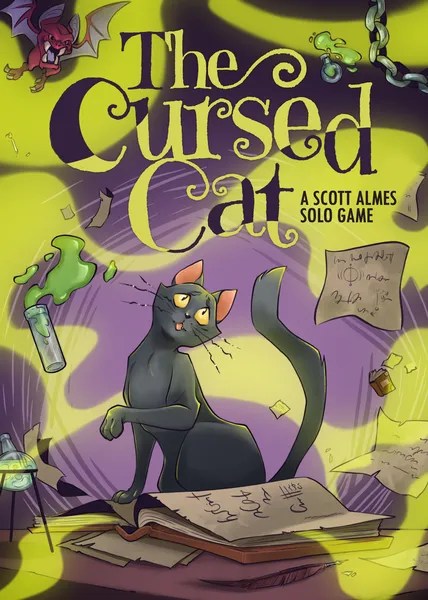
Image taken from https://boardgamegeek.com/image/9576957/the-cursed-cat
Designer: Scott Almes
Publisher: Button Shy
Oh my gosh, have I got a story for this game! I promise I’ll explain more about the actual game, how it works, the gameplay, etc., but let me just share a quick anecdote.
Before that, remember this is a preview copy so components and rules are subject to change.
Button Shy kindly sent a copy of this game for review, and I actually had time the day I received it to learn it and give it a try. As with any new game, I started on the easiest difficulty level. The game plays quickly in general (like 10-15 minutes) but this first game was very quick and seemingly way too easy, so I tried the medium difficulty level and had a similar experience. At this point, I was getting discouraged – I really wanted to like the game, but I had a hard core “is this it?” moment where I felt like there wasn’t enough to the game. Immediately thereafter, I played a game on the highest difficulty and it all made sense! It finally felt like a game that was challenging but not impossible and that has some interesting and fun decisions to make and strategies to explore. I proceeded to play it at least six more times (I say at least six because at some point I lost count) that evening in hopes of winning on that highest level, and I finally did, but it took quite a few games which was exactly was I was originally hoping for/expected.
Setup for the game is super easy. The three room cards get laid out with the lab on the left, the spellbook in the middle, and the portal on the right. The rest of the cards are spell cards which get shuffled together. Three are then dealt spell side up below the rooms, and then a certain number of monster cards are placed in each column (above the room card) based on the chosen difficulty level. Then, each row is sorted so that the highest valued monster card is on the left above the lab and the lowest valued monster card is on the right above the portal. The remaining spell cards provide the deck.
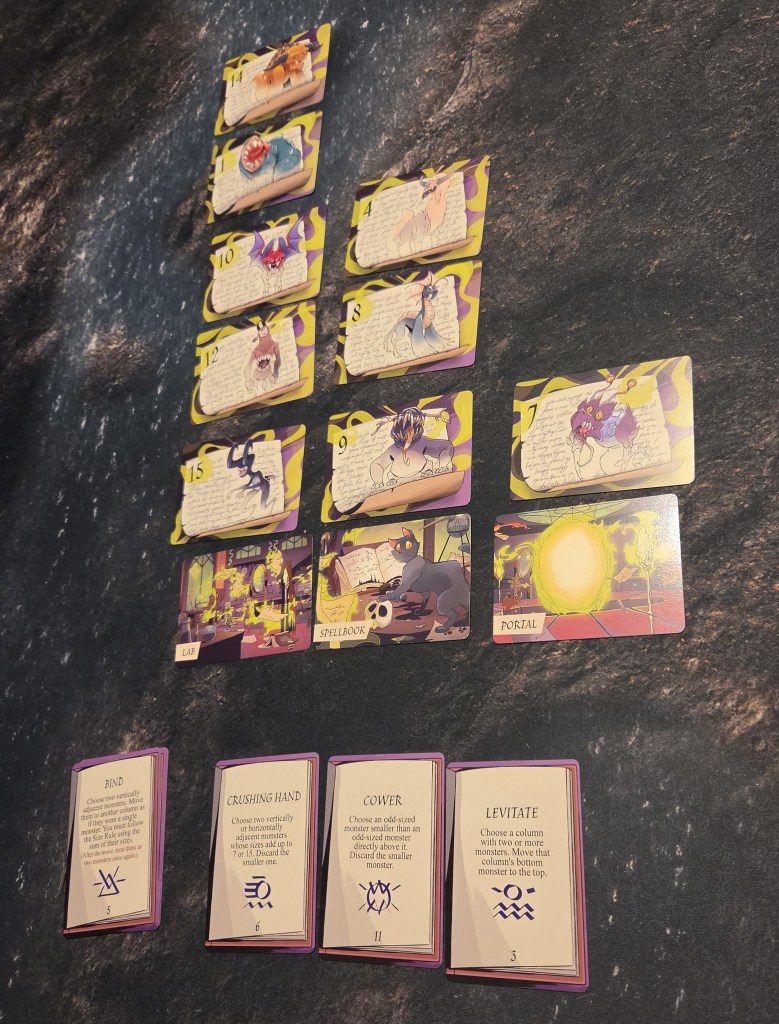
At the start of each turn, the player can perform up to two monster relocations, unless your previous spell failed (we will discuss spells momentarily) in which case only one monster can be relocated. There are two main rules when relocating a monster. The first is that the monster has to be at the top of its column. The second is that it has to follow the size rule which means monsters with higher numbers cannot be placed on monsters with lower numbers. Besides that, any monster can be relocated to either other column as long as it abides by those rules.
After the optional relocations, the player attempts to cast a spell from one of the three face up available spells (called the spell row) or the card on the top of the deck. The effects of the selected spell are then resolved in order. Some spells can move columns or monsters, but actions via spells are not considered relocations and therefore don’t have to follow the size rule unless the spell states otherwise (they still have to move to tops of columns unless the card says otherwise, though). If the player cannot resolve the effects of the spell, it is considered failed and only one relocation is available at the start of the next turn. Regardless of whether the spell succeeds or fails, that spell card gets discarded. If the card was taken from the spell row, that card does not get replaced! Using spells from the spell row limits options as the game progresses since that row is never refilled.
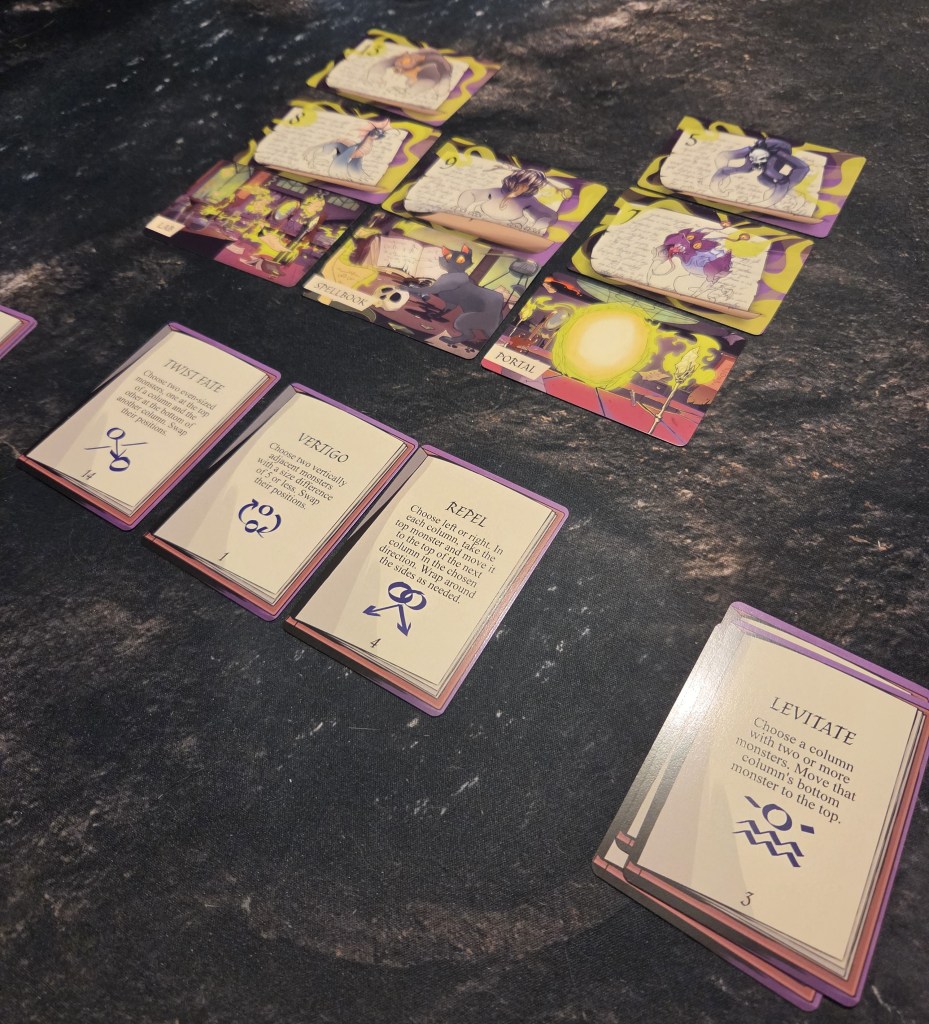
The game ends in one of two ways. If the player can successfully move all monsters into the portal room, they get banished and you win the game. If the player ever runs out of cards in the spell deck and row and there are monsters left in the lab and/or spellbook room, the monsters have taken over and you lose.
After my story, you can probably ascertain that I did not care for this game at first, but then I really enjoyed it! It plays quickly, is mechanically light with easy rules, and the challenge level is good at its highest difficulty level. There’s a fun little puzzle with the monster relocations and spell selections and how to maximize both and plan ahead. There is also a surprising amount of variability despite there only being fifteen monster/spell cards. Even after a few plays, there came a spell I hadn’t seen yet, and even if you know all of them, the number of combinations of monsters and available spells creates a lot of diversity.
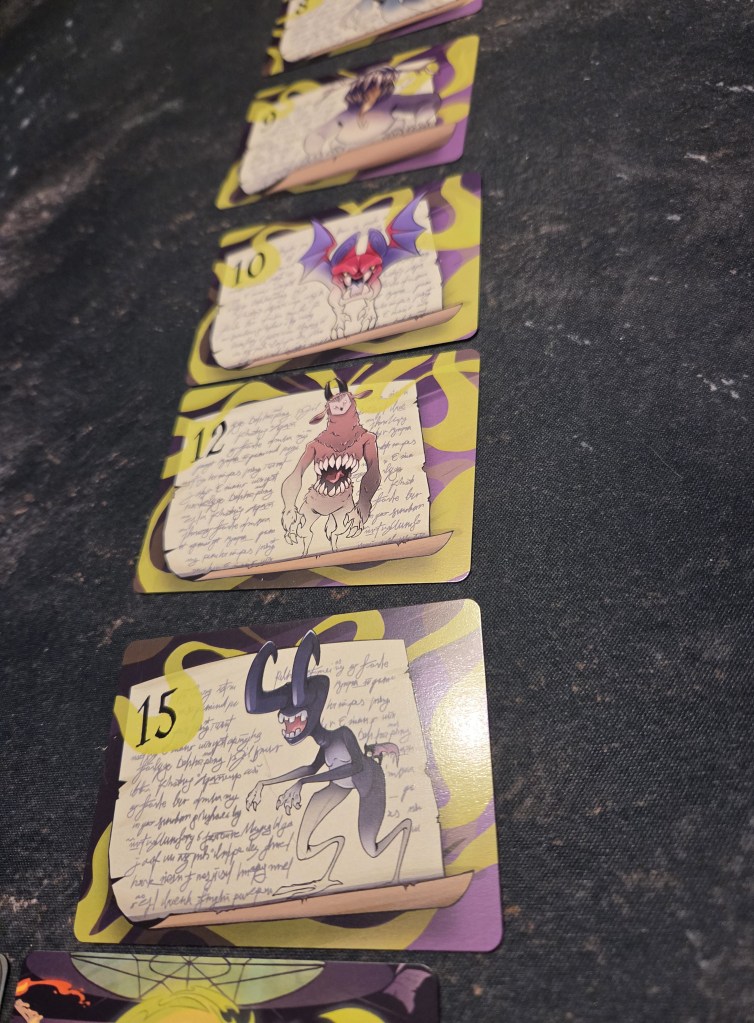
The artwork is also really amazing and brings the monsters to life. Besides some of the artwork aiding in the thematic expression and maybe “casting spells” (AKA performing an action), the theme overall is quite weak. I genuinely did not know what the cat’s role in everything was until I checked the BGG page before writing this. The rules tell me, but I must have skipped that section. 😂
Despite the strong lack of theme and a serious misstep with the difficulty levels (in my opinion*), I really like this game! Even after my marathon of games that first night, there is a hardcore cravability to this game for me. I’ve succeeded once, but I’m interested in playing more and seeing more combinations and challenging myself to keep winning.
*Please note that Button Shy actually updated the rules regarding setup for the different difficulty levels after I wrote this. I did try easy and medium again with the corrected rules, and my statement still stands; the hardest difficulty is my goldilocks.


Leave a Reply