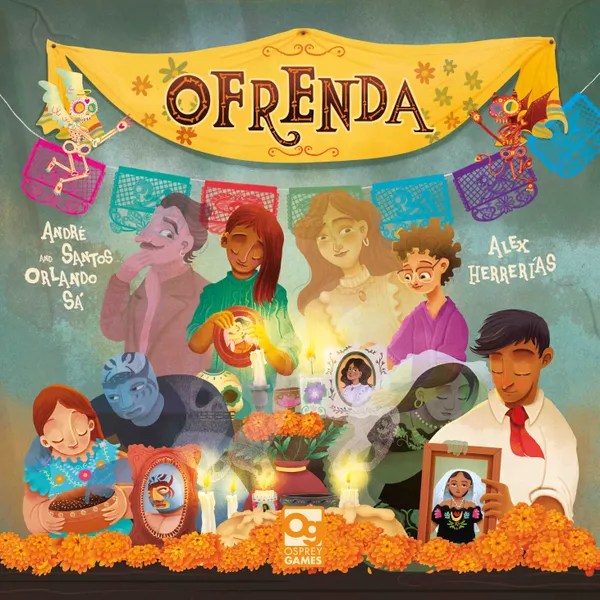
Image taken from https://boardgamegeek.com/image/8574369/ofrenda
Designers: Orlando Sá, André Santos
Publisher: Osprey Games
Artist: Álex Herrerías
Ofrenda is a thematic yet abstract card-based game where players are trying to fill in their ofrenda with family members in the perfect configuration. Each turn, players draft a portrait card that they then add to their ofrenda. Drafting follows pretty standard rules where one card is free, and if you want any that are further up (or down?) the line, you have to add a marigold to each card you skip. Each portrait card on the main board also has an associated candle that can be drafted with the portrait card. It’s also possible to gain a candle from an alternate location by placing a marigold on the corresponding portrait card for the candle you choose (if you choose the one that corresponds to the portrait card you selected, it’s free).
After adding the portrait card to your ofrenda board, if all three adjacent spaces have family members in them, the player can choose to add a candle or marigold (depending on the spot) which can score additional points at the end of the game. If a player chooses not to add the associated candle or marigold, though, they can’t go back later in the game and place one; that spot gets forfeited. One other neat design choice is that some spots on the ofrenda cost a marigold to place a card there, while others give marigolds, so timing and strategy are both important in this game.
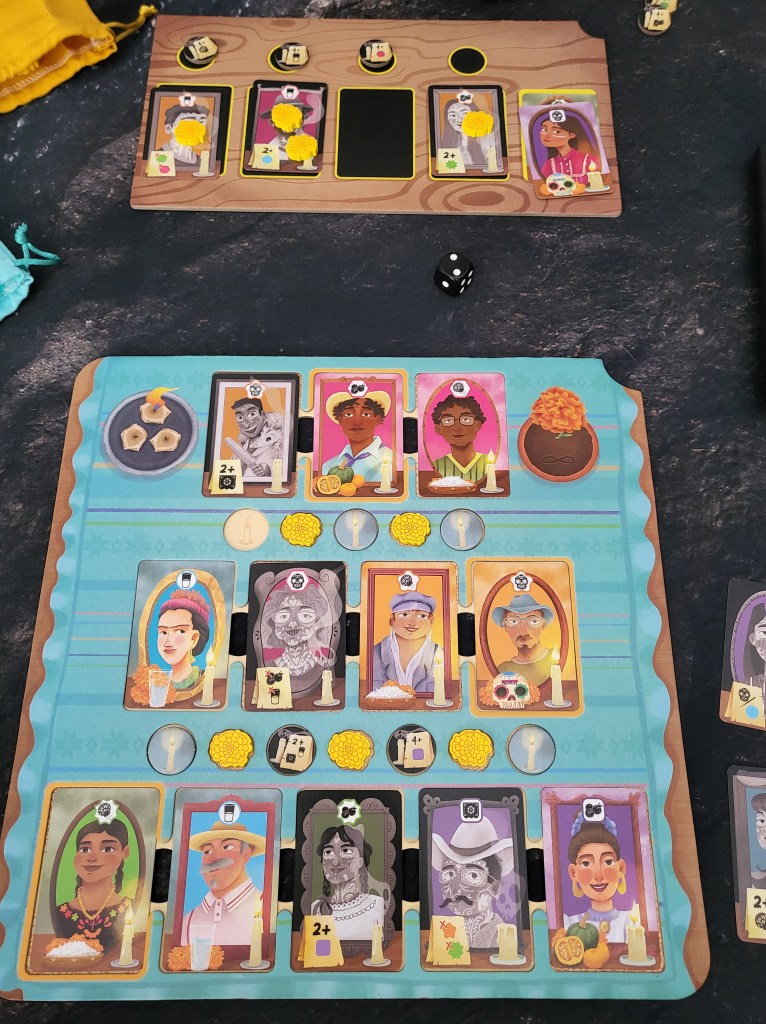
Throughout the game, the main goal is to “complete” portrait cards by successfully meeting their requirements. Some require all adjacent portraits to be of a certain color or to have a specific symbol and others don’t want certain colors or symbols around them, and some others require specific numbers of certain symbols or colors surrounding them. Candles have similar requirements but usually need 4+ of something, one of each color, etc. When portraits and candles get completed, they get flipped over and then are able to score at the end of the game. Any incomplete portraits and/or candles will score zero points. The other interesting twist with scoring is that completed items score based on the number of completed portraits adjacent to them, and there are also some locations on the board that can score double points. So, not only do you want to flip as many portraits as possible, but it also behooves you to try to keep completed portraits adjacent to each other and/or in those double spots.
In the solo game, there is a bot type opponent controlled by a die that helps remove cards from the draft board, takes candles, etc. to keep the available items constantly changing while also potentially removing items the player may need. The location they take from is determined by a die, so it can be challenging to predict which will be taken, but there are some probability odds you can use to try to guess which card you may not have access to next turn.
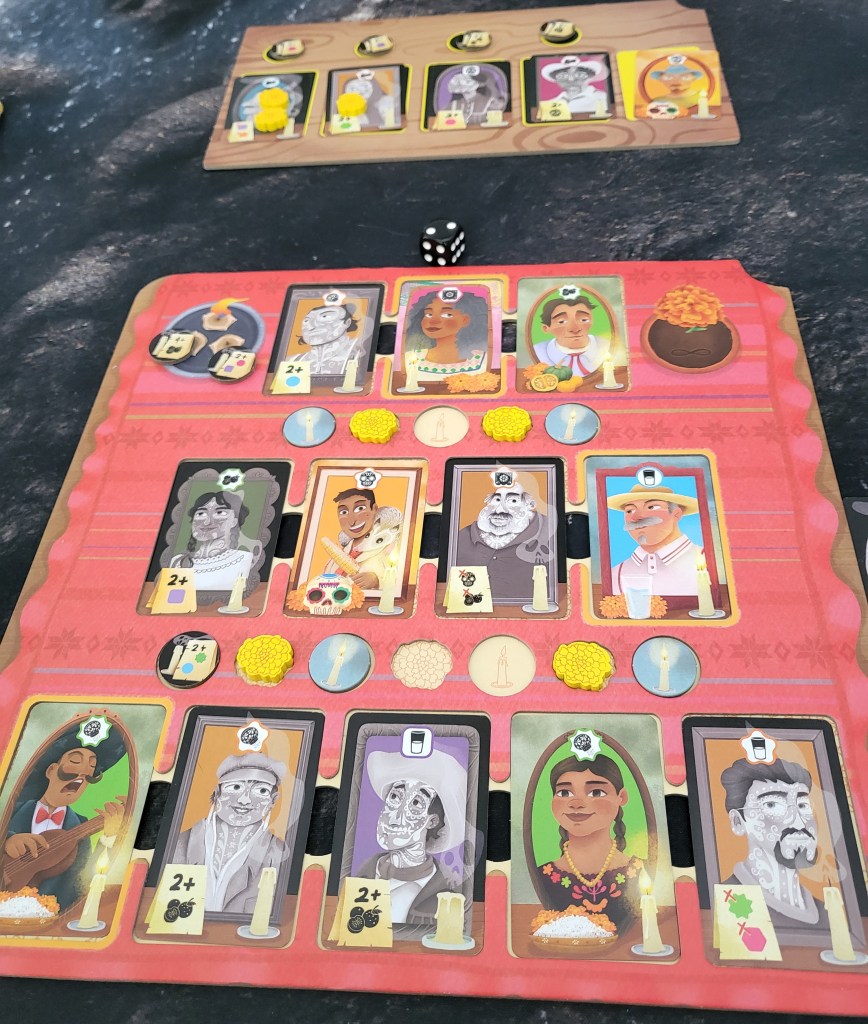
Overall, this game is fun, quick, easy to teach, and thematic, but there can be quite a substantial amount of luck involved. It’s possible you need one card to complete something and you may never see that card in the game. The order in which you draft and place cards is obviously highly dependent on the cards that are accessible to draft, which can be 100% reliant on luck of the draw. This can make the game more or less challenging, but it’s pretty difficult to do well in general because the exact combinations you need can be difficult to secure sometimes.
Besides some interesting mechanics and design choices, the artwork is also amazing.
Ofrenda is a really solid, clever game that plays quickly and has some interesting strategic elements but does rely a little too much on luck. It’s definitely one I look forward to playing in spooky season, but it’s really a great game to pull out anytime you want a 20-30 minute thinky game that doesn’t take itself too seriously but still provides a thematic experience and thoughtful puzzle to solve.
 The Adventures of Yogi Bear and Delaware
Leave a comment