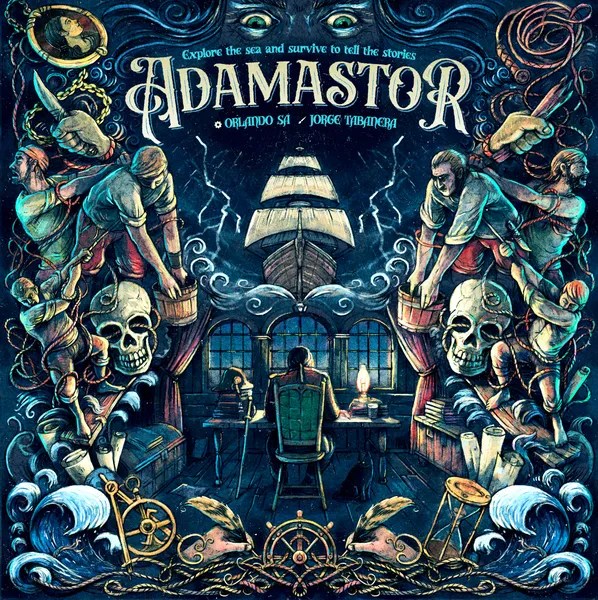
Image taken from https://boardgamegeek.com/image/8967591/adamastor
Designer: Orlando Sá
Publisher: Ludonova
Artist: Jorge Tabanera Redondo
Adamastor is a hand management and action selection game where the player is trying to traverse the sea and reach an island. Along the way, they can gain skills or (the more likely option) they’ll have mutiny, disease, or some other problem that causes them to fail before they reach their final destination.
Each round, the weather gets determined by the three visible action cards. The weather determines how many actions the player gets that round and if there are any other modifications to the situation. With each available action, the player can either navigate and move their ship, draw a card, or swap a card in hand with one of the three visible. Obviously, the goal of the game is to move your ship across the map cards, so that’s an important action. Each action card has a certain value that can be utilized for navigation, and each spot on the map cards has a specific total that needs to be reached to advance. Exchanging cards can be useful in gaining skills and preventing bad events from occurring at the end of the round.
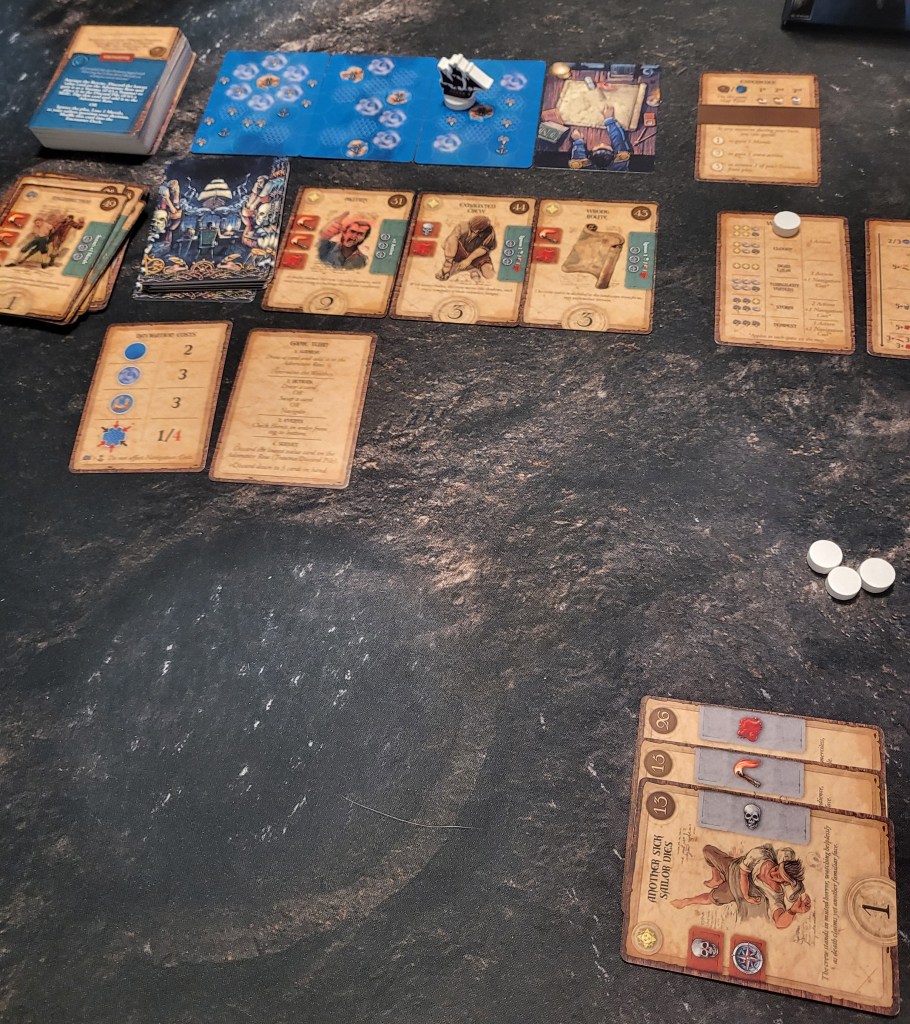
Once the action phase is over, the events get evaluated. Basically, 5+ of one symbol is bad and 3+ of all symbols means mutiny, which equates to an automatic loss. Besides the cards visible in the action row, any cards acquired for their negative effects also get added in (see next sentence about acquiring trauma). Once the events are complete, the player either discards the rightmost visible card if it has a skill on it or gains it if it is a trauma card.
The player wins if they successfully make it to the final destination island, but they lose if mutiny ever occurs or if they run out of action cards which symbolize morale. Besides what I mentioned, there are encounter cards that are quite fun and can be positive or negative, and there are experience points that you can gain to aid you in your journey, among a few other things.
Before I get into my thoughts on the game itself, I must say the art is really well done. It looks amazing and exceptionally portrays the vibe and overall feeling of the game.
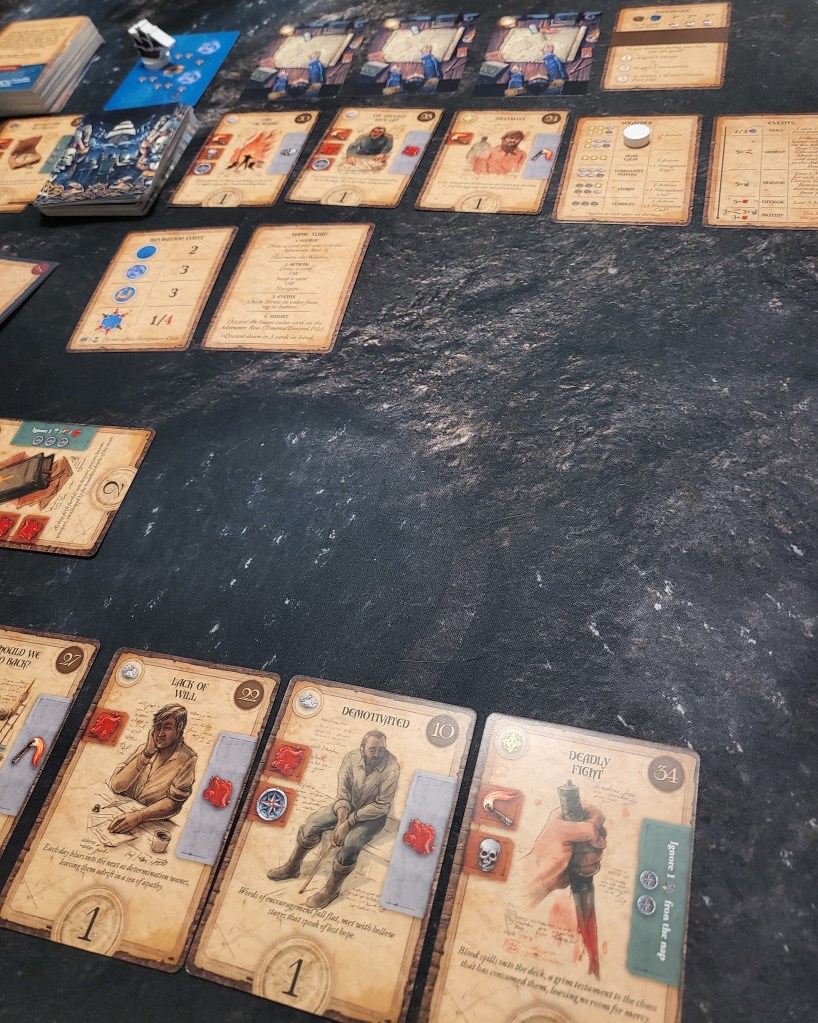
My favorite aspect of this game is probably the encounter cards. There are a lot of them so it would take many many games for all of them to be discovered. They also add some fun surprise elements and choices to the game. Unfortunately, they’re a little bit more of an add-on than a central part of the game. It’s very possible to play and never draw one (based on your navigational choices), so I wish they were incorporated a little better.
Overall, for me, this game is far too challenging and way too random. I don’t mind a difficult game, but the way the game is designed to be so reliant on the cards, the luck factor is a major problem and there is a serious lack of player agency in the likelihood of success. For example, there was one game where I kept getting skill cards in the visible cards area which isn’t bad, but I was never able to acquire any skills because I didn’t have the necessary symbols (symbols to help gain skills usually show up on the trauma cards). Then, later, as I was one or two moves from reaching the island, I drew cards that all had similar symbols, so I lost automatically and there was literally no way to avoid it.
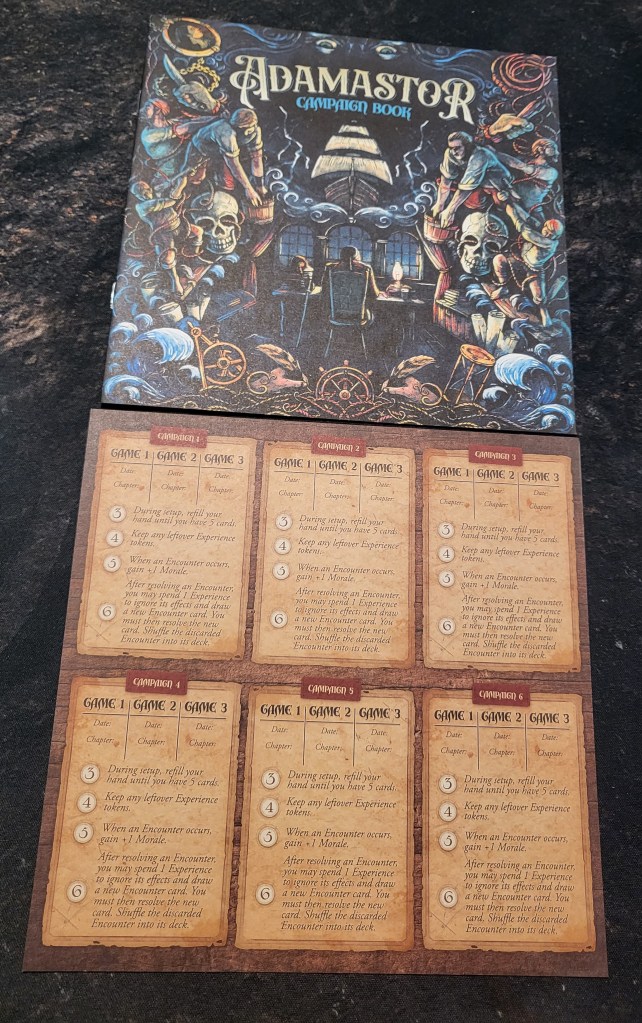
On top of that, one of the main draws for me (as with most solo games) was the campaign mode. But, after playing the standard game and getting crushed, the fact that the campaign increases the difficulty is insane. How would anyone even remotely be able to complete it?! Especially with the serious reliance on luck of the draw? Nah, I’ll pass.
Truthfully, this one was a letdown for me. I was really excited about it and had high hopes for the gameplay and campaign mode, but it was a disappointment. Like I said, the art is really nice and I like some aspects of it, but it’s just too difficult and too luck dependent for my liking.


Leave a Reply