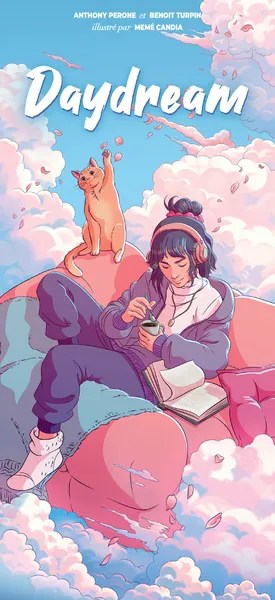
Image taken from https://boardgamegeek.com/image/8572999/daydream
Designers: Anthony Perone, Benoit Turpin
Publisher: Disto Studio
Artist: Memé Candia
Daydream is the quintessential “cozy” board game. The theme is lighthearted, the artwork is lovely and chill, and the overall gameplay is more focused on enjoying the puzzle rather than being tense. For something that puts itself in the same genre/category as “A Gentle Rain”, I think it fulfills its purpose and does it well! It’s nothing revolutionary or super exciting, but it is a nice, relaxed game that still has some interesting tactical decision making. In my comparison, I’d say Daydream is a step up in terms of complexity over A Gentle Rain, but it’s far from being brain burning, mechanically challenging, or strategically deep.
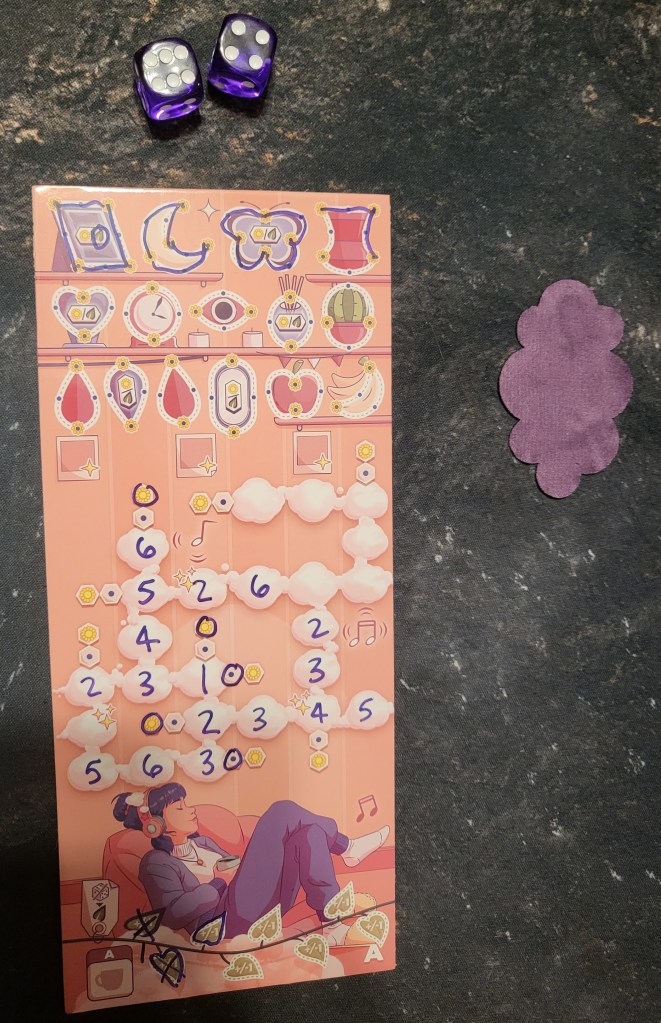
Each round, two dice get rolled and can then be utilized for their value in locations adjacent to those that already have assigned values. In general, the goal is to have each row and column of clouds to not have any repeating numbers and to also be in either ascending or descending order. These aren’t restrictions, though; they’re just the way to score points. Any number can be placed in any adjacent location, but only unique numbers will score and having the ascending or descending aspect provides more points. On top of that, certain “scenarios” or board combinations have other scoring considerations like photographs, frames, etc.
The main cloud number scoring occurs when a row or column is completed. If each number is different but does not fit the ascending/descending stipulation, the player can mark lines connected by black dots on their items at the top of their boards (check out the board pictures for this to make more sense). However, if they are ascending or descending, the player gets to mark lines between suns which essentially doubles how quickly items can be completed. As you can imagine, besides any board specific scoring, each completed item is equivalent to one point at the end of the game. Play continues until each cloud has a number in it.
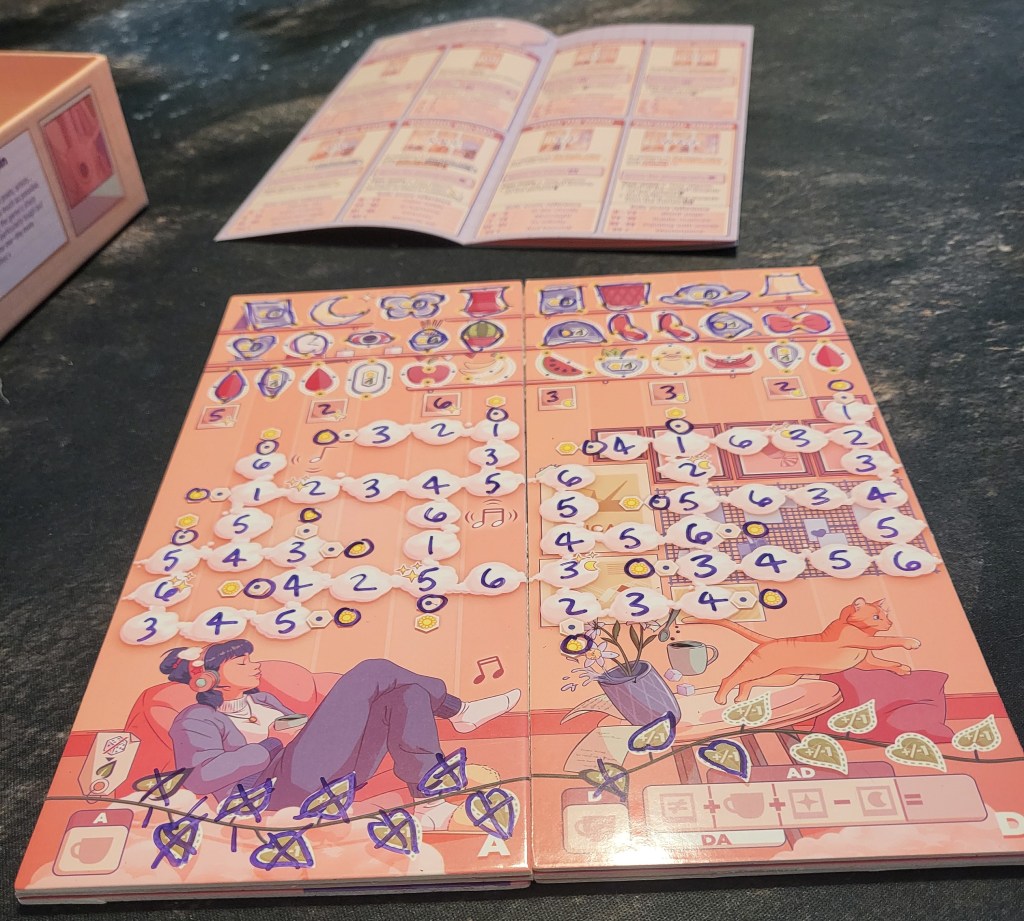
One design choice I appreciate is the variety in scoring conditions, how the dots vs. suns scoring works, and how both types of scoring are achieved. I also really appreciate the premade combinations of the boards to experiment with. Each plays differently and has some unique scoring opportunities to make each feel simultaneously familiar and fresh. After playing all printed scenario combinations, I tried to make up my own but realized all the ones in the rulebook cover each option, so they definitely put some work into creating the boards and scoring possibilities.
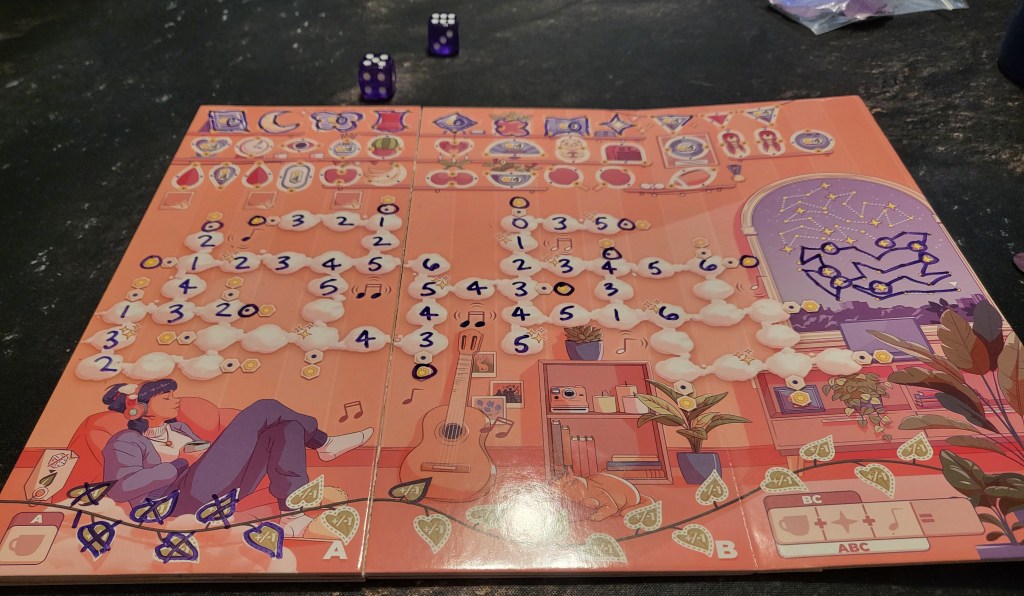
My only major qualm is related to the luck of the dice rolls, which can be legitimately problematic. Thankfully, there are leaves that can help mitigate the effects of this, but those can get used very quickly and very easily (they leave too quickly, pun intended). Due to the nature of the scoring, one wrong number can really mess up your board and your chance of scoring well in certain rows and columns.
Daydream for me is the perfect game for a casual evening or afternoon, maybe on a chilly day with a cup of tea, or even on a beautiful day sitting outside with a nice cool beverage enjoying nature. It’s quick, easy, and fun, and isn’t anything more than it needs to be. As with many games, I do wish there were more board combinations to try, but there is still a decent amount of replayability as it’s currently designed. It’s just a very versatile, chill game that doesn’t force unnecessary complexity or have small rules to keep up with making it an enjoyably straightforward roll and write that still provides some interesting puzzliness.
 The Adventures of Yogi Bear and Delaware
Leave a comment