Image taken from https://boardgamegeek.com/image/5945719/grove-9-card-solitaire-game
Designer: Mark Tuck
Publisher: Side Room Games
Artist: Mark Tuck
As the title insinuates, in Grove, you are playing cards to construct a grove of lemon, lime, and orange trees. After shuffling the deck of 18 cards, it gets separated into two 9 card stacks. One deck gets set aside; it will not be used this game, but once you’ve finished the current game, you can immediately play again using this deck. The remaining deck gets placed face down (AKA recipe side up – we will come back to the yummy recipes), then the top card is drawn and placed face up in the middle of the playing area. This card represents the start of your grove. To start, draw two cards to your hand.
Each turn consists of playing a card, placing dice, and then drawing another card. When playing a card, you select one from your hand to add to the grove. The card can be rotated 90 degrees or 180 degrees before placing it, but at least one tree or glade must overlap an existing tree or glade in your grove. The fruit on any overlapping tree much match the fruit underneath it but can freely cover open glades. If a glade has a die on it, however, the added tree’s fruit must match the die color. Glades can overlap any tree or another glade.
For each tree on the newly placed card that overlaps an existing tree, a matching color die gets placed on that overlapping tree with its value equal to the amount of fruit shown on the covered tree as well as the new tree (those numbers get added together and that value is what is represented on the die). If no more dice of that color remain, no die gets added. If there is already a die on the tree underneath, you increase its value by the amount of fruit shown on the new, overlapping tree. If a die’s value ever exceeds six, the die gets rotated to show a basket of ten. If a ten is overlapped by a matching tree, then that die gets replaced with the wheelbarrow token, which represents a “wheely good” (this sounds like a joke I’d make 😂) haul of fifteen fruit.
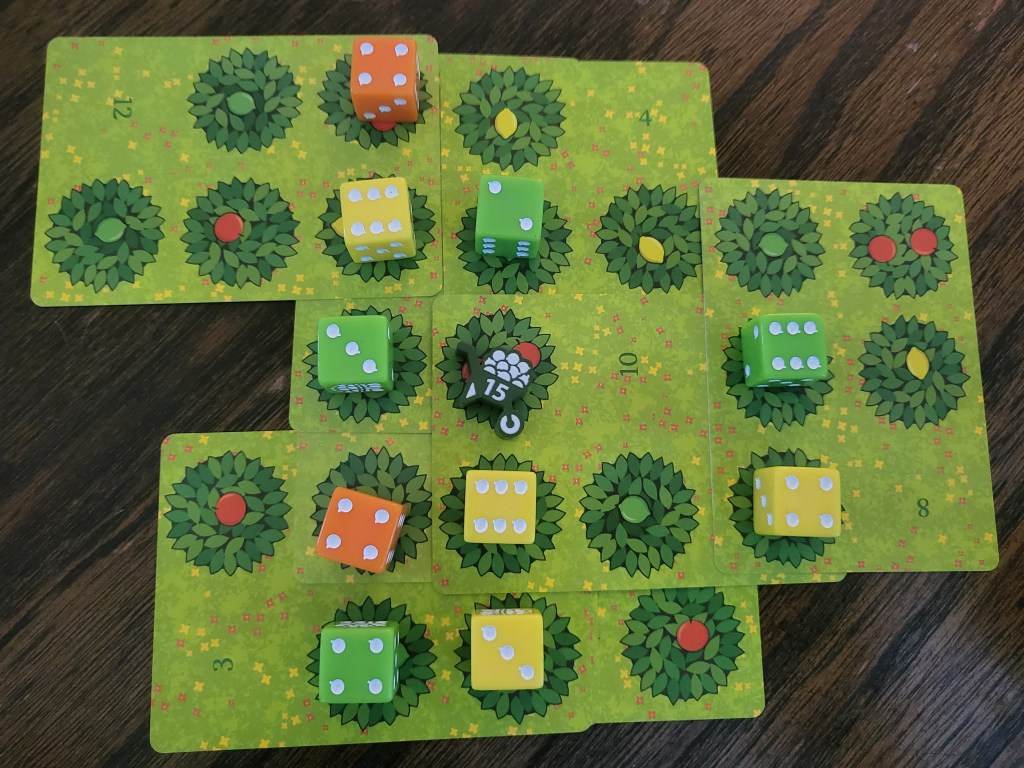
If a glade covers a spot with an existing die, the value does not change, and it just gets relocated on the new glade. A tree may overlap a glade that has a die on it as long as the fruit matches the die’s color. If a tree overlaps an empty glade, no die is added.
Then, you draw another card, so your hand is back to two and continue until all cards have been played in the grove.
One other interesting mechanical aspect is the squirrel. Once per game, you may place a card so that an overlapping tree’s fruit does not match that of the tree or die underneath it. If a die is on that location, it gets removed, but regardless, the squirrel token gets placed in that location. This tree may no longer be overlapped.
At the conclusion of the game, the score is calculated by summing the values of all placed dice that are on trees; a die on a glade does not score (thematically, the fruit fell to the ground and rotted). If the squirrel is in your grove, subtract one from your score, and also subtract one for each die that is orthogonally adjacent to the squirrel. Thankfully, there is a fun, thematic, punny score comparison chart so you can evaluate how well you’ve done and get a nice laugh.
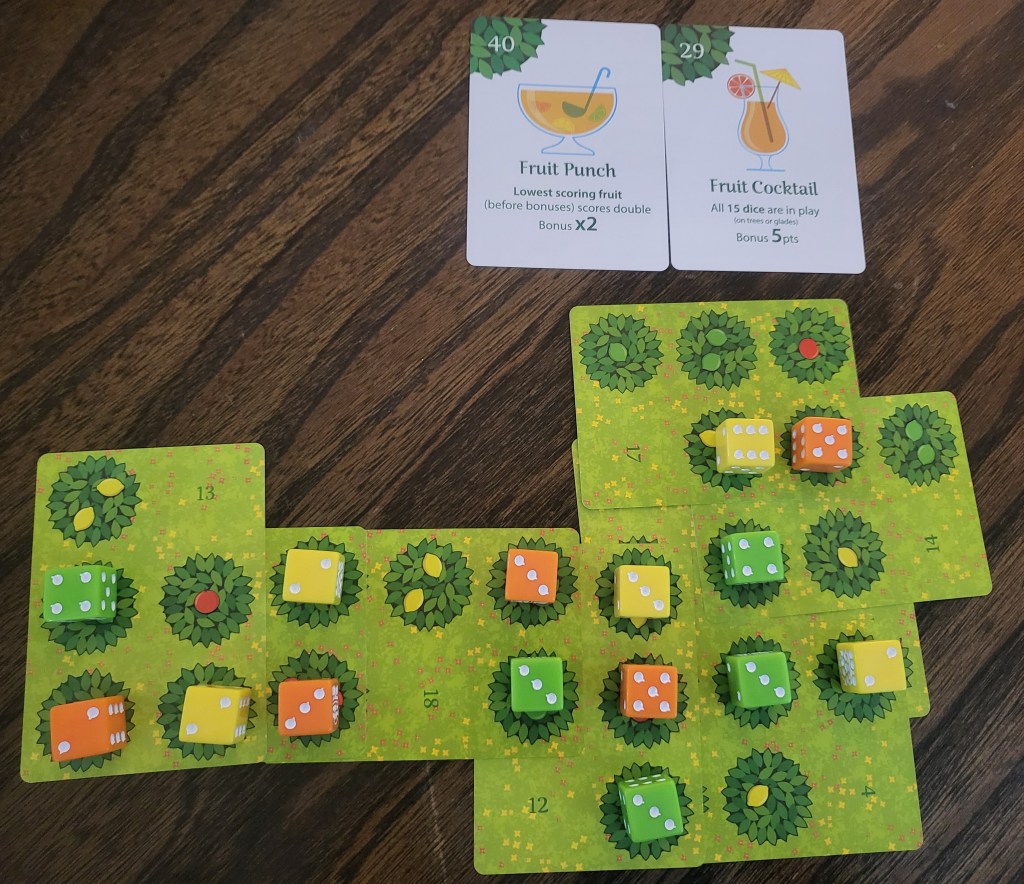
There is also a variant that includes the recipes on the “back” side of each card. Here, the game play is the same, but before creating your deck of nine cards, two cards get set aside with their recipe sides face up. Each recipe displays a special scoring condition for the game and/or a score modifier if the goal is achieved. The numbers in the top left of both recipe cards get added together to provide the target score for the game. This way, you have a specific score requirement and provides a win/lose condition instead of the standard beat your own score situation.
In my opinion, after having learned the game, the recipe version is superior. I don’t mind games that are beat your own score, but I prefer to have an exact target value, and I enjoy that it’s a win/loss condition. The additional scoring goals on the recipe cards also help guide the game and increases the challenge level, which I appreciate.
In general, I find this game design incredible. The puzzle created in the game is very fun, satisfying, and unique. There are many strategies to try and decisions to consider each turn, so the game feels pretty thinky while still remaining light and breezy. Placing the last two cards each game is always the most challenging for me! The optimization puzzle that arises from the restricting number of cards and options creates a really nice internal tension (not saying the rest of the game isn’t this way, it just always hits me hard when I realize I’m running out of time).
Even though there are only eighteen cards, there still seems to be good variation in each game, especially with the recipe variant. For a small, quick, minimalist game, I’m sincerely impressed by its high replayability value.
Not only is the box small and portable, but I also appreciate the minimal table real estate needed to play. I can definitely see this being an easy game to travel with.
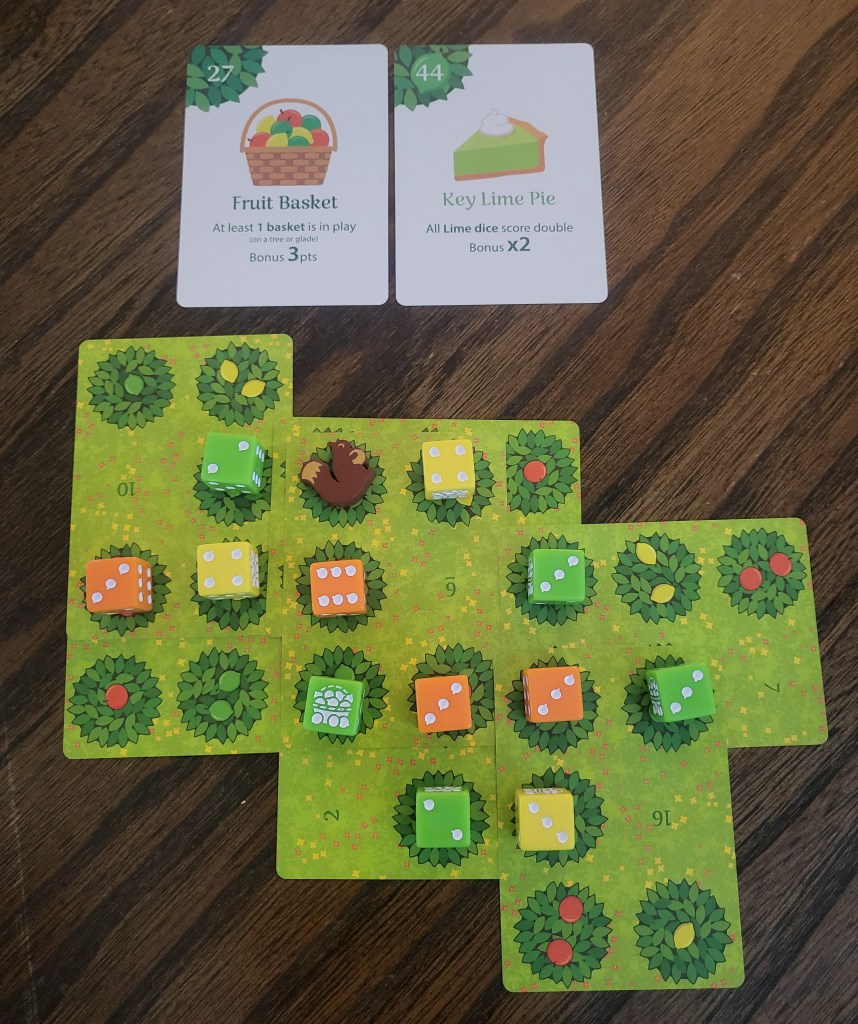
Besides the fabulous, zesty (pun intended) game play, Grove also boasts quality componentry. PVC cards for durability, wooden squirrel and wheelbarrow tokens, and lovely, brightly colored dice.
For anyone that enjoys a solid, quick, enjoyable, unique, strategic solo spatial puzzle, this is a no brainer – I can’t recommend it enough. I foresee getting a lot of use and play time out of this game, and we haven’t had it in the collection for very long.
While I haven’t played either of the other games in the trilogy (Orchard and Forage), I considered purchasing Forage, but I really like Grove, and I don’t think I need any more or anything else. I’m not saying I won’t ever try or buy either of the others, but for now, Grove fits me and my gaming preferences very well, and I’m more than content continually exploring its visual and mechanical beauty and brilliance.
 The Adventures of Yogi Bear and Delaware
Leave a comment