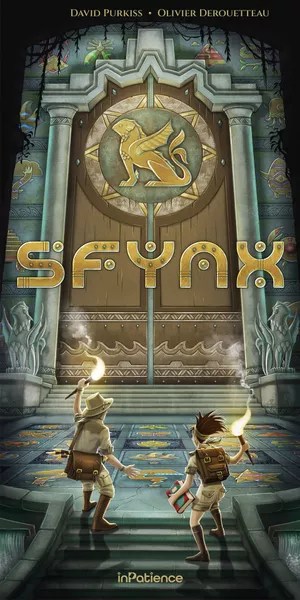
Image taken from https://boardgamegeek.com/image/8157876/sfynx
Designer: David Purkiss
Publisher: inPatience
Artist: Olivier Derouetteau
Sfynx is a really neat, abstract, cooperative puzzle game that’s focused on organizing symbols in a grid to match specific patterns. Each game consists of a 5×5 grid of symbol tiles, all unique, a round tracking board, riddle cards which display the current required patterns for success, and action tiles (amongst a few other things). The goal is to complete all riddle cards before time runs out, which is tracked by the round board; you have twelve rounds, and if there are unsolved riddles remaining, you lose.
During each round, one player gets to use two standard action tiles and one special action tile to try to complete the pattern of at least one of the visible riddle cards (usually three are visible until the end of the game when there are less than three left to complete). The pattern must be represented in the grid either left to right or top to bottom, and all tiles used for completion must be on their restored/healthy side (as opposed to a cursed side on the back). At the start of the game, the players select a difficulty level which determines the cards that get placed in the riddle deck. The more challenging you want it to be, the more symbols each card in the deck will have.
The basic actions allow players to either move one tile orthogonally one space (called a swap) or flip one tile from its cursed to restored side. The special actions can allow for diagonal movement, multiple orthogonal movements or restorations, moving a whole column or row, etc. Every time a player solves a riddle, they get to select a one-time-use reward card that has a strong, useful ability. They can seriously come in clutch!
The other main part of this game is in relation to the round tracker. At the end of each player’s turn (regardless of the number of players, there are always a maximum of twelve rounds), there is a Sfynx phase where challenge tokens are revealed that have negative effects (but occasionally they can be useful). For example, some tiles move riddle cards around, others curse tiles, and others cause rows and columns to slide. This uncertainty makes it a little more difficult to plan your next turn, as you may have a new riddle and/or rearranged tiles.
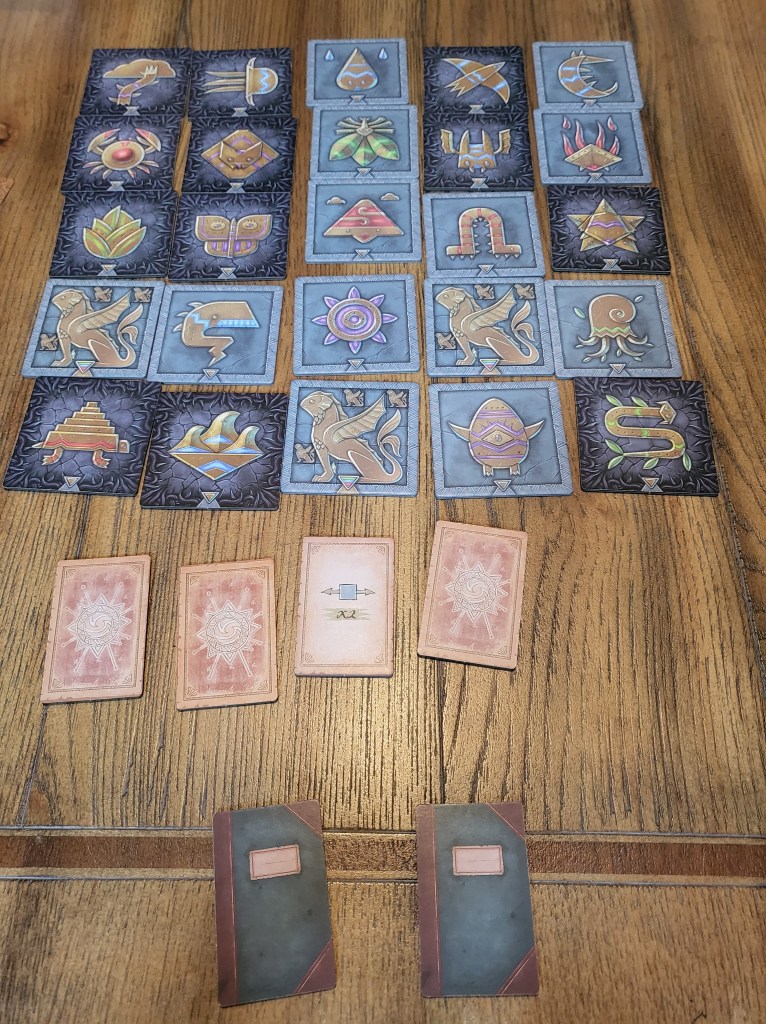
The only other mechanical thing I want to point out is that there are a few sphynx tiles in the grid which are basically wild and can be any symbol in a riddle. However, some cards (especially as you increase the difficulty) do not allow players to use sphynxes to complete that riddle.
I was pleasantly surprised by this game! It’s not very thematic, but the beautiful artwork on the tiles helps make it a little less abstract. We find it to be a really cool puzzle overall. In my opinion, it works well solo and with two players. They’re both fun but feel different in terms of the satisfaction of collaborating vs. solving the puzzle yourself. For the two-player game, I honestly don’t know if players are supposed to communicate or not, but we found it more fun that way, as it gave us the chance to discuss, strategize, and maximize our turns. That said, I cannot imagine playing with more than two people. I’m sure it’s still enjoyable, but that seems like it could become a “too many cooks in the kitchen” situation very quickly.
The componentry is nice – it’s really all it needs to be. The artwork on the tiles is lovely, and there is a satisfying tactile element of physically moving the tiles around. The box size and shape are quite odd, though. Also, the game length is very good. There’s always the same number of rounds to succeed unless you win before the last round, of course. The time aspect creates the main tension in the game considering there are a limited number of rounds as well as a certain number of moves/actions that can occur each round.
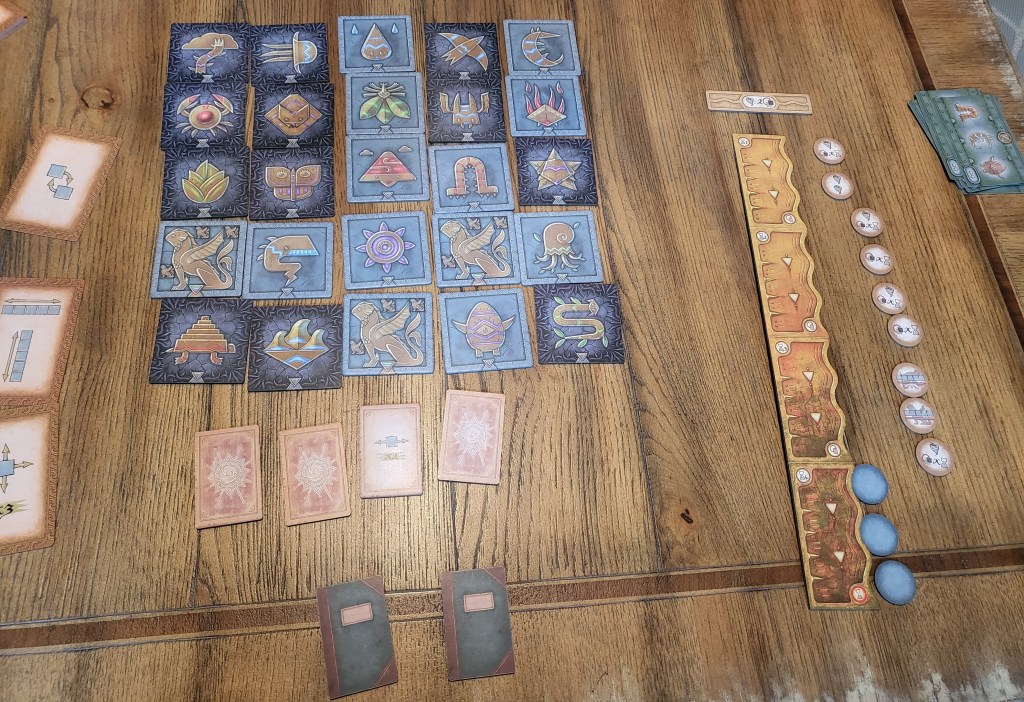
Overall, I think Sfynx has a really clever design. The limited number of turns, wild sphynxes that can sometimes be useful and sometimes can’t be utilized, the game fighting back some but not being terribly detrimental, the two basic actions plus one special action, the rewards cards for completing the riddles, etc. It’s all really well done! One other aspect of the special actions that is cool is that you start the game with four tiles, and as each tile gets used, it can’t be used again until they get reset after each set of three rounds. It adds to the importance of action selection and timing that is truly the crux of this game, besides the visual pattern building and matching.
I also love the variability of the game and the different difficulty levels. Yes, the game is essentially the same every time, but the order of the Sfynx phase events will differ, the starting tile organization will always be inherently variable, and the challenge levels of the riddle cards are done very well. There is a really nice natural progression to make the game more difficult by simply using certain cards instead of others. Not all cards of one difficulty level are utilized each game, either, so no two games will really ever be identical.
My one small complaint is that luck is definitely prevalent, which isn’t always my favorite. Thankfully, there is usually enough you can do to mitigate it and/or work around it, but there are times it can be quite detrimental to success which is always frustrating.
For us, this one is a keeper! It’s not something I will always want to play necessarily, but it packs a really good puzzly punch in a short time frame with lots of variety and customizable difficulty level selection. Despite the tiles, it’s also quite easy to set up and put away, and the box has each section labeled for which components go where. If you like tense, time-sensitive (but not real time!) puzzle games, check this one out!
 The Adventures of Yogi Bear and Delaware
Leave a comment