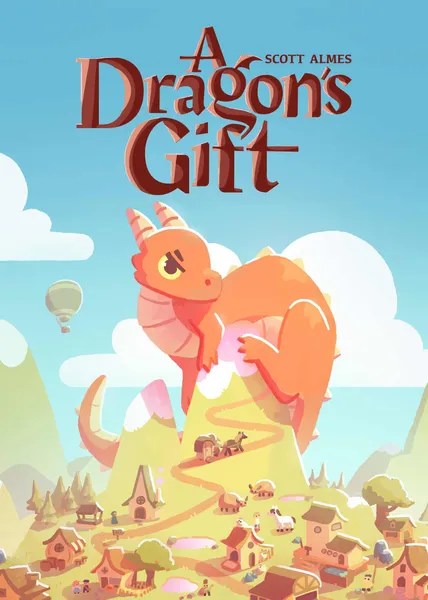
Image taken from https://boardgamegeek.com/image/9200097/a-dragons-gift
Designer: Scott Almes
Publisher: Button Shy
Artist: Manon Mergnat
In A Dragon’s Gift, a single player is working to gather resources and craft items to eventually deliver the ultimate gift to a dragon. To do this, players lay and align cards so that paths connect from craftspeople that can build items to locations that have the required resources to construct those. At any point, or if you can’t place anymore cards, you can attempt to craft the gift for the dragon (which triggers the end of the game) by placing the gift in your created village via the standard placement and delivery rules with the main rule being that the resources can’t be more than two cards away via connected roads. There are also certain cards that have modes of transportation that can be utilized throughout the game to help ease the constraints on delivery.
I have to say, this game is challenging! Of course, that’s not necessarily a bad thing, but the adorable art and eighteen card design make it seem as though it may be more on the simpler/easier/more family friendly end, but it’s pretty tough. The scoring in the rulebook goes from 9 to 12 points (to be considered a win) and I genuinely have no idea how to get more than 9 or 10 points maximum. One of the most difficult aspects in my opinion is that there are two separate roads on each card, so even though you have a resource on an adjacent card, if the paths don’t connect, you can’t utilize that resource for that specific construction. It’s a clever design that’s deceptively tricky!
One commendation for this game is that, unlike many other Button Shy games, this one doesn’t take up too much table space, but it’s obviously still a tile laying game and requires a decent amount. I enjoy that this game is quite mechanically simple but there is definitely a lot to think about and an interesting puzzle to solve.
The rules themselves are a bit odd and hard to understand during the first read, but it all clicks once you’ve gotten into the first game. I suspect this has to do with some of the terminology and how it relates to what’s happening in the game.
I am very interested to see what the planned expansion content adds. Truthfully, I find this game fun, cute, and challenging but it’s not particularly original or replayable enough for me with just the base eighteen cards. While there are some clever elements, and it’s a fun and well-designed puzzle, there’s just not much that sets in apart in the tile/card laying genre to make me want to keep playing. So, whether or not I later acquire this game will heavily depend on what the expansions add and if I think it’ll increase the replayability and/or my enjoyment of the game.
 The Adventures of Yogi Bear and Delaware
Leave a comment