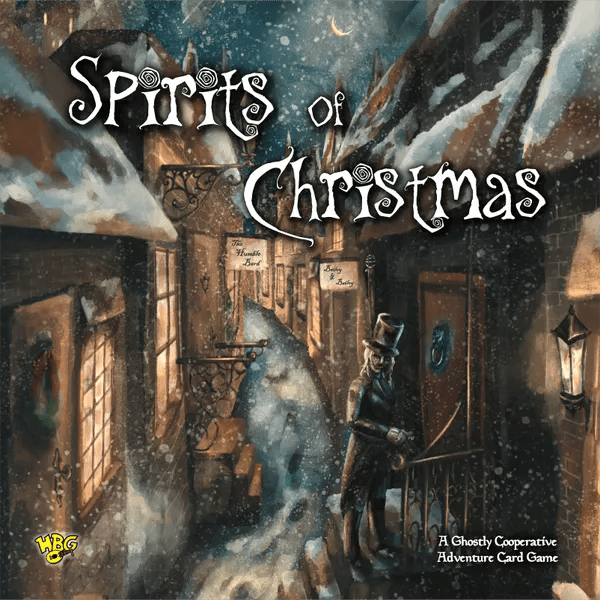
Image taken from https://boardgamegeek.com/image/8306902/spirits-of-christmas
Designer: John S. Bailey
Publisher: Humble Bard Games
Artist: Emmie Bailey
Spirits of Christmas is a nice, pretty small box game about the classic A Christmas Carol story that we know and love. Over three rounds, representing the ghost of Christmas past, present, and future, players use coins and cards to travel around on scene cards and perform actions with the goal of “completing” the scene. Players score points depending on how efficiently they completed the scene. The solo game plays quite similarly with only a few minor changes. From here on out, I’ll be talking about the solo game, but know the multiplayer isn’t very different, except in the ways you would imagine (can help neighbors, limited communication, etc.).
There are three main aspects to the decision making in this game: a rondel type action wheel, the scene layout, and coin and card resources. Starting with the wheel, each round, a player selects one of the four action locations on the wheel which include move, draw three cards, play cards, and give or trade (you can only trade in the solo game). Once the player has selected which action they want to take, they have to pay one coin if that location is adjacent to their current location, or one coin plus something else if it’s further away. In the solo mode, if you move over the standard one space limit, you also have to discard one card.
The move action allows you to move Scrooge around on the scene cards, which are randomized and placed in a single horizontal row at the start of the game. When moving, the player has to discard a card from hand (in addition to any coins via the rondel) and then moves the corresponding number of spaces as that card’s value. Drawing cards is rather self-explanatory. Trading cards means the player can discard one card from hand to pick up two available cards from the counting house board. At the end of each turn, the player has a hand limit of five, though, and must discard down if required. The last option is to play cards to the scene. If Scrooge is located on what is called a shadow scene, there are certain symbols on the scene indicating which cards can be used to complete it. A player can only play cards on a scene if Scrooge is at that location and if they have any of the required cards (you don’t have to complete the scene in one go, though).
At any time, if a shadow scene is completed, that card gets flipped over. Similarly if movement is stopped on other cards (some give coins, cards, additional action options, etc.), the player chooses to utilize the card or not. If it does get used, the card gets flipped over and cannot be reused this game.
That’s basically it! The goal is to complete every shadow scene in that round and then progress through the story until the end of the third round.

Besides the standard mode of play, there is also a story mode that requires you to complete the scene cards in number order, as though you are going through the story chronologically. There are also other variants that can be utilized in multiplayer games, and varying difficulty levels and things that can be experimented with.
For me, the standard/basic version of the game was not very fun and far too easy, but the story mode is significantly better and more enjoyable. Needing to complete the scenes in order with only fifteen coins creates a really neat and fun puzzle that’s thinky but not overwhelming. It’s difficult to figure out based on the scene layout the correct action order to accomplish everything before your money stash gets depleted. The rondel action wheel is also done well and creates an interesting decision space and optimization puzzle.
My two main concerns are in regard to replayability and the luck factor. Besides the randomization of the cards and scene layouts, there’s not much variability between games. This is one I’d love to see added challenges or achievements or something to keep me wanting to go back and try different things and have varying goals and focuses. As this is mainly card based, success can be quite luck driven, especially in terms of the layout of the scene cards. If you get a tough configuration, there may be little you can do to succeed. The game does provide gift cards that can help, but they can only do so much. With only three card suits, the randomness and luck of the cards there seems to be less impactful or troublesome to me, especially with drawing cards and trading cards as action options.
Overall, this game is a great cooperative game for the holiday season that has a good theme and a solid player count range. I wouldn’t say the theme is exceptionally prevalent as some aspects are still quite abstract, but there is some good thematic integration and representation overall. It provides an interesting twist on resource and hand management, along with a nice rondel action selection wheel. It’s not perfect, and it’s not something I find highly replayable both in terms of variability and the luck dependence, but it will assuredly make appearances on my table at least a few times every holiday season. Especially considering we don’t have any other Christmas themed games somehow…
 The Adventures of Yogi Bear and Delaware
Leave a comment