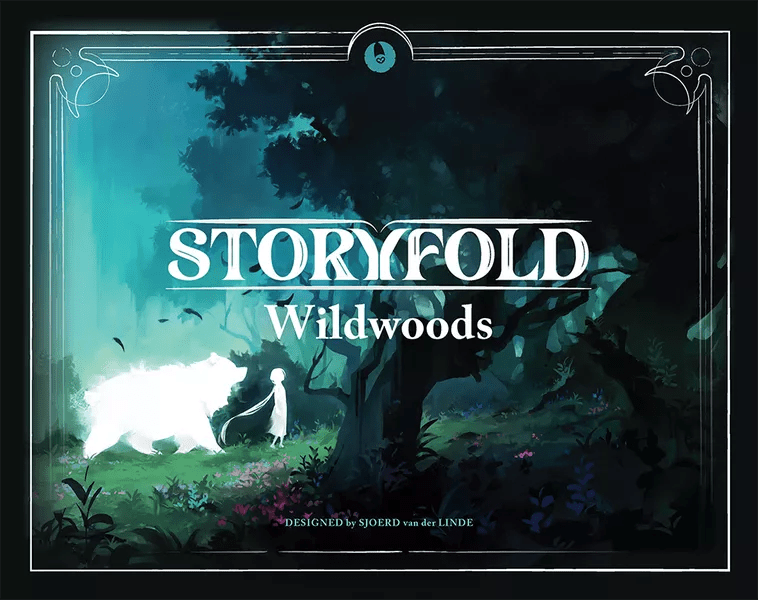
Image taken from https://boardgamegeek.com/image/8332322/storyfold-wildwoods
Designer: Sjoerd van der Linde
Publisher: Open Owl Studios
Apologies in advance because this is a long review (my longest ever!); I want to try to convey as much of this game as possible without ruining anything. I have also never formatted a review this way, but because of the amount of information, I think this is probably easiest. Grab a drink and a cozy blanket and (hopefully) enjoy!
Premise and Theme
In Storyfold: Wildwoods, the player assumes a third person in a story about a girl, Luma, and her trusty friend (who happens to be a bear), Brom. As the story progresses, the player is part of the story but is never referenced as “you” or “I” or similar; everything is happening and you’re watching and helping and along for the ride.
The story unfolds as Luma and Brom set out on a quest in the forest to heal it, as darkness and shadows start to set in and ruin the beauty. Thankfully, Luma and Brom have each other and the power of light to help them save the forest and restore its natural state.
How it Works
The player follows a branching storyline through a prologue game as well as five additional chapters. Each chapter consists of multiple scenes which is where most of the gameplay occurs. Every scene has specific set up instructions and differing win/loss conditions as well as potential options for the story to branch. For example, there could be a scene where failure (when the darkness engulfs everything) could cause you to draw a story card and advance to another scene, while it’s also possible to have to restart a chapter. Similarly, success almost always leads to a new scene, but depending on decisions during that scene and other factors, there could be multiple options for the next scene, meaning you don’t see everything in one playthrough.
After a certain number of scenes have been completed, the end of the chapter is triggered, and the player can either save their progress or continue playing. Every chapter has its own deck of cards that contains story cards, shadow cards (bad cards), creature cards, explore cards, boon and bane cards, and more. Each chapter’s deck is different, and they seem to increase in difficulty as the story and chapters progress. Each chapter takes 40-80 minutes, depending on decisions, the story, and how far along you are; the later chapters took me a little longer than the earlier ones.
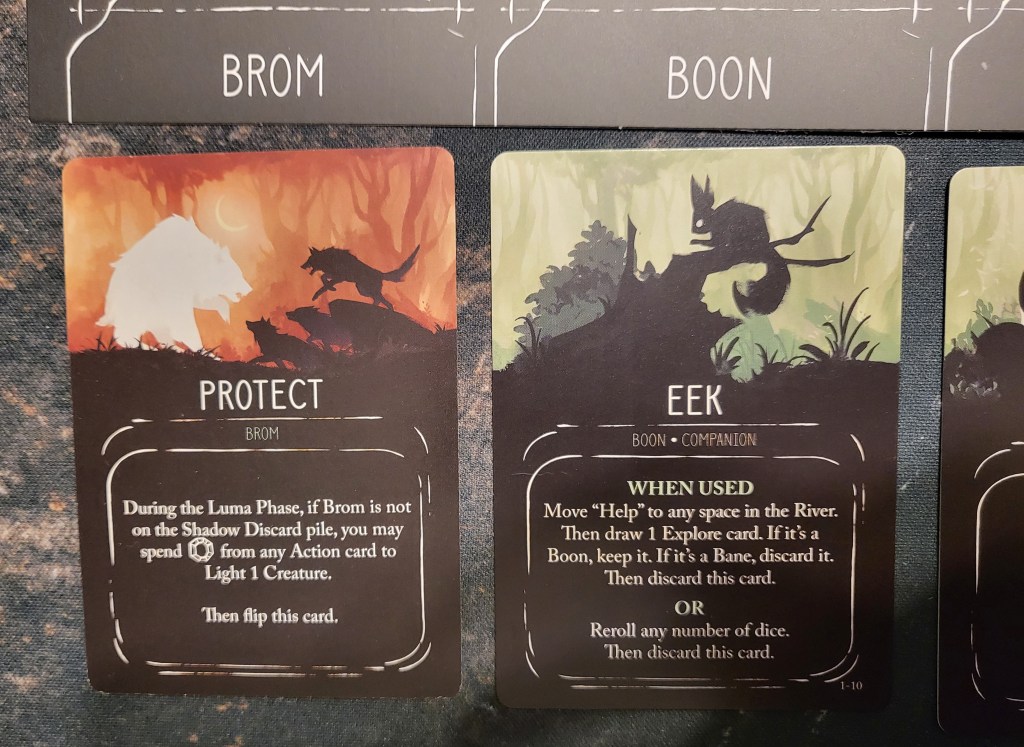
The determination between success and failure relies on two main ideas: spirit and darkness vs. light. Luma has a certain amount of spirit at the start of each chapter, which gets depleted when creatures attack, events occur, etc. Each time the spirit track must restart, a shadow card gets drawn providing a new challenge to overcome. If the shadow deck is ever depleted (meaning the last card is drawn), the shadows win and the player faces some form of failure. The other aspect of dark vs. light is basically a time tracker for each scene. Each round, the shadow marker advances one space towards the middle of what is called the Wildwoods track. If the shadow marker ever reaches the middle space (the other half of the track is light), the player faces consequences and potentially failure as well.
Mechanics and Gameplay
To achieve success, Luma has four action cards at her disposal that lie in the “river”, which is basically a type of conveyor belt system. The location of the card in the river determines one key mechanism: what numbers on the dice rolls are needed for success. The farthest left spot in the river requires the values to be 3+ while the rightmost needs 6+. Regardless of where it is in the river, once the action card gets used, it moves to the end of the river.
The four cards do the following actions: explore, heal, help, and light. The explore action allows you to either visit a location in the scene or gain explore cards from your exploration deck. Advancing through locations is the crux of this game and completely necessary for the story and scenes to progress. Each location has a form of strength value which corresponds to the required number of successes on your dice needed to explore the location. The heal card allows you to heal creatures that are in the river or gain spirit. Help can be used in help locations or to gain crystals, which can be placed on action cards and counted as a success (assuming at least one success was already rolled). Lastly, the light card allows you to light creatures in the river, essentially stunning them, or move the light marker on the Wildwoods track. For reference, to complete most scenes, the light tracker has to be moved to the middle space (one or more locations require this).
As I keep mentioning, dice are the main way actions occur. The player typically has five dice at their disposal, and they can select any number of them to use for any action that falls in those 3+ to 6+ spaces. Once the dice are used, they get placed aside until the next round. Thankfully, there are quite a few ways the luck of dice rolls can be mitigated during the game.
To summarize, the main mechanics are action selection, dice rolling and manipulation, and card-driven (and general) narrative story elements and decisions.
Turn Structure
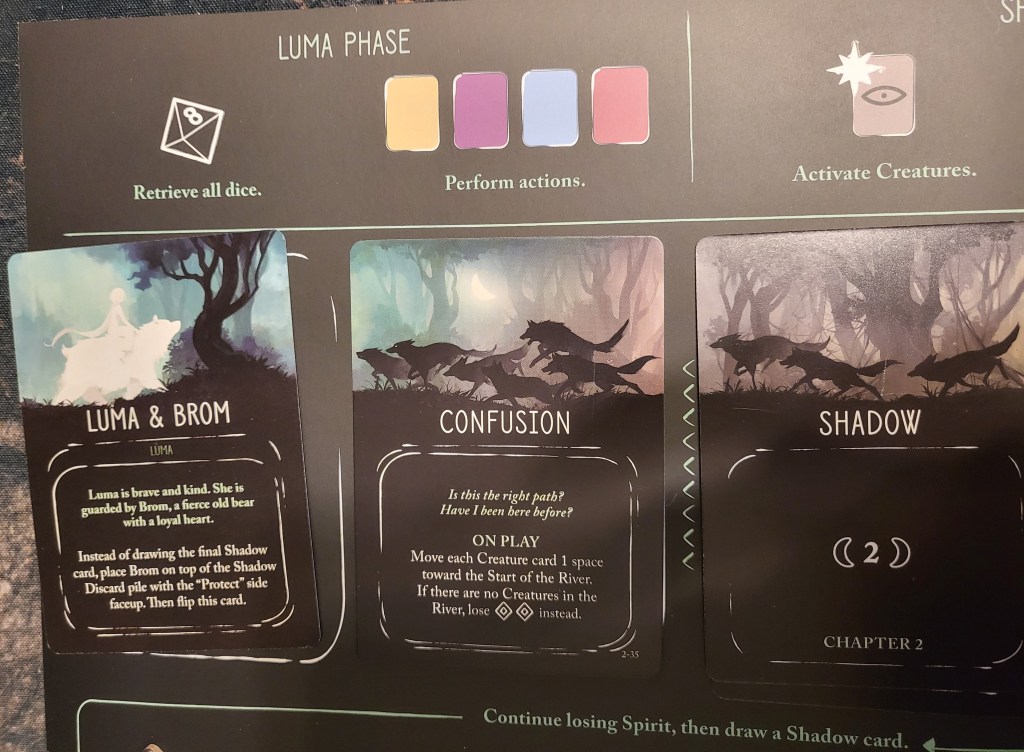
Each round consists of a Luma phase and a shadow phase. During the Luma phase, the player gathers all dice and performs their actions as previously described. Once all dice are used or the player chooses to end the Luma phase, the shadow phase begins. The first part of the shadow phase is where the creatures present in the river attack. If any were healed, they’re typically discarded from the river, and if any have a light token on them (meaning the light action was used that round), they don’t attack. Any creatures that remain attack for a certain value of spirit that gets subtracted from Luma’s current level. Some creatures also have activation actions that would then occur, and these will still happen even if the card has a light token on it. Creatures are resolved in the river from left to right. The second part of the shadow phase is where the shadow token advances one space towards the center of the Wildwoods track. This often triggers other negative events as described by the scene (usually adding creatures to the river or similar).
Prologue and the Rulebook
The prologue takes you through some introductory story while also teaching you the game mechanics, turn structure, and other important caveats and information needed to play the game. Some people will not enjoy this method and would prefer just a rule book, but I liked the prologue. I appreciate learning the game through playing and the cards in the deck broke it up nicely and introduced everything at a nice pace. I will say that it can be a bit of a pain to try and find rules later as you’ll have to search through the cards to find the one you need, but there is a solid rulebook that should be able to answer most questions. Honestly, I rarely had to go back and reference the prologue cards as the rulebook has a nice quick reference guide. On my second playthrough, as I knew how the game worked, I still had to go through the prologue to grab some cards that get utilized throughout the game, but I was able to speed through most of it. Some will find it irritating that they have to go through the prologue again to replay it, but it really doesn’t take long, and you basically know what cards you need if you just want to search for them and pull them out of the deck.

Saving and Resetting Chapters/The Whole Kit and Kaboodle
I’ll get to a list of likes and dislikes eventually, but I have to say, the saving and resetting aspects of this game are phenomenal. First off, the story book itself is just one book that has flaps that fold out for you to track and organize everything (and that functions as your player mats), but it also then allows you to fold the flaps in depending on how far you get and just save the game. The book also lays out step by step how to save a game, which I greatly appreciate. Each scene and chapter also explains how to set everything up for that game and then that specific scene, again step by step so the player can just follow along. In terms of resetting everything, all cards are labeled in the bottom right corner with an identifier as to what chapter it belongs to and what card number it is, so it’s very easy to reset all the decks at the end of the game.
Art and Componentry
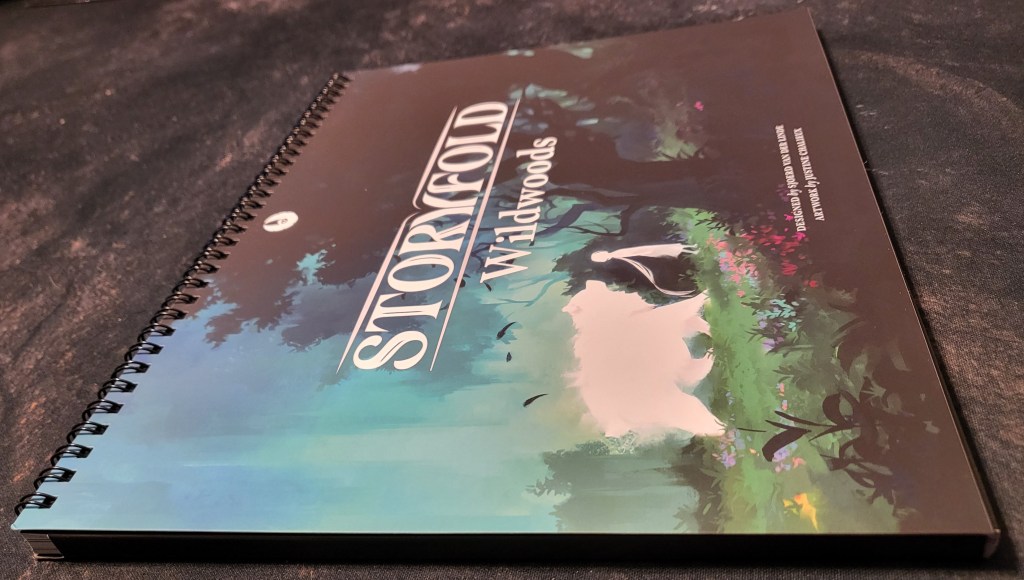
The componentry here is good. The book is magnificent, the tokens are the usual cardboard, and the cards seem to be well made but can get scratched somewhat easily. The artwork is truly drop dead gorgeous. For the theme and the setting, it’s perfect and amazing, and I’m sad there isn’t an artist listed on BGG so I could credit them for their beautiful designs and creations. Every page, every card, everything is just truly visually stunning. I also love that the box looks like a book!
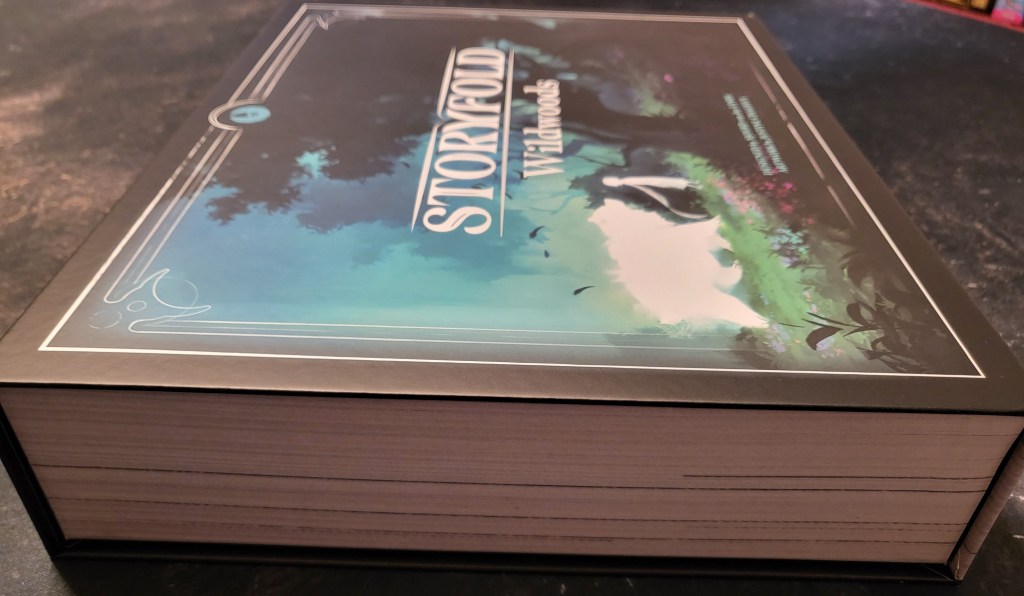
Replayability
As with any narrative game, I’m sure replayability is at the forefront of everyone’s mind when deciding whether or not this game is a good investment. Before I get into replayability, I was able to snag this game for a reasonable price in retail and even without any massive replayability, this game is worth the cost I paid for it.
As with most games of this nature, once you’ve played through the story once and know the major twists, turns, and events, no playthrough will ever be the same, as you’ll almost certainly remember the big stuff, which holds true here. However, I do feel there is enough branching in the story and player choices where it’s at least decently replayable. You will know the main arc and big plot points, but you can visit different scenes and locations, and experience new-to-you story cards throughout the second playthrough. I especially think replayability is decent if you wait a year or so to play again; you’ll lose that sense of initial exploration regardless, but you should still have new experiences, and I think you could still enjoy the game again. The mechanics are pretty solid, so it’s a fun game even without the story-based surprises and discovery.
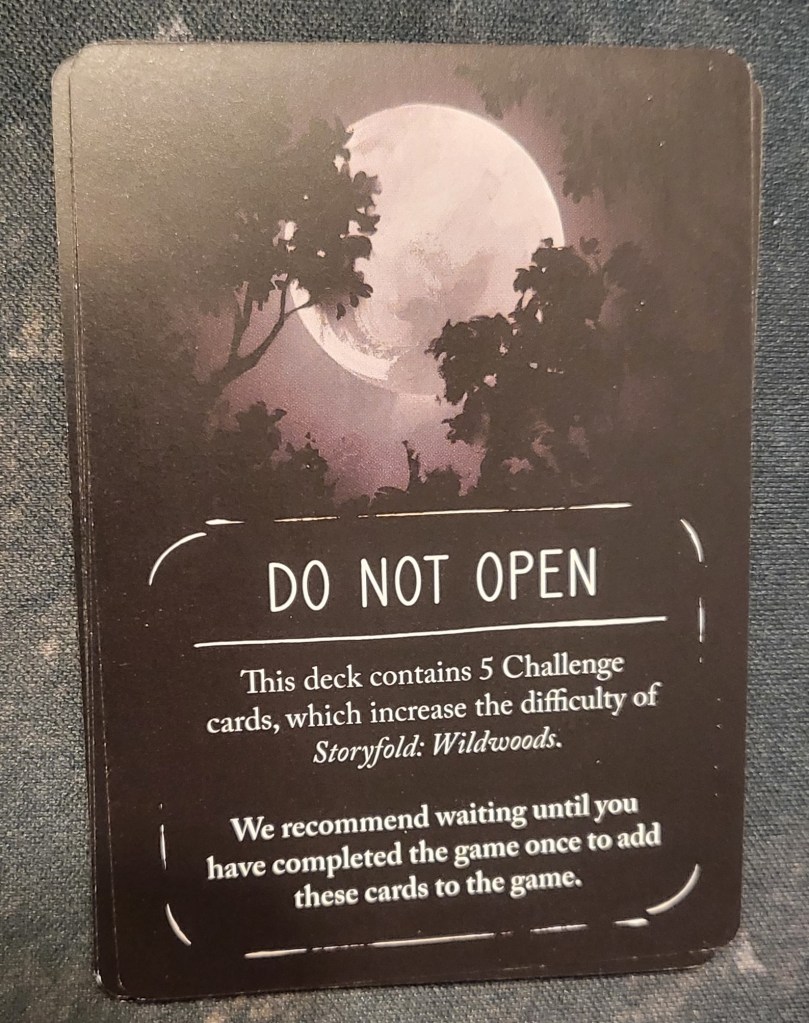
The box also comes with additional cards to open after playing once which increases the difficulty level. Truthfully, I don’t really need a heightened challenge level (we will come back to this point), but I do appreciate the inclusion of the cards, nonetheless. They’re simple but add a little extra layer to each game, and each card is unique.
There are also two endings to the story, so you could at least play twice and feel like you’ve experienced different things.
So, What Do I Like About This Game?
Forewarning: some of this will be a little repetitive if you’ve read the whole review so far, but I want to make sure everything I enjoy is in one space together for those that don’t want to read my previous ramblings.
1) The artwork is truly gorgeous, and it’s perfect for the story and the vibe of the game.
2) The organization and design of the storybook is awesome. Not only does it double as the player mats and main source material, but each chapter and each scene explain the set up and save options very well – it’s literally step by step; very clear and concise.
3) The story itself is enjoyable and well written and creates a new and interesting world without making it feel like there’s ever too much to read. The storybook has some text and there are also story cards that add to the narrative, but there’s never more than a page of text to read at one time.
4) If you are new to solo gaming and/or narrative style games, this is a great introduction to both. Being newer to story-based games, this was a great start in the genre, and even though I’m a seasoned solo gamer, there is still enough mechanically to make it interesting, and the story, production, and art are wonderful regardless of gamer status.
5) This game is very different from anything we have in our collection currently. As aforementioned, I’m trying to get more into narrative style games, and this was a great (and reasonably priced) introduction.
6) Besides the story itself, there is also very good character building in the narrative and throughout the game that really brings the characters and creatures to life. I also enjoy that some of the story parts are “if…then” statements making decisions matter and seem important while not being overwhelming. This also helps some with that replayability factor.
7) There’s a nice balance between mechanisms and story. Mechanically, this game is quite lightweight, but it is still thinky and puzzly while also delving into the narrative well and fully without it being too much.
8) Similarly, there’s a really nice balance between strategic planning, tactical decision making, and overall straightforward gameplay and mechanics. The four base action cards are simple, but each card provides two options, you have to consider its movement to the end of the river, and more, so there’s a decent amount to think about it. Of course, you’re always at the mercy of the dice, though, and have to make some tactical choices based on those outcomes. The fact that some locations also require the light marker to be in that middle spot creates some additional interesting action selection choices that can be tough.
9) The river idea isn’t necessarily new or original, but it’s done very well. The fact that each card when used moves to the end, enemies can be added to muck it up, and the values needed on the dice make certain spaces more difficult than others make it an interesting action source. Also, I haven’t mentioned this yet, but if you are ever required to add a creature card to the river and there isn’t space, you lose spirit based on the attack value of the creature, so you also want to ensure it doesn’t become too full (for multiple reasons).
10) I also haven’t explicitly mentioned this, but the explore deck grows and changes over the course of the game which is really neat. It also carries over some from chapter to chapter, so certain decisions or occurrences in the early chapters can make an impact later.
11) The shadow cards and advancing marker representing a type of timer are really slick and clever. There is a sense of tension in terms of how much time you have, how many actions you can take, and how many attacks you can endure, but none of the shadow cards (except for the last) are earth shatteringly devastating. That said, I do appreciate that even if you fail a scene via shadow cards or marker, it’s possible you can still continue, or you just have to replay something before continuing. There’s always a way to make it to the end of the story, though, which is nice.
12) The enemy creatures feel similar enough, but they definitely differ in strength, abilities, how they are affected by light, if they can be healed, etc., and they also get more challenging as the game progresses, as they should.
Neither Here nor There/Both Good and Bad
1) There is more enemy fighting than I initially expected. It’s the main source of peril in the game besides the shadow time aspect, and there needs to be that tension and cause for consideration (it would be boring if it was only the locations), but it’s more prevalent than anticipated.
2) The story can get a little dark, but it’s nothing that seems inappropriate or like something that an 8-10+ year old couldn’t reasonably handle (in my opinion).
3) The game is difficult. It’s not ridiculously punishing by any stretch, but depending on your dice rolls, success can be quite challenging.
Dislikes and Qualms
1) As you may have already surmised with the dice rolling, luck is a huge limiting factor in this game and can really be make or break experiences. It’s definitely my least favorite aspect, and I wish the luck and randomness weren’t so prevalent and that they weren’t the sole source in terms of determining success vs. failure.
2) On the flip side, thankfully there is the opportunity for some decent dice luck mitigation with certain cards, the crystals, etc., but I can’t lie and tell you I never botched one or two rolls here and there to progress the story. It’s also a little easier to handle if you know how it works and have that expectation going in. It’s honestly no different from Final Girl, Elder Sign, etc., but it’s still quite significant and prevalent.
3) As much as I say it is replayable, I do wish there was a little more branching and/or more options for different paths to take during the game to increase the variety and make it even more variable and fresh on subsequent plays.
Conclusion
If you’ve survived this long, props to you, because this is quite a lengthy review for a pretty simple game. I honestly enjoyed my experience(s) with it way more than I anticipated. I look forward to pulling it out in year or so to give it another go, and I could see it being very fun to play through with my nephew. I hope to see more iterations because, besides some unlucky dice rolls, it’s been a very pleasant game to spend time with.
 The Adventures of Yogi Bear and Delaware
Leave a comment