
Image taken from https://boardgamegeek.com/image/8380887/ravel
Designer: Daniel McKinley
Publisher: inPatience
Artist: Christine Alcouffe
R.A.V.E.L. is an absolutely brilliant solo puzzle game where players rearrange different colored dice to achieve specific conditions. Each game, there is a square central board that houses the eight dice, and then challenge cards get distributed around each of the four sides. Every challenge card has a requirement and a bonus action or benefit. To accomplish these specific conditions, players receive tokens that can be utilized to move dice around and/or change their values. The player wins if they manage to complete all the challenge cards.
It’s exceptionally abstract but a simple game mechanically: you just try to optimize your turns and tokens to complete cards that can provide useful benefits. The system is straightforward, but the strategic and tactical elements have good depth and complexity without being overwhelming.
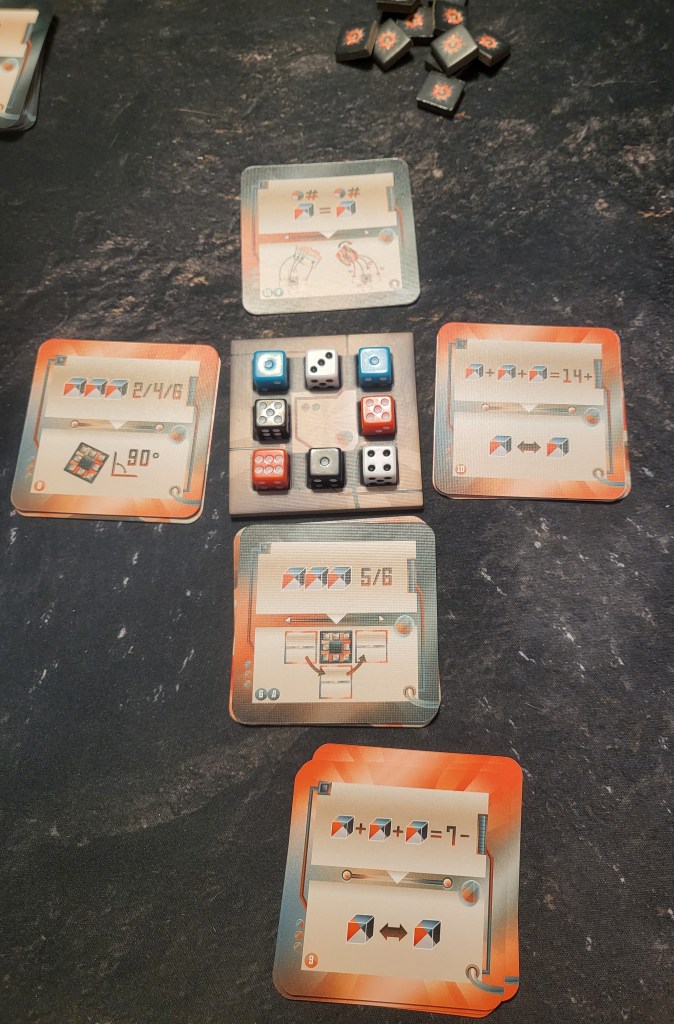
There are varying difficulty levels you can experiment with which adds significantly to the replay value in my opinion. After the standard game, you can add a certain number of more challenging cards to the deck. You can incorporate as many of these as you like, so the difficulty level is very malleable. I appreciate that there aren’t any additional rules or set-up requirements; it’s a very easy and smart way to implement multiple levels of difficulty. Because each card in the challenge deck is different, I also find there’s a fun little exploration aspect in terms of seeing what additional requirements will be needed for success. I’ve played the base game and have added up to five or six different challenge cards in varying combinations and I still love the game and find it continually satisfying and stimulating in the best way.
The different abilities that are gained when a challenge card is completed are clever and enjoyable. They’re not always helpful, but that almost adds to the strategy of the game. Deciding when to complete which cards to utilize their benefits while also considering the current state of your dice causes some fun and interesting tension.
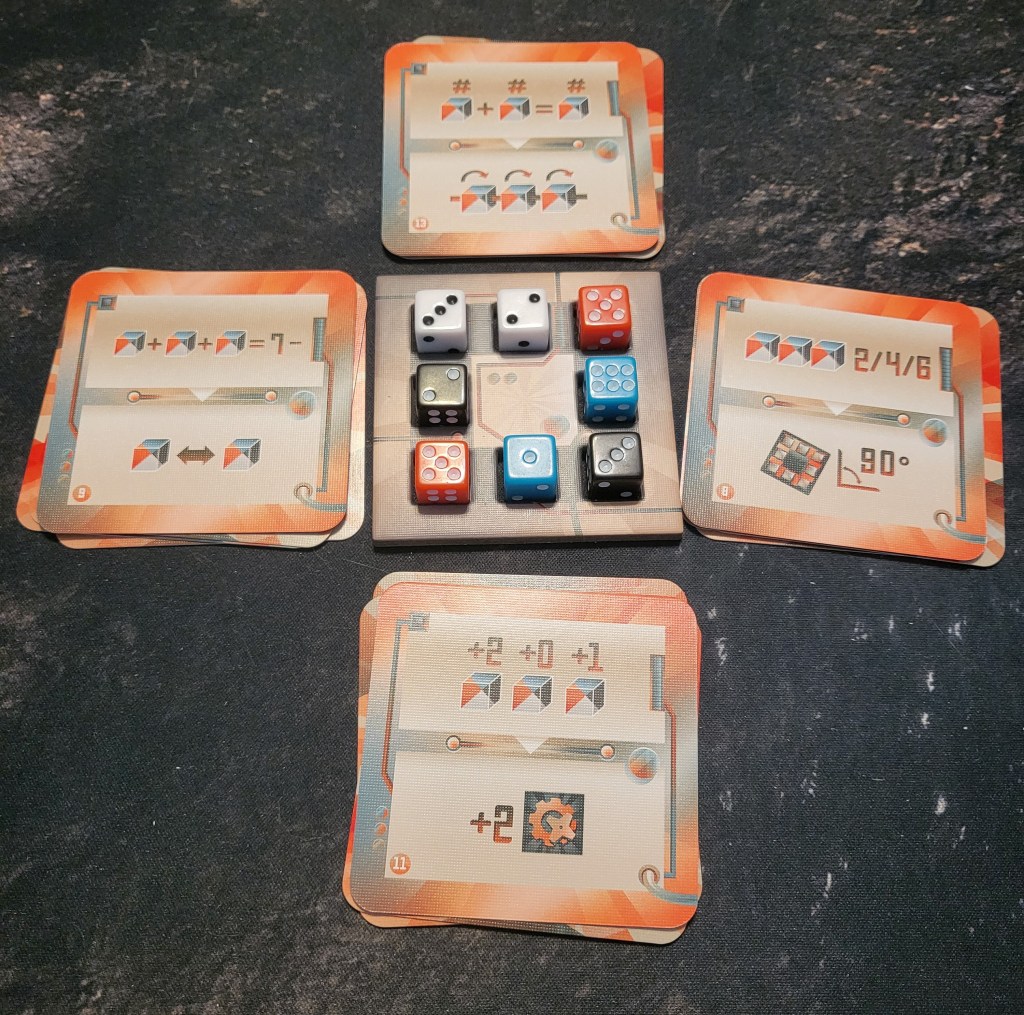
Usually luck in games bothers me, but this one feels more like randomization than luck. There are ways to mitigate unhelpful dice and the strategy and puzzliness of the game stem from the random layout of cards and dice and deciphering the best way to make everything work.
I will say, the icons on the cards can take a second to learn, especially the bonuses and benefits. After a few plays they make more sense, but I still find myself referencing the rule book every once in a while. The rule book is wonderful, though, at explaining all the cards you could come across. The art is also lovely, and the cut outs in the main board for the dice are perfect.
This is one of the best small, reasonably priced, quick, easy to learn, portable (small box and minimal table space is required), yet highly enjoyable and strategic solo games in our collection. For me, it’s the perfect combination of puzzliness, accessibility, and replayability and I can’t recommend it enough if you enjoy these types of games.
 The Adventures of Yogi Bear and Delaware
Leave a comment