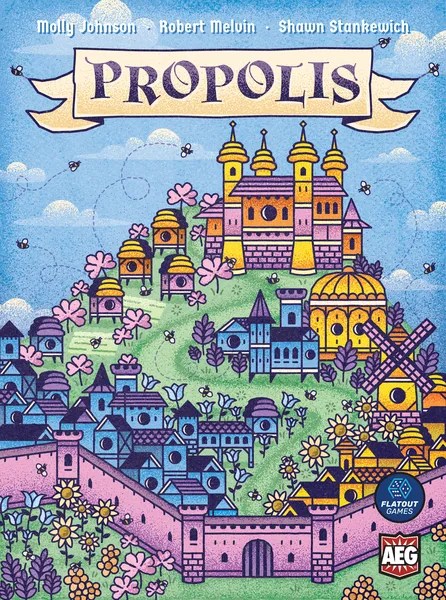
Image taken from https://boardgamegeek.com/image/8514363/propolis
Designers: Molly Johnson, Robert Melvin, Shawn Stankewich
Publishers: Flatout Games, Alderac Entertainment Group
Artist: Dylan Mangini
Propolis is a bright, colorful resource management, worker placement, area control, and contract fulfillment game that’s different from this design group’s Point line, but it still fits in the same realm, in my opinion. Some of the main characteristics of the Point games (Salad, City, Galaxy) include double-sided cards for resources and recipes or contracts, which also show up in Propolis. Similarly, there are permanent resources provided by constructing cards, and then larger order fulfillment that can be done via those permanent resources. So, this game feels unique, but it’s still consistent with the usual content released by these wonderful designers, and that’s certainly not a bad thing! If it ain’t broke, don’t fix it.
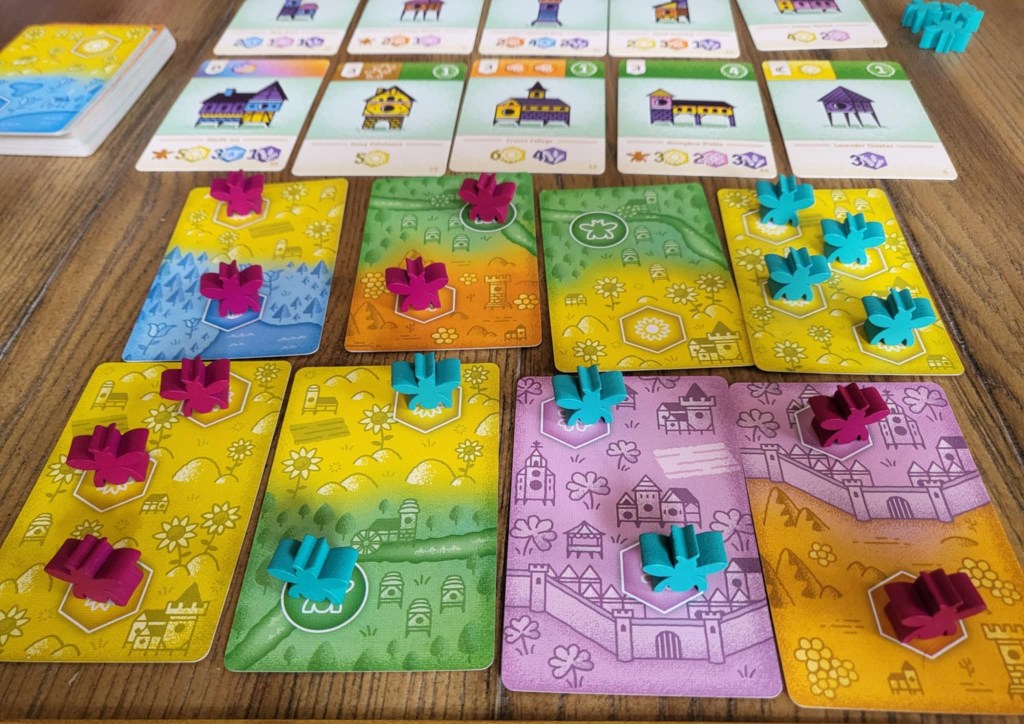
On each turn, you have five action options: deploy workers, fortify workers, retreat workers, construct a structure, and construct a queen’s palace. At the start of the game, rows of resource cards (called structure/landscape cards) are laid out depending on player count. If a player chooses to deploy their workers, they place their beeples (BEEPLES ARE BACK, BABY!), on a card of their choice filling one or more open resource/landscape spots; they then gain the respective resources or other benefits. Fortifying the beeples will make more sense later when I explain the area control, but essentially your beeples on a selected card gain strength/influence. Recalling beeples means returning as many beeples as you choose from the landscape cards back to your supply. Constructing a structure requires certain combinations of resources and sometimes beeples, and a queen’s palace card can only be constructed via permanent resources from previously built structure cards.
As you can see, the actions are mainly focused on resource management, worker placement, and contract fulfillment, but there is some sneaky area control thrown in as well. In a solo and two player game, there are two rows of four landscape cards. When the last remaining empty card in a row has beeples placed on it, that player gains one wild resource for completing a row. Then, an area majority contest ensues based on the strength of the beeples (regular are 1 each, fortified are 2 each) in that row. The player with more area majority gains a wild resource (if it’s the same player that finished the row, they only gain one total wild resource, though, not two) and gets to recall any beeples of their choosing from that row.
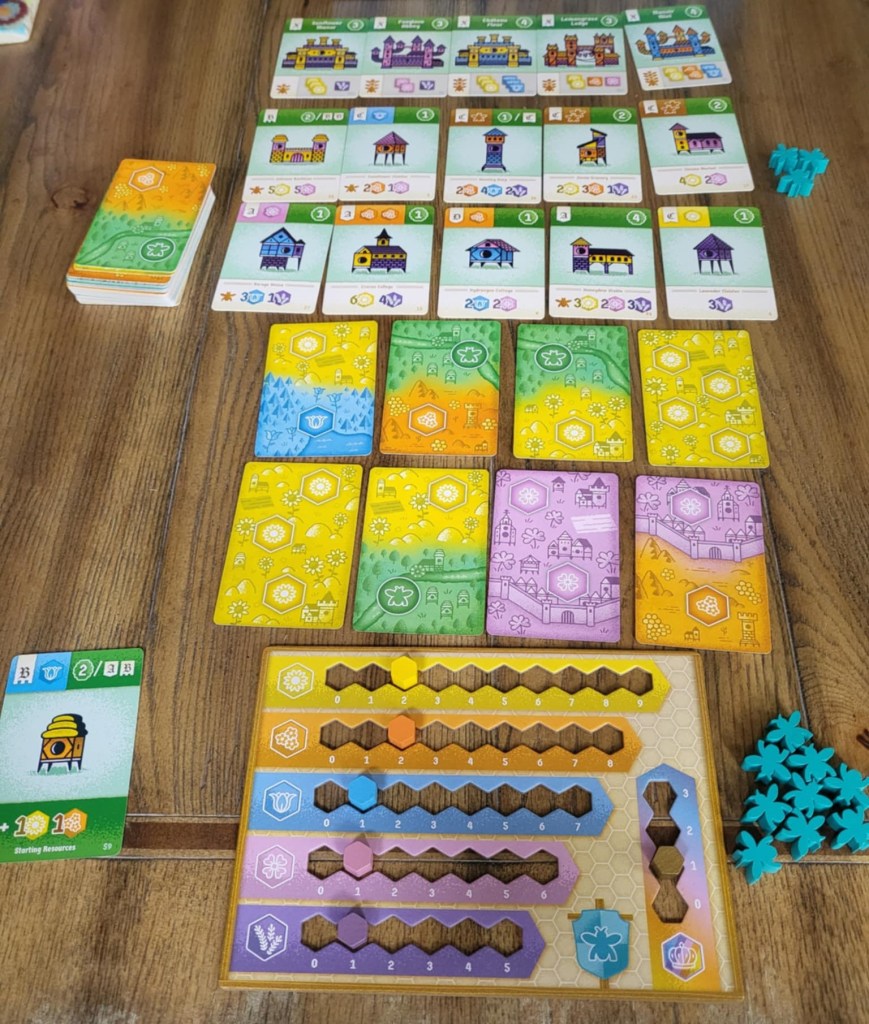
While on the topic of area control, I appreciate the addition as it’s integrated well, but I definitely think it’s more effective at higher player counts. It works fine both solo and at two players, but the stakes would be higher and the competition tighter (I assume) in a three or four player game. Also, in the solo and duo games, fortifying beeples didn’t seem particularly important, especially considering it uses an action, and you can’t gain two wild resources in the same turn.
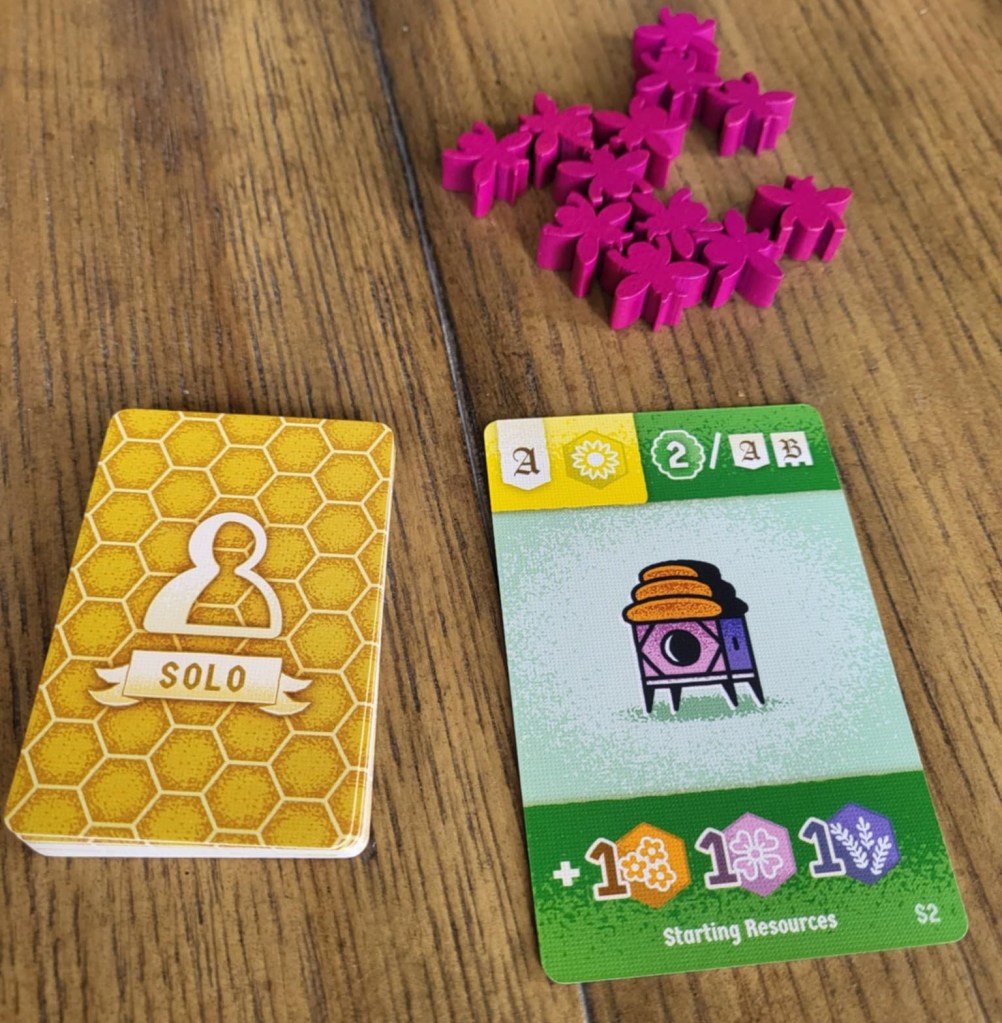
The solo mode in the game is well done! There is a deck of cards that dictates your opponent’s actions to keep the competition for resources and area majority. At the end, it’s a beat your own score style game as your opponent doesn’t score. It’s very simple to facilitate, but I found it pretty easy overall – I didn’t feel it did enough to challenge me, necessarily, but there are ways to increase the difficulty I haven’t experimented with yet. There is also a list of achievements in the rule book which I love! It helped me want to come back and play more and see which of them I could accomplish that game. Especially for solo gaming, I really appreciate it.
The components of this game are quite nice, especially for the box size and price point. The beeples are nice, thick wood and unique colors, the player boards have punch outs for your resource trackers, so they aren’t easily knocked, and the cards are solid as always.
The Kickstarter version also came with a mini expansion that adds cards to the landscape/structure deck (which already has quite a few cards for variety) that have a unique card landscape style. It’s different enough, but there’s very few additional rules to learn and it integrates seamlessly into the base game. I can’t imagine playing without it at this point.
While the achievements add to the replayability value for me, the sheer number of cards and their combinations can provide a lot of variability from game to game. I don’t know how often I’d want to play solo besides working for an achievement or two, but the husband enjoyed it, and it plays quickly (but not too quickly) so it’s one I can see us pulling out for a shorter game that’s still puzzly.
Overall, the gameplay is pretty straightforward but there is still a decent amount of depth; it’s easy to teach but there is interesting tactical and strategic decision making. The unique combination of mechanics works well, especially for a game of its size and play length.
I wouldn’t say it’s a favorite, but it’s a well-designed game that is a nice addition to our collection!
 The Adventures of Yogi Bear and Delaware
Leave a comment