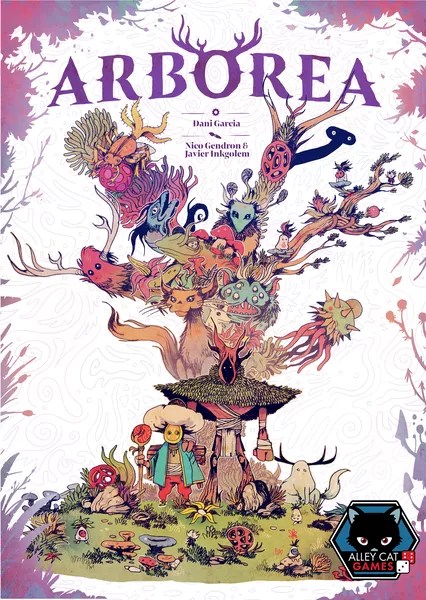
Image taken from https://boardgamegeek.com/image/7230067/arborea
Designer: Dani Garcia
Publisher: Alley Cat Games
Artists: Javier González Cava, Nicolas Gendron
Wowee, this game is colorful! I was initially concerned the board would be too bright and too busy and would detract from game play, but it doesn’t; it’s wonderful.
Arborea is a superbly designed mid-weight euro that provides a unique twist on both resource management and worker placement. Over the course of the game, players place workers on moving tracks on the board to gain bonuses and ultimately advance on those tracks until they choose to hop off and explore a chosen path. The paths can include resource collection, ways to advance the game’s time tracker, actions like placing creatures in habitats, drawing cards, and gaining more workers, or even giving gifts!
I know some of the bonuses mentioned don’t make sense, but if you want to understand better, I’d advise watching a how to play video or skimming the rule book. I’ll touch on some rules and mechanics, but this won’t be a deep dive into turn structures or all actions specifically.
Overall, I find the mechanisms in this game very interesting and unique, and there’s a clever interconnectedness that exists between certain actions and bonuses. The track advancement is cool in and of itself, the paths and the decisions behind which to choose are neat, the types of workers and how they advance tracks are different, and there is an original take on resource management. For the resources, everyone playing shares the same resources; if you gain two of the red ones on your turn and don’t use them, they’re available for the next player. But, if you don’t use them, you do gain victory points for not using them, so there’s an interesting balance between not wanting other players to benefit from your work gathering resources, while also capitalizing on the option to score points.
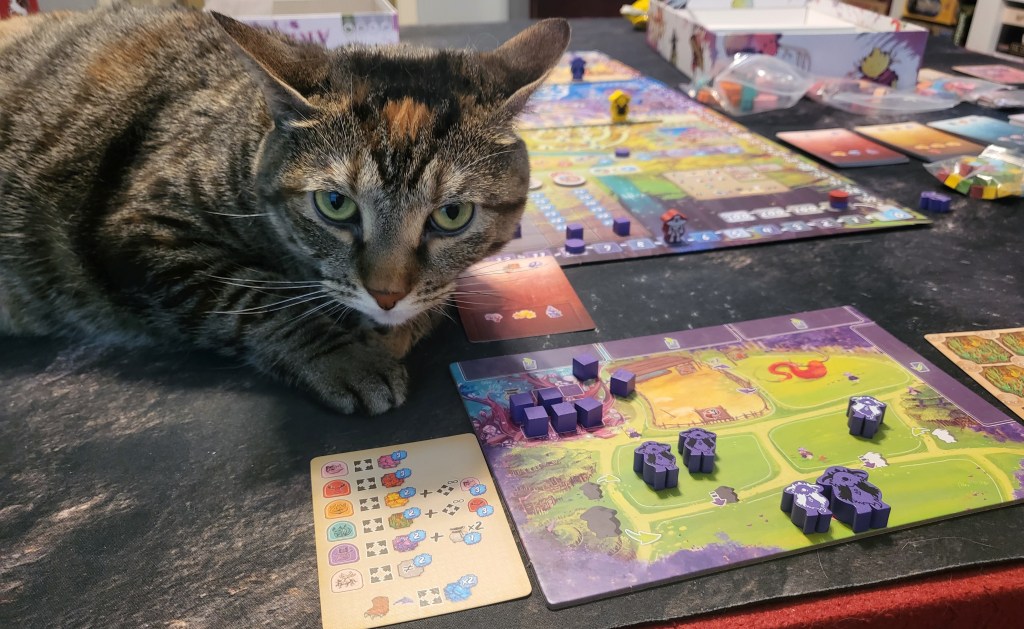
I had a “helper”.
The time tracker aspect is well done and also pretty unique. Each time you pass a spot with a creature and gain that creature, the time tracker advances one. It’s nice to know exactly when it will advance, so you can plan some, and also speed up or slow down the game to some degree. It seems he pulled from this idea some in Windmill Valley.
I also appreciate that there isn’t much luck in this game. All options are clear and visible, and the choices you make impact the game and your success more than anything the game does, which is really nice. It’s a very strategic game while also having tactical elements, but success is seldom based on luck. That said, I do think there is enough randomness in terms of set up and card combinations and things to provide variability from game to game, which helps with replayability.
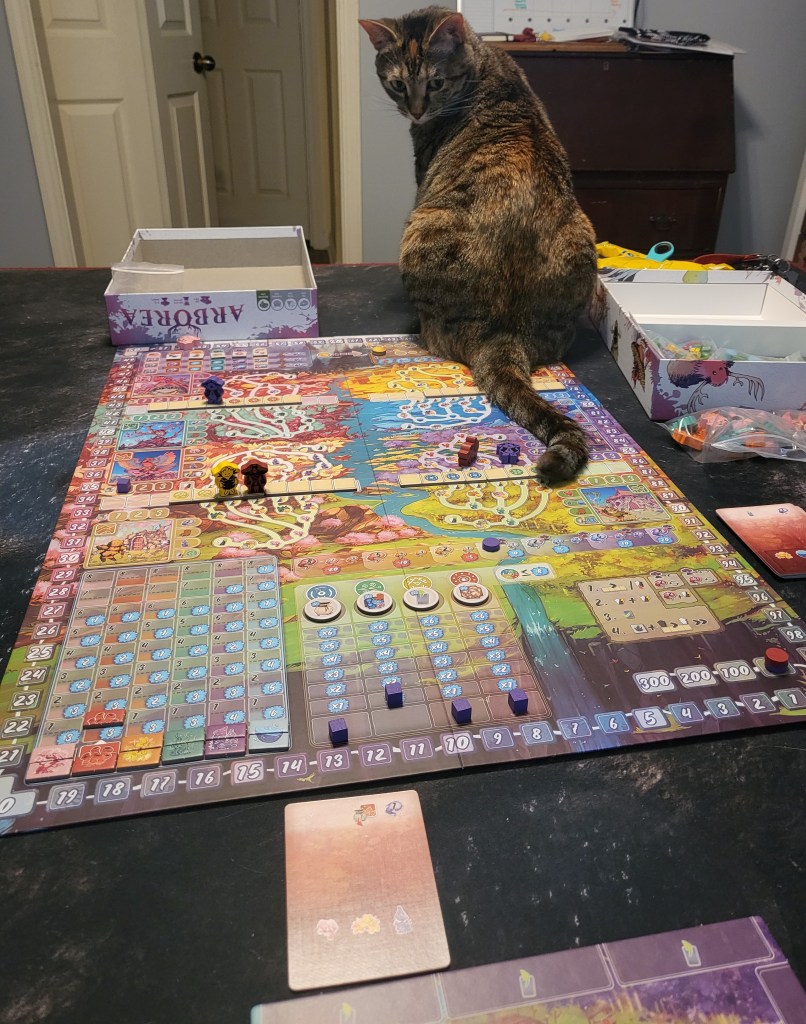
As you can see, she was very “helpful” in knocking over me and my opponent; I respect her fairness.
The components in this game are lovely. Many of the pieces are thick wood, and the player pieces are screen-printed. The art is also lovely, colorful, and whimsical, which fits the vibe of the game very well. I also have to say, the main game board has a box on it that briefly goes over each step of a turn which is very helpful! It’s easy to get lost in the fun of the game and the combos, so it’s nice to have a reminder handy.
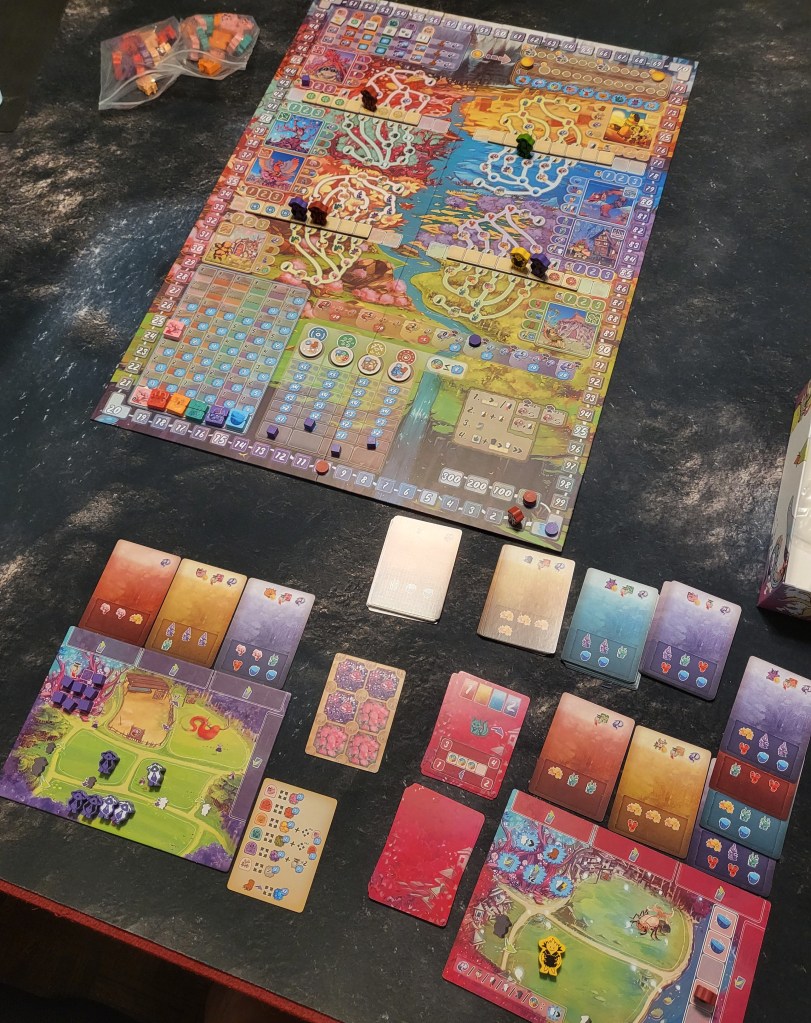
The solo implementation is well done and very enjoyable. The opponent you face does require some player facilitation which can detract some from your brain being focused on your own game, but it’s really not too difficult or complicated. It takes a small amount of time to get through their turn, likely similar to an actual opponent, but due to the nature of the game and the track advancements and shared resources, there needs to be an AI style player to help the game along, increase the tension, and alter the player’s strategy some. My only complaint is that the opponent, Feronia, uses three different colored meeples which can get a little confusing.
While not a complaint, my only small criticism has to do with the gift mechanism. I feel like it’s a bit of a random addition and probably the least “necessary” aspect of the game, but it’s still an enjoyable puzzle/mini game style thing that still relates back to player’s main turns. Also, when you can manage getting gifts and then utilizing them, those extra bonuses can come in clutch.
For me, Arborea is a really solid mid-weight (to mid-weight plus) euro option that plays in a decent time frame (90 ish minutes solo) and is not too complicated or convoluted but it’s still very thinky, strategic, and tactical, especially with the creative moving tracks. The game seems to go quickly as you’re enjoying everything you’re doing and the decisions you are making but it still feels like you’re getting stuff done. It’s not too long and not too short (at least for me solo).
I think this one is a gem! I honestly adore Dani Garcia as a designer, and the more of his games I play, the more I enjoy his designs and their uniqueness and clever ideas and mechanics. Don’t let the bright colors fool you; it’s not overwhelming but also certainly not something I’d consider family friendly. 🙂
 The Adventures of Yogi Bear and Delaware
Leave a comment