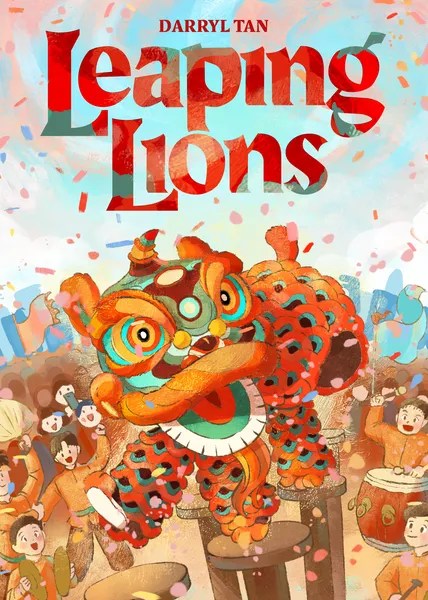
Image taken from https://boardgamegeek.com/image/8904222/leaping-lions
Designer: Darryl Tan
Publisher: Button Shy
Artist: Nguyen Ngoc Anh Tram
After some subpar Button Shy games, this one was a welcome surprise! I get nervous when games are designed for two people (or more) but then an expansion makes the game playable solo. I’ll eventually be posting some reviews where this design ends up being a letdown, but this one actually plays really well solo, even though it’s only an expansion to the base game.
Leaping Lions is a cute, fun little card game about the Chinese New Year celebration that always includes a lion dance. Over the course of the game, players work to advance their lion along platforms to score points, all the while considering the placement of new platforms, upgrades, and specific scoring conditions. Each turn, players draft a platform card from a shared supply and either add the platform to their stage or discard it to upgrade and improve cards currently comprising their stage. Every platform card has a star value that determines which column the player can select cards from in the supply, most have an ability, and there is always at least one symbol represented on it.
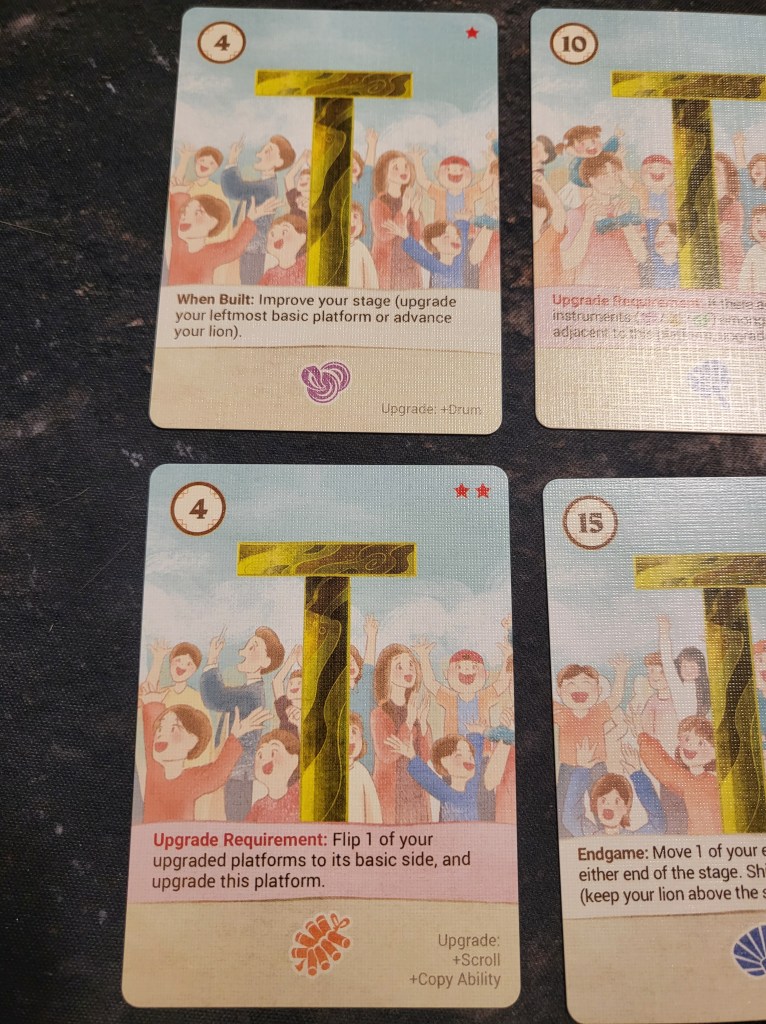
The first strategic element to this game is the stars. Besides the first turn, the number of stars on the rightmost card in a player’s stage determines where they can select their next card from. The common supply is made of two rows and three columns; the stars indicate which columns a card can be taken from. The second interesting part is the option to build or upgrade. Having a long stage can have its benefits, depending on the cards in play, and more cards usually mean a larger number of symbols which can help with end game scoring. Upgrading cards, however, is also useful as the star values increase as do the number of visible symbols (usually). Rather than upgrading a card, you could also discard and then advance your lion one space instead. Then, of course, the abilities of each platform card have to be considered as some apply immediately, others during endgame scoring, and everywhere in between.
At the end of the game, when all platform cards have been utilized, points are scored based on the number of stars present on all cards the lion is on or has passed, certain symbols have different scoring conditions, and points are also scored based on the number of poles in your stage area that ascend in height (each card has a number on it that corresponds to its height).

The solo game, made possible through the Aspirations expansion, plays similarly except there is a card-based bot style rival lion that you compete against. The expansion comes with five different colored lion opponents, each of which have specific preferences and unique scoring goals. Not only does each lion truly feel like a different experience, but they’re also pretty easy to facilitate and impact the game enough (similar to that of another player from what I can surmise) without being super cutthroat and frustrating.

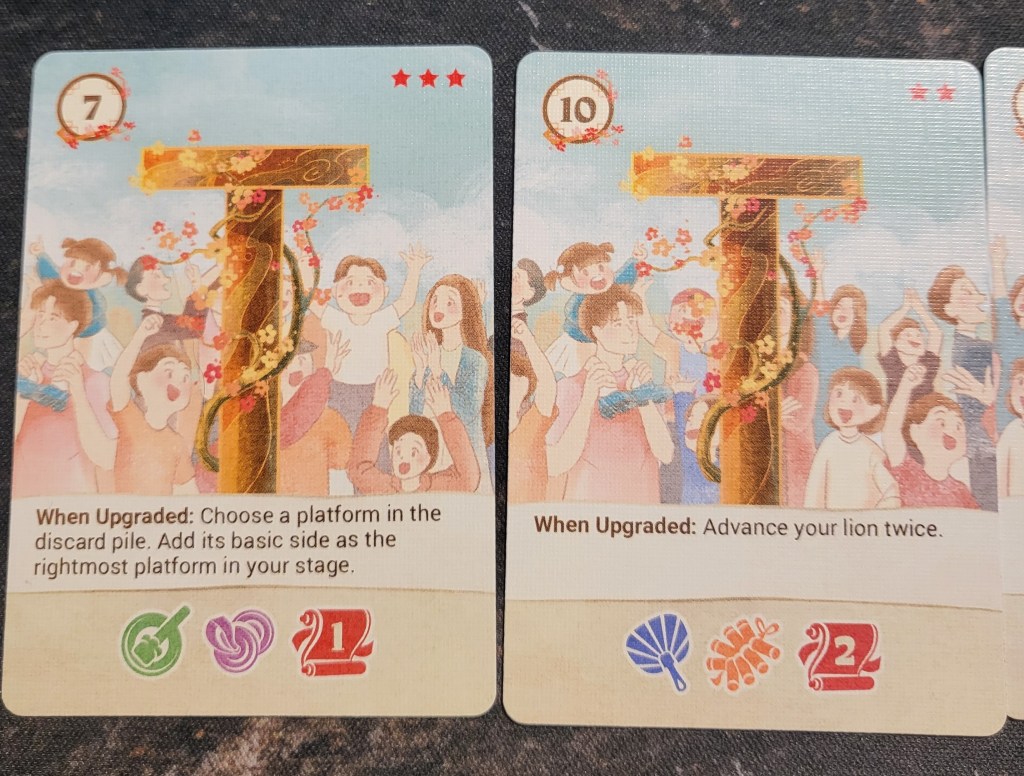
The other expansion, Prosperity, includes six new platform cards, and several of them have a specific requirement that needs to be met for them to be upgraded. I find this expansion to be a lovely inclusion. It increases the variability and freshness of the game without adding too many new rules or other stipulations that bog down the game or make it unnecessarily complicated.
As I mentioned, I’m genuinely surprised at how much I enjoy this game, especially considering its initial design for two players. The five different lion rivals in the solo expansion are all really cool, play uniquely, and create varying experiences based on their scoring goals and overall difficulty levels.
The puzzle itself is also quite interesting and distinct from other card games I’ve played. I like the star-based constraints for acquiring a new card, but the strategy behind the card selection and usage is also very fascinating and deep. There’s quite a lot to consider each turn without being overwhelming.
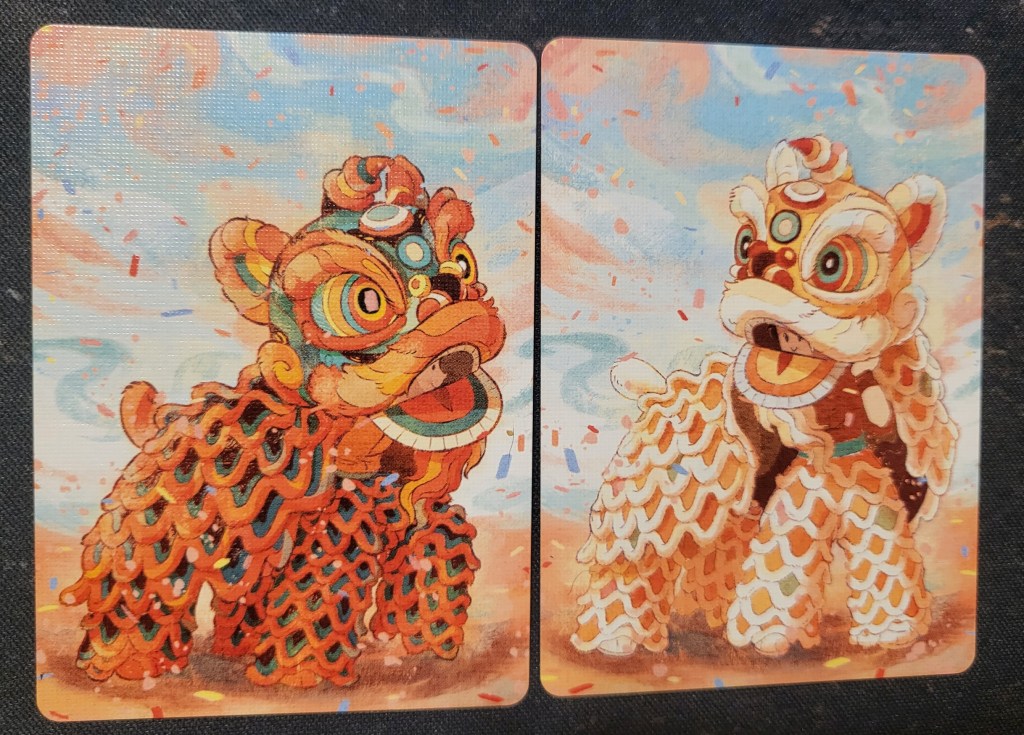
I also adore the theme, and the artwork is absolutely gorgeous. After playing with a few of the solo dragons, I finally realized each has its own art-based characterization on the back side of the card which are all stunning.
As you can see from some of these pictures, this game is a serious table hog. Since both players are constructing a many-card-long stage structure, a lot of table space is required and used over the course of the game.
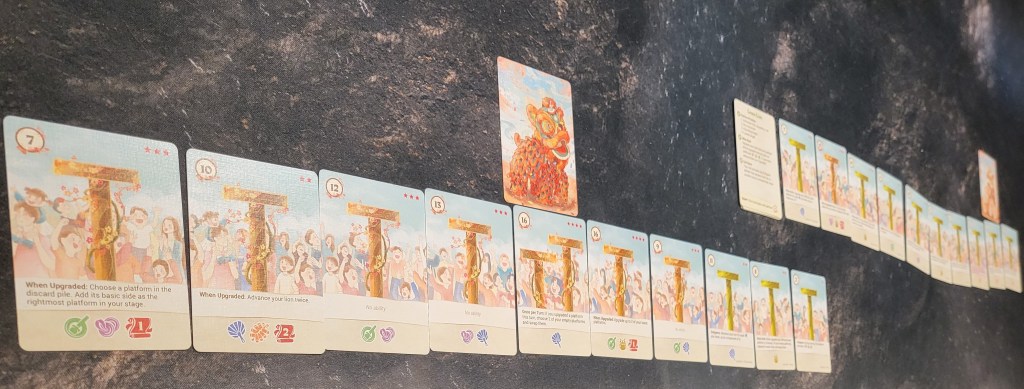
There is some luck in the game in terms of which cards are available in the market, but some of that can be expected and/or mitigated based on the number of stars your last card has. Also, since each card in the market can either be added to the stage or discarded, there is always something you can do to help yourself improve, expand, and score points.
This game is a breath of fresh air. I assume it plays well at two, and hope to try it soon, but even as an only solo game, it’s lovely. It’s quick, fun, strategic, variable, and truly delightful to experience. The alluring artwork helps, but the gameplay backs up the beauty. I can definitely see this one experiencing many plays and getting lots of use in our house. I’ve played it least five or six times and am already looking forward to more!
 The Adventures of Yogi Bear and Delaware
Leave a comment