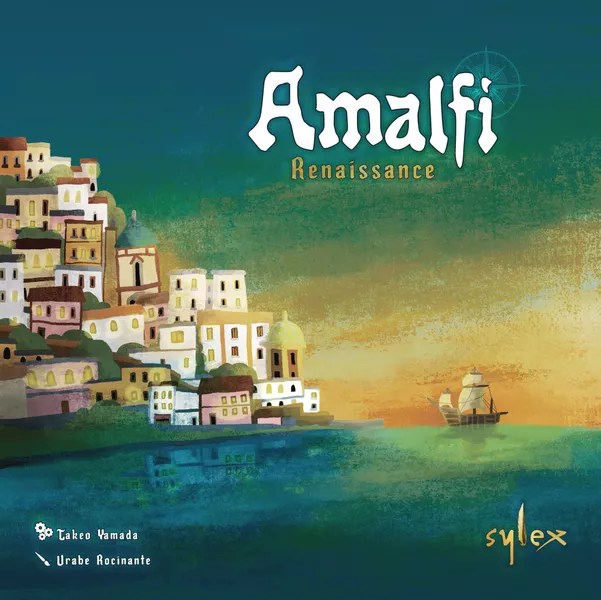
Image taken from https://boardgamegeek.com/image/6518144/amalfi-renaissance
Designer: Takeo Yamada
Publisher: Sylex
Artist: Rocinante Urabe
Amalfi Renaissance is a unique resource management, action selection, and worker placement board game that takes place over four periods. Each period, players will use constructed ships to visit destinations, gather resources, obtain art, and make friends with famous people of the time. Throughout this, you score victory points in various ways. Also, at the end of each period there is a specific condition for gaining points, and there are also race objectives that provide point opportunities. The player with the most victory points wins!
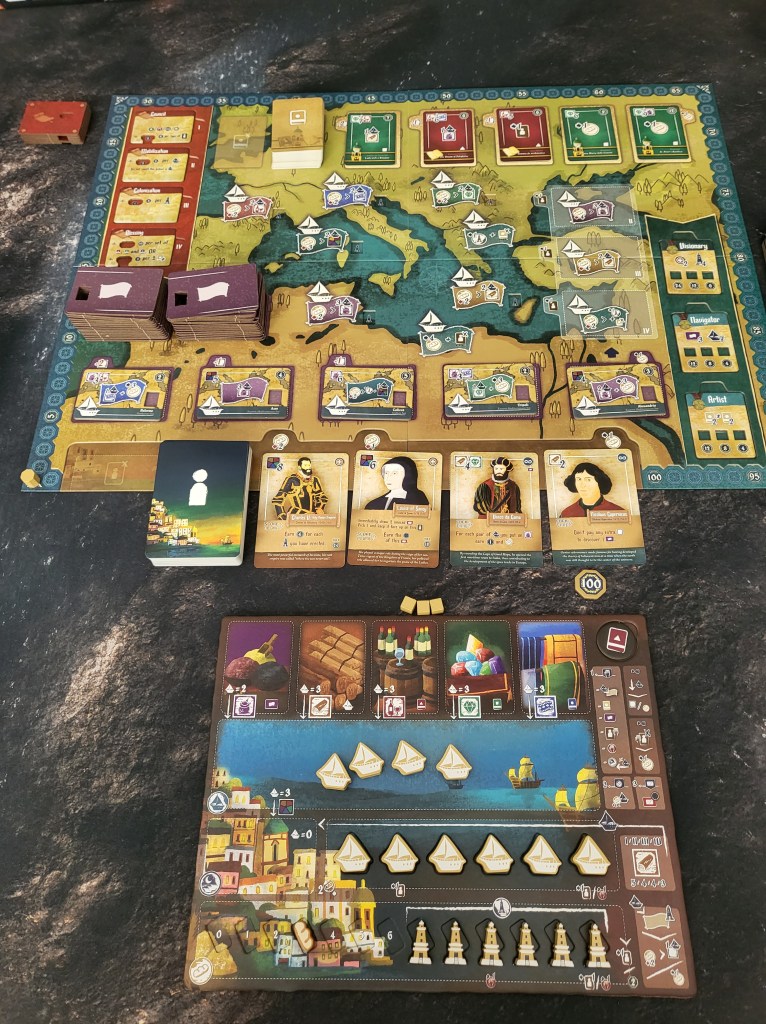
Before I go any further, I have to say, the componentry of this game is amazing. Not only are the ships and lighthouses thick and painted, but they’re also screen-printed. Each player board is also double layered, as are some of the items in the game (or at least have a cut out). But the best part of all is that the central board is also double layered. I don’t think I’ve ever played a game with that, and it is glorious, especially considering the nature of the game and its pieces.
I thought for a while about how to write this review and I’m thinking a pro/con list is the easiest, so here we go!
Things I like:
1) The solo mode is very unique as the opponent does a sort of follow actions thing. Essentially, there’s a section in the rules that shows what the opponent does, and their reaction depends on which action you select on your turn. Not only is it easy, efficient, and effective, but it’s something different and creates some interesting strategic elements. You know if you take a certain action what the opponent will do, so it can add a level of challenge when determining the best action for the turn.
2) There are six different starting card combinations that all contain specific and unique historical figures. They truly do shape the game (some) and provide good variability in an easy implementation.
3) The art is nice and fitting for the thematically expressed time period. The rule book is also well designed and easy to follow. The solo mode is a separate section and does explain all opponent actions well.
4) There is good variety in the end of round and race scoring objectives. Like the starting hand, these can shape your strategy and priorities throughout the game and provide good variability. I also like that some are race objectives and others are based on merit in certain aspects of the game. It provides multiple different scoring opportunities which is always a plus.
5) Some cards have neat abilities. Also, while some character cards repeat in their action, they usually require different resources, so each card is unique from what I can tell.

6) I was pleasantly surprised by the game play and mechanics. There is a lot of interconnectedness, which I love, and some of the actions and their mechanisms are quite cool. For example, there are no physical resources in the game except for bread (I’ll come back to this momentarily). A ship is worth a certain value of resources based on where it goes. On the top of each player board are five different resource locations, and to get those associated resources, you must gain them somehow and then the ship(s) you move in becomes a representation of those resources. The people and art cards (haven’t explicitly mentioned these but they exist) also add to the intertwined nature of the game, creating some really interesting decisions. The order in which you perform specific actions is very important and fun to puzzle out. Oh, and the bread, man, the bread! It’s like a universal resource that can be used for many things, but you must ensure you have enough bread at the end of each round to feed your sailors!
7) In the same vein, there is an interesting balance between using a ship to get resources on the board or using it to perform more actions (among other things). The ships are a major limiting factor which creates the main tension in the game, in my opinion. There is also the option to basically retire a ship for the round and gain any three resources from it, but then it’s unavailable for the rest of your actions that round. Additionally, in order to build more ships, you have to use ships to represent the wood resource. The ships also get cheaper as the game progresses, but it’s always tempting to build them early, so you have access to them for more rounds. It’s so fascinating and clever!
8) The game has a very nice flow. I think the ships representing basically everything and the lack of physical resources helps with this.

Neither a pro nor con specifically:
1) It’s really not as heavy as I was expecting. It’s definitely a euro, but it’s a solid mid-weight game that seems decently easy to teach and introduce to people. The husband asked me to compare it to Windmill Valley, and while BGG disagrees, I find Amalfi Renaissance lighter than Windmill Valley.
Things that make me a little sad:
1) While I obviously enjoy this game, the gameplay didn’t stay exciting for me. That could be influenced by the fact I’ve only played solo, but after four or five games, I didn’t have the desire to play again. I actually gave up on a game midway through because I just wasn’t feeling it anymore. It is totally a personal thing, but it seems important.
2) As I progressed through the games, I really felt I advanced in terms of points and strategy, and I also started understanding the game more, which I appreciated. But, and this kind of relates to #1, once I started to comprehend more and figure out some of the strategies more, that’s when it got somewhat boring. Before that, I felt there were many ways to improve and I also felt I was exploring the game and discovering new elements, combos, cards, etc. Once I hit that four to five game threshold, though, that feeling of wanting to play the game more and more died out very quickly.
Overall, I appreciate its welcomed unfamiliarity, uniqueness, and puzzliness, but there’s no major draw that keeps me wanting to play again and again.


 The Adventures of Yogi Bear and Delaware
Leave a comment