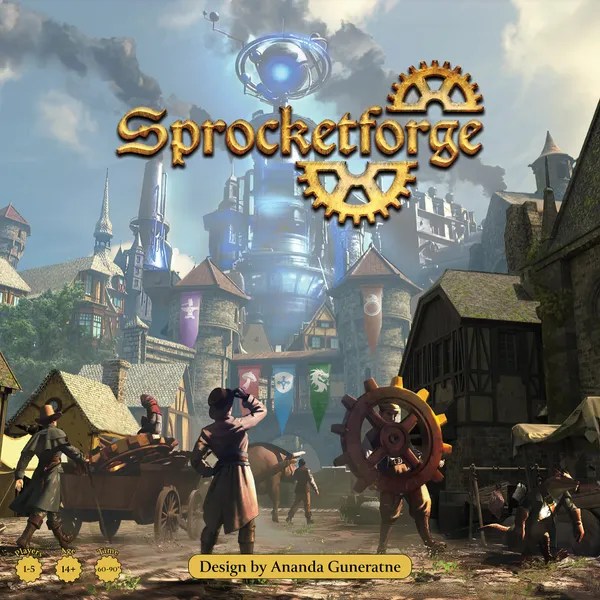
Image taken from https://boardgamegeek.com/image/8699633/sprocketforge
Designer: Ananda Guneratne
Publisher: Sophisticated Cerberus Games, LLC
Artist: Tyler Edlin
Sprocketforge is a game I backed on crowdfunding because it looked fun, unique, and plays 1-5 players which covers our usual preferences (solo is almost a need, five players is a major bonus). We typically enjoy engine building, the interconnected gears with the resource management seemed neat, and it also didn’t seem too complicated (we like heavy games but have enough for now). While these all hold true, we were disappointed with the final product. The production quality is absolutely amazing, but the game play falls flat and is rather boring overall.
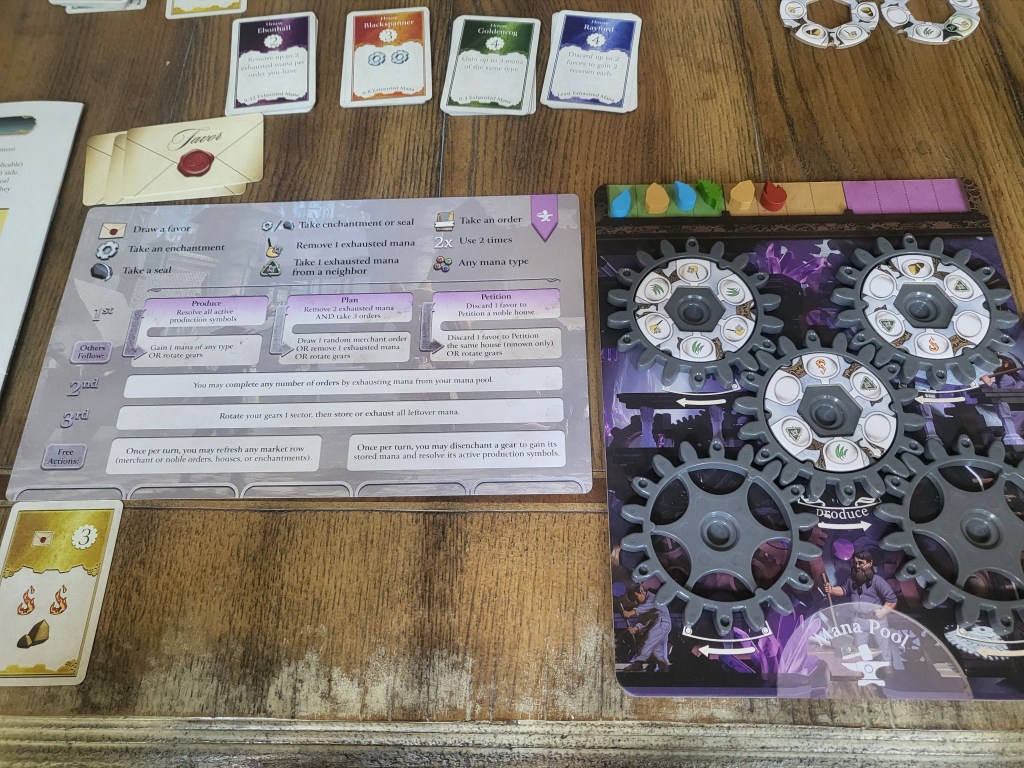
This game is a classic resource management and recipe fulfillment game. Each round, players either produce, meaning they collect resources and other goodies, plan, by taking additional contract cards to fulfill and doing some clean-up on their player board, or petition, which is essentially turning existing points into more points and potentially other benefits. Those are the only three action options each turn, among a few other free actions that can happen at any time.
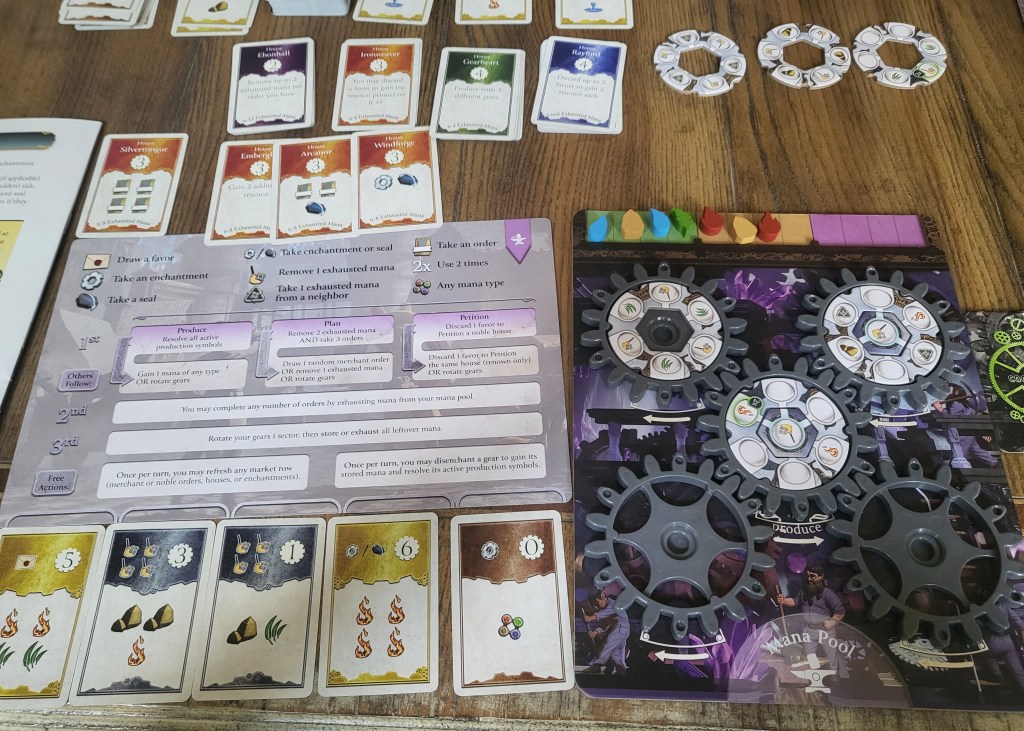
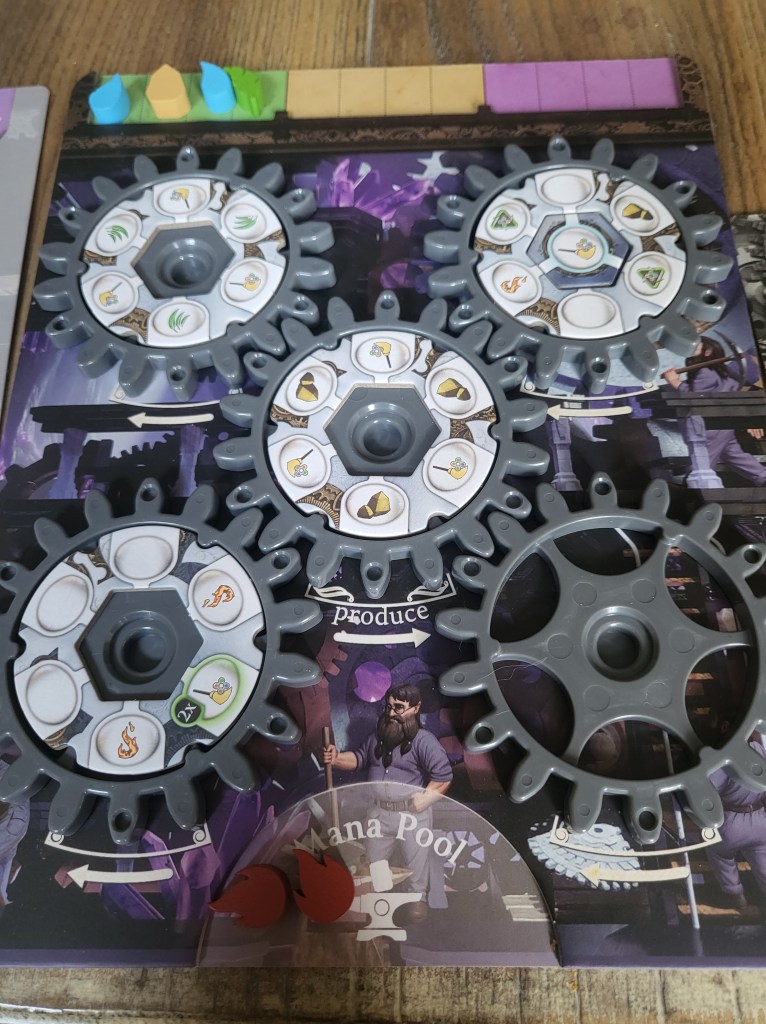
Each player board starts with two “enchanted” gears which equates to having the option to gather resources or other benefits from those gears. If a player chooses to produce on their turn, they obtain everything from their gears that appear in their active sections, AKA the very bottom of each disk. If they gather mana (resources), they place it in the slot at the bottom of their player board (their mana pool) so it can be used to complete contracts this turn. If there is any remaining mana in their mana pool at the end of their turn, it can be placed on existing enchanted gears in open locations, or it must be placed in the exhausted mana section – it can’t be saved for the next turn.
After any action, players have the opportunity to complete any orders and then their gears also advance one space. The gears always rotate in the same direction, but some rotate clockwise and others counterclockwise as expected.
If a player chooses to plan instead of produce, they get to select and gain up to three order cards from the market and place them under their player board in the designated spots. Each player has five slots for orders, and each contract (order) has a mana requirement and a completion bonus.
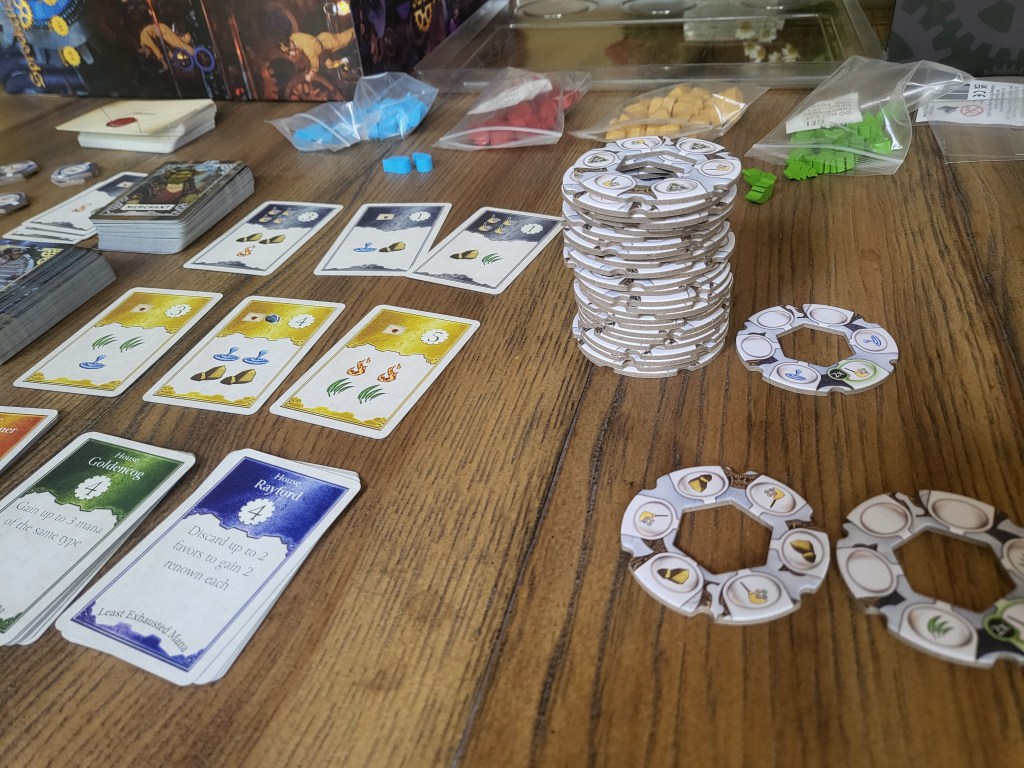
The last action option is to petition which means the player exchanges an existing favor card they gained to “petition” one of the face-up house cards based on the amount of exhausted mana on their board. The house cards typically provide additional points and other useful benefits.
One of the most interesting aspects of this game is that after each player selects one of the three main actions, each other player gets to perform an optional “follow” action. For the produce action, the other players can gain one mana of any type or rotate their gears one sector. For planning, they can draw a random order card, remove one mana from their exhaust, or rotate their gears one sector. After a petition action is taken, other players can discard a favor card to gain the renown (points) shown on the card chosen by the active player (but doesn’t receive any other benefits), or, as always, can advance their gears one sector.
Honestly, that’s basically it. The game continues until someone reaches 30 points and then the end of the game is triggered, and the player with the most points wins.
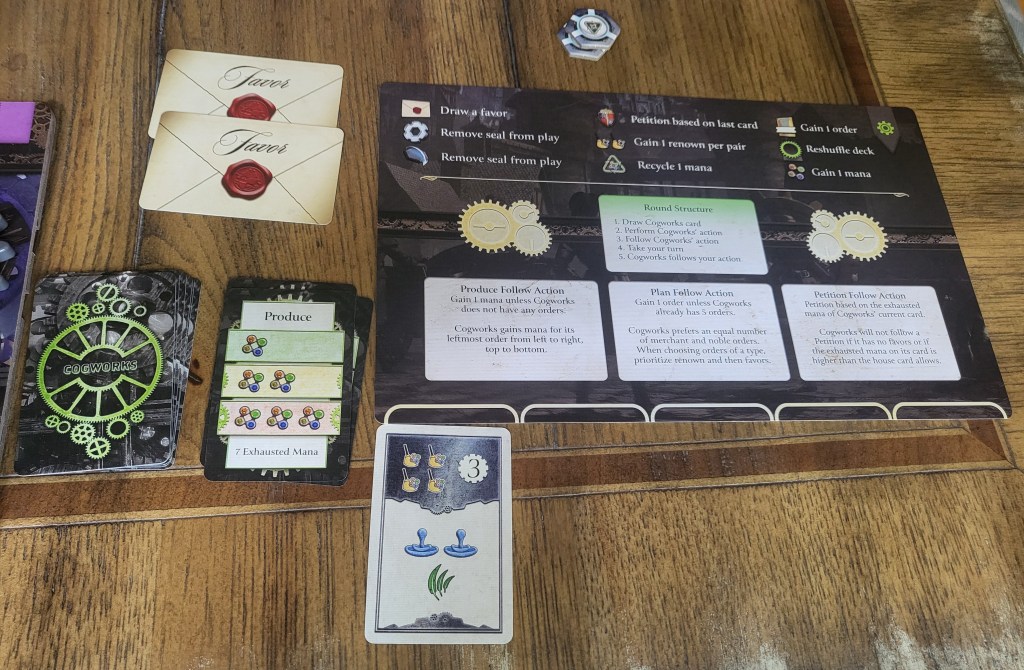
The solo game plays similarly, but there’s a bot (Cogworks) that scores points and interacts a little with the player. It’s quite easy to run overall and provides a decent feeling of playing with another human player. I appreciate its inclusion, and it’s fine enough, but it’s nothing revolutionary or particularly incredible.
Here are some positive thoughts about this game:
1) The gear mechanic is unique and fun and putting the leftover resources on the empty gear enchantment spaces is quite original. The mana exhaust system is also pretty neat. It’s interesting that you have to ensure you don’t have too much exhaust, otherwise you get penalized. The gear advancement/turning is also cool and fits the idea of the game.
2) The player turns are very quick and snappy. With only three short action options and a few maintenance steps, turns can take less than a minute if you know what you’re going to do. There is also nearly zero downtime considering there is always the option to follow another player’s action, so you’re continually invested in what other players are doing.
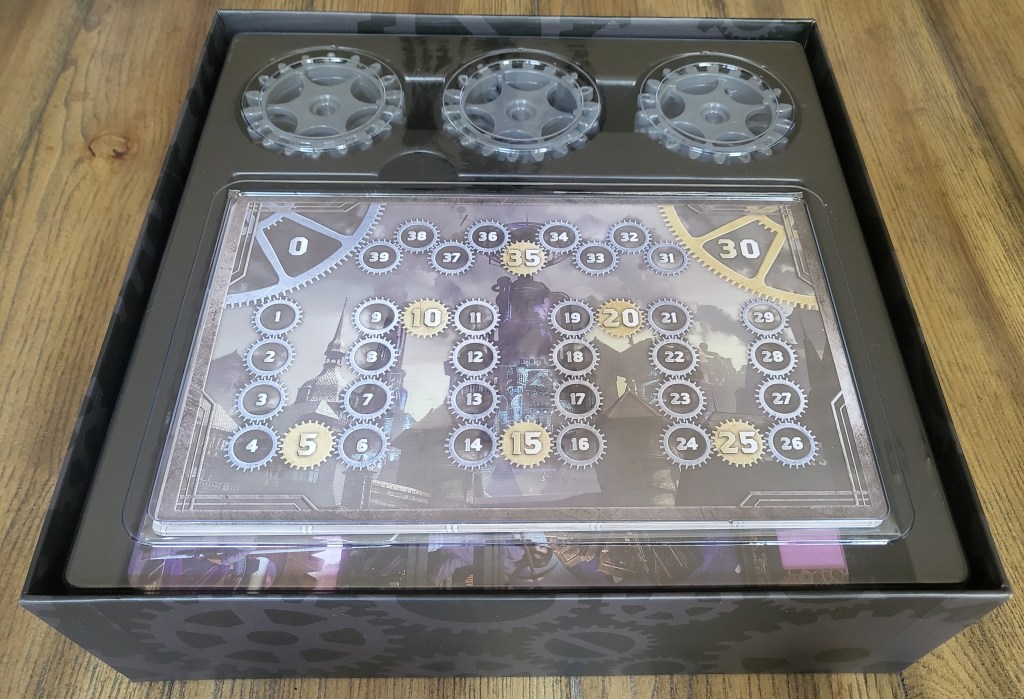
3) The production quality is absolutely stunning, even with the “cheaper version” with plastic gears instead of metal. The wooden resources are nice and chunky, the player boards are well designed and double layered in a very smart and sensible way, and the plastic gears are thick, high quality, and seemingly durable. The artwork is also pretty. The storage solution inside the box is also phenomenal!!
4) There are a lot of contract cards to keep each game feeling fresh (in that regard).
5) There is a recycling action where a player can take resources from another player’s exhausted mana which is a unique and clever player interaction design choice. The player taking the mana obviously benefits from gaining something they want, but it also helps the player they are taking from as it cleans out their exhausted mana. The idea of recycling is always something I love in a game, and this one executes it very well.
Now for the aspects we don’t care for and/or have issues with:
1) It makes me sad because I wanted to like this game and we love engine building (we will come back to this point), but this game is boring. I learned it and played it solo twice before I introduced it to the husband, and I thought it might just be the solo game, but our experience wasn’t any better at two, unfortunately. I was hoping for some added player interaction or other enjoyment from a human opponent, but it was pretty nonexistent. It may play better at higher player counts, but we legitimately gave up about halfway through our two-player game after I asked the husband if he was bored. I also think it could be more interesting and enjoyable with the advanced variant that introduces unique player boards and powers, but the game play loop seems as though it would still be the same which is our main issue here.
2) In relation to the last point, I think there needs to be more action options (or something) to make it more exciting and strategic. It is one of the most basic recipe fulfillment games ever: gain resources (albeit in a somewhat cool way), complete a contract and gain the benefits, then use those benefits to fulfill other goals and gain points. That’s literally it. In theory, the game seems cool and original, especially with the gears and the gear enhancements, but there is something missing from the game play to make it engaging. Each turn feels similar and very rigid in a way; it’s usually very clear what you need to do to try to complete your contracts.
3) Continuing with the previous qualm, there’s very little important decision making. There’s almost no strategy and no real puzzle here. You basically look at what contracts you have, what your gears look like, and what you need to do for those two to work in conjunction and then make the best of it. The engine building aspect is completely absent besides growing your network of gears and gear enhancements. You’re not building anything that reduces costs, provides resources or points, or has any permanent effects.
4) These are pretty minor complaints in comparison, but they’re still worth mentioning. If you get unlucky and don’t have many contracts that provide favor cards, it’s hard to get additional points. There are contracts that give renown as a reward, but the main way to gain larger chunks of points in the petition action which always requires a favor card. Also, not being able to store unused mana for the following turn can be a pain. I understand it makes the game more unique and difficult, but if you have a poor combination of contracts and enhancements (which can be luck driven like the favor card issue), not having that mana for the following turn can get frustrating very quickly.
As much as I wanted to like this game, it was not a hit for us. There are definitely some unique ideas and elements, but it’s not a fun, exciting, or puzzly game, so there’s no real draw for us. I do appreciate its ease of teach and wonderful components, but that’s also not enough to keep us wanting to play.
 The Adventures of Yogi Bear and Delaware
Leave a comment