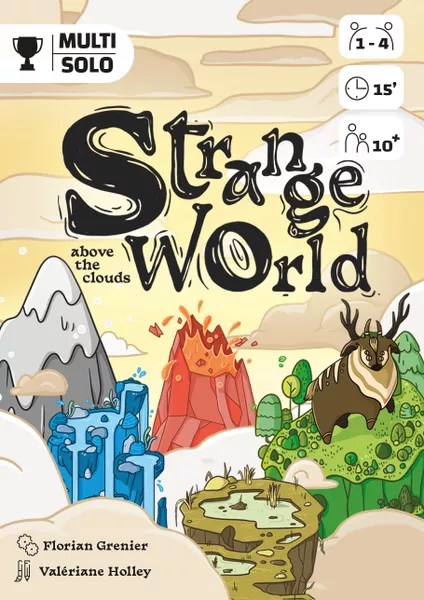
Image taken from https://boardgamegeek.com/image/8389733/strange-world-above-the-clouds
Designer: Florian Grenier
Publisher: GRRRE Games
Artist: Valériane Holley
Oh my gosh, this game has such a funny story behind it. So, I heard about this through a YouTube channel, and it seemed like it would be right up my alley, but I couldn’t find it anywhere. Lo and behold, someone had it listed on the BGG GeekMarket, so I snatched it up. In my excitement, I managed to overlook the small detail that it is the French version. Needless to say, I laughed out loud when I opened the box and saw the rules in French. Thankfully, I actually know a decent amount of French, but it was still a true adventure using my elementary-middle school level knowledge of the language and a trusty translator to decipher the rules. I’m proud of myself for figuring it out, though!
Strange World Above the Clouds is a fun card drafting and tableau building game. Each round, players draft cards and add them to their tableau with the only major basic rule being the newly placed card must be adjacent to an existing card (except for the first card of course). However, each card type has specific scoring conditions and other placement rules that increases the difficulty and makes the puzzle really enjoyable.
Before I explain the unique cards, I have to describe what Tzimimes are. Tzimimes are seemingly hungry monster type of blob things (see pictures) that like to destroy cards in your world if you don’t meet their very specific rules (at least I think this is the idea, I didn’t read much of the French flavor text). While Tzimimes aren’t negative points, any card that gets flipped to the Tzimimes doesn’t score individually or as part of any other card combinations.
So, how does one get Tzimimes in their tableau? Each type of card has unique stipulations for placement and when placement results in flipping the card to the Tzimimes side. Water cards don’t like to be adjacent, so if one gets placed as such, the new card gets flipped. For grassland cards, there can only be one per row. Animals are free to do as they please, but the moon cards always have to be in the top row. Any cards above them at any point get flipped to reveal the Tzimimes. Also, some cards have half portals on them, and if you form one portal, you can’t create another in an adjacent line (you can’t two complete portals next to each other).
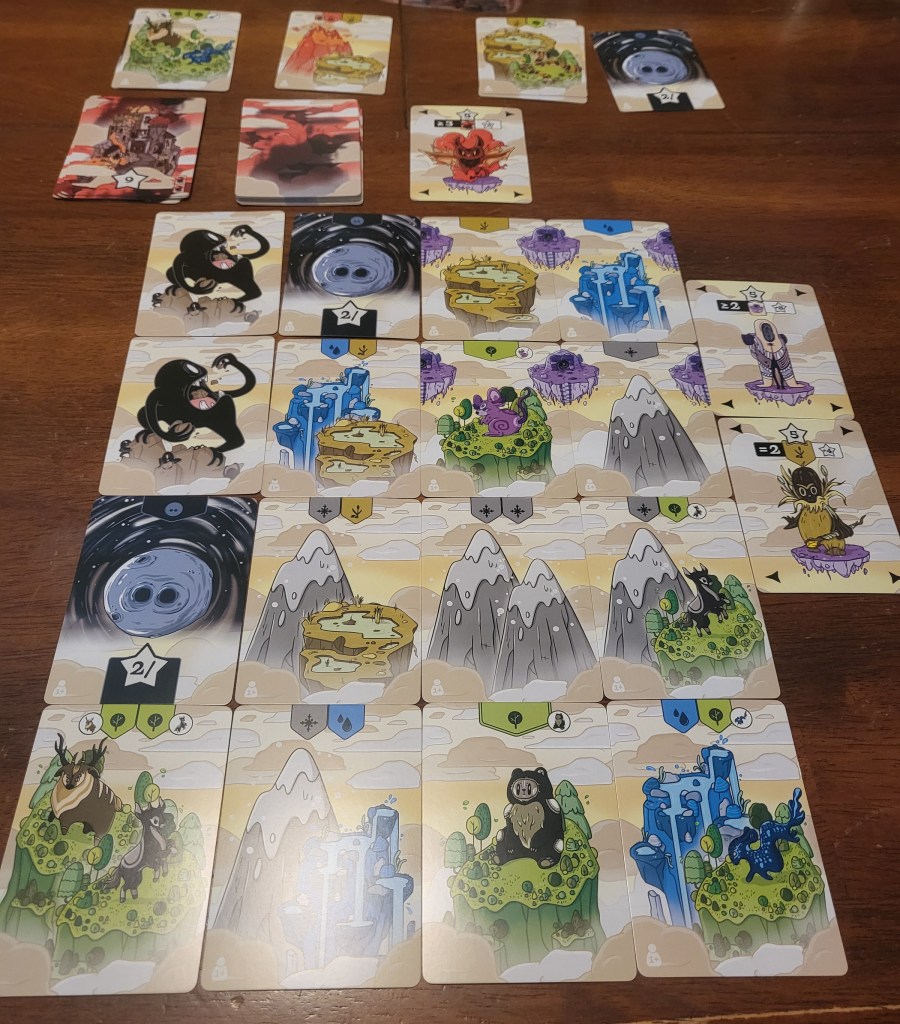
Besides taking into account all these placement rules, each type of card also scores differently. Animal scoring is based on the diversity of animals in your world, while grassland cards just score three points apiece. Only the largest group of adjacent mountains get scored while the water cards score one point for each adjacent card (so up to four per water). The moons like repeating and also different types of cards to be below them. You score for each unique type that you have at least two of below the moon. I didn’t touch on volcanoes because those are a little more complicated, but they score flat points depending on the card(s) in play. You can also score from the portals I mentioned. When you complete a portal in your tableau, you get a voyager card that gets added to your tableau and provides additional points and scoring conditions.
In the solo mode, the player makes seven stacks of three cards with only the top card in each visible. Based on that limited information, the player picks a stack and must place all cards from that stack into their tableau.
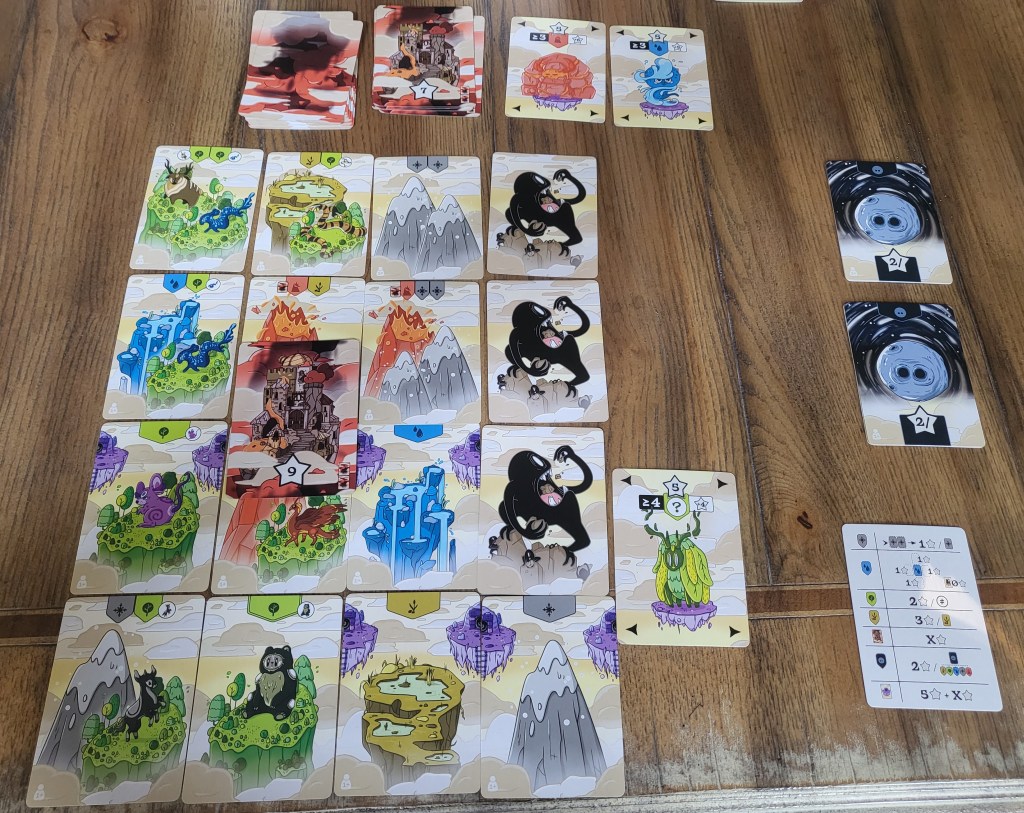
There may be a few things I missed, but that provides a decent overview of the game. I have to say, there is definitely more here than meets the eye, if you can’t tell already from my rather lengthy explanation. There are a surprising number of decisions to make each round, as well as some serious point optimization and combo chaining. It’s very easy mechanically but it’s difficult to master the balance of not getting Tzimimes with scoring points from the cards and your voyager(s). Think of it as a familiar drafting tableau builder that still provides depth and is also quite unique. The cards and their abilities are very original, as are some of the design choices with the scoring and the Tzimimes.
In terms of player count, I liked it better at two players. As always, I appreciate the solo mode and it is still quite enjoyable, but the drafting element is definitely more fun than the seven stacks of three cards. For the record, it’s a standard pick and pass draft. I also feel there’s more luck in the solo version since you can only see the top cards where you get to see all cards in the draft. Truthfully, two player drafts in general aren’t great, but it’s done pretty well here and still creates some interesting decisions regarding taking cards and/or keeping cards away from your opponent. I can also see this one scaling well without adding too much play time. The simultaneous turns help with that, but it’s a quick game overall as you only make a 4×4 grid of cards and then the game ends. I do have to say, it’s also fun to see what everyone created at the end of the game making the multiplayer version more enjoyable for that reason as well. It’s cool to see what they did with the cards you didn’t want and those they chose to draft.
A few other likes include useful player aids, silly character names to add to the theme and fun of the game, and cute, lovely art that really fits the vibe of the game.
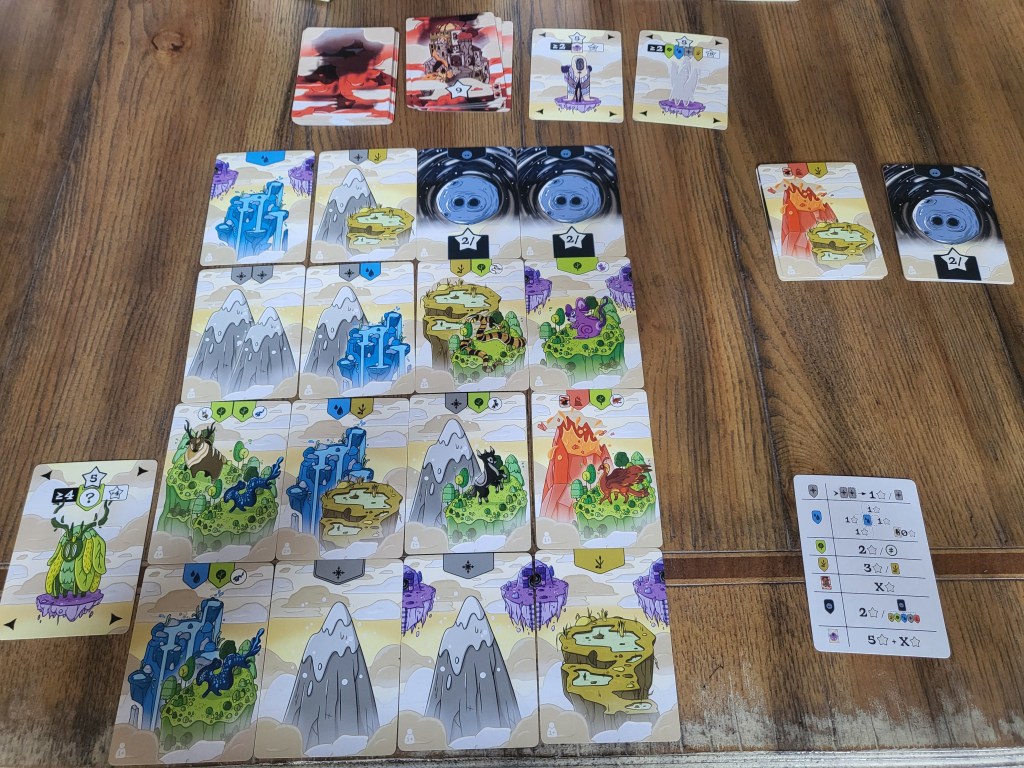
This is really weird, but I don’t know if I have many negatives. I’m not saying the game is perfect, and there is still always luck involved, but it’s a really solid game. It’s compact, quick, fun, interactive without really being mean, plays well at multiple player counts, and does the two main mechanics it boasts very well. I suppose I wish the solo mode was stronger – that can be my critique!
If you can’t tell, this game is a chill, silly, thinky, fun, gem of a game. It may be difficult to find (and be careful what version you get), but it’s worth it if you can secure it, especially if you enjoy and appreciate a good, unique tableau builder. It’s a really good representation of a simple yet deep quick-playing small box game.
 The Adventures of Yogi Bear and Delaware
Leave a comment