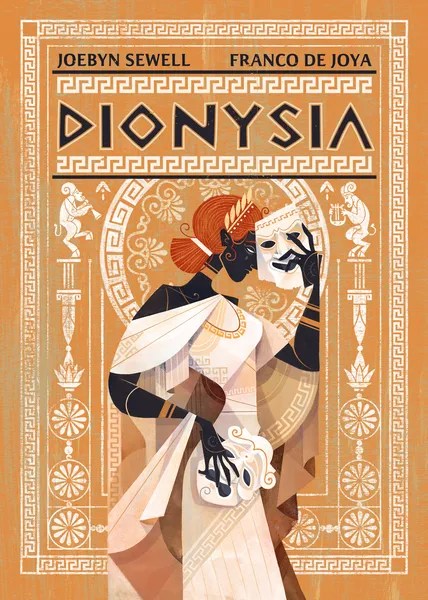
Image taken from https://boardgamegeek.com/image/8598800/dionysia
Designers: Franco De Joya, Joebyn Sewell (Solo Design: Mike Mullins)
Publisher: Button Shy
Artist: Dan Gartman
Here’s the next installment of my ongoing reviews (spread out of course) of Button Shy games we’ve been receiving. Overall, this one was a letdown for me. As of recent, I’ve felt Button Shy has released some strong pocket games, but this one did not do it for me. I will say, the game is designed as a two-player game and I’ve only played it solo (this is possible with one of the expansions), so it very well may be better at two.
Every game, players draft cards to create a three-act play. Each card has either an endgame scoring condition or an immediate when-played ability, and there are various symbols each card can have at the bottom. At the end of the game, each act will have three cards, but only one card will be on top (called key scenes) and only those three total cards will be used for scoring.
Each turn, players draft a card from the stage (contains three cards to choose from) and then add that card to one of their three acts. If the player has fewer than three acts started, they can choose to start an act, and if some acts are already started, they could alternatively add to those as well. If a card gets added to an existing act, the player decides if they want the card to be placed downstage, or below the existing card(s), or upstage which is on top of existing card(s). Play continues for nine rounds until both players have three three-card acts complete.
For scoring, each favor (scoring) condition on the top three key scenes gets evaluated and scored accordingly. Each card also has a desired pattern of symbols that can score additional points. If that symbol combination appears anywhere in the three-by-three grid, the player scores the indicated points for the number of times that pattern exists. However, patterns can only be represented either left to right or top to bottom.
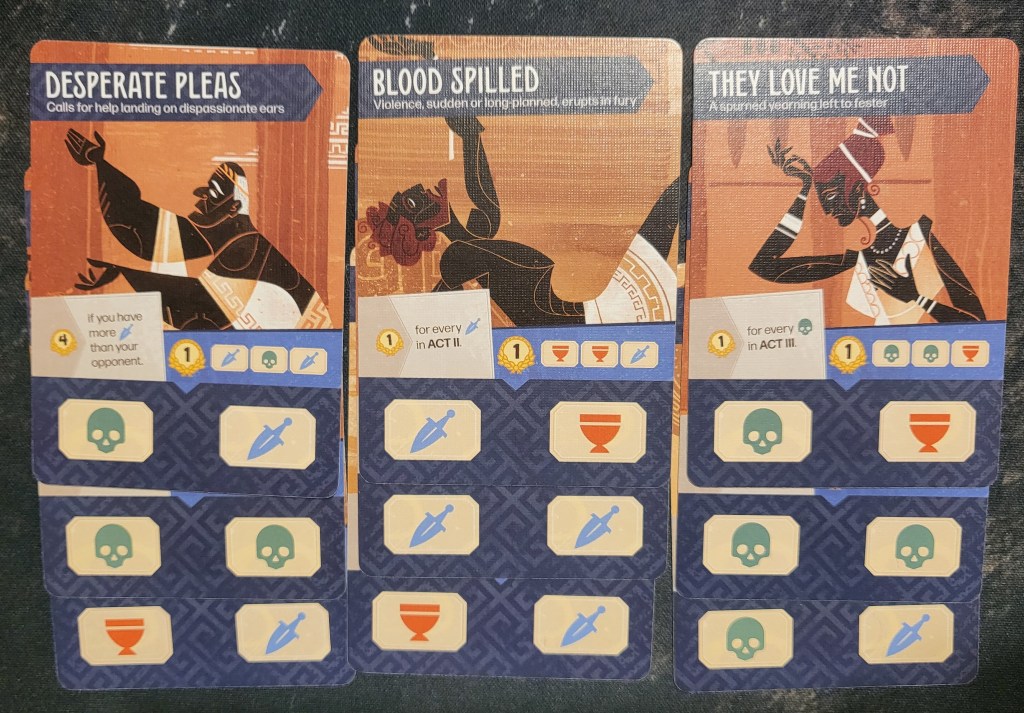
Honestly, the game play is pretty simple, and almost too simple. Yes, you must select a card, but there aren’t many options (of either two or three available, depending on if second/first player respectively), and you also have to decide where to place it, but that’s literally it. In theory, the puzzle sounds cool since you need to consider the scoring opportunities, pattern requirements, immediate abilities, etc., but the execution isn’t as fun as expected. Also, the success of varying patterns and favor conditions is quite dependent on luck; the likelihood of you placing your cards to fulfill more than one favor opportunity is pretty slim, so it’s difficult to maximize the combinations of your cards.
The solo mode, while I always appreciate its inclusion, is pretty weak in my opinion. The game plays similarly to that of a standard two-player game from what I can surmise, but it’s relatively unexciting and repetitive. Thankfully, it’s super easy to facilitate, but there wasn’t much enjoyment in the puzzle for me. There are also solo cards that you can optionally use which do make the game more challenging, but they’re also very mean. I like that you can play without them, but without them means less variety and variability.
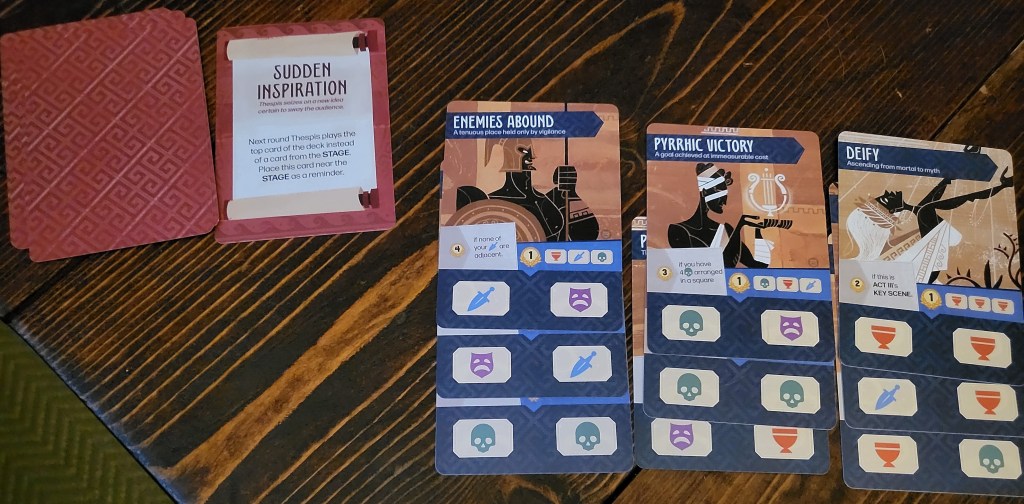
There is inherent variability in the randomness of the cards, as always, but as I’ve previously stated, the game is rather samey overall, even with the expansion (I’ll come back to this – there’s one additional expansion that’s not just the solo mode). Each turn of every game is exactly the same and the puzzle, while present, isn’t fun enough, deep enough, or clever enough for me.
Speaking of the puzzle, yes you’re maximizing points, but it’s almost more frustrating trying to figure out what to do than it is enjoyable for me; there’s nothing motivating me to sit there and think about all possible combinations and devise which one’s best – like I said, the puzzle isn’t very fun and the solo cards could totally mess it up anyways. Also, is there really a puzzle?? All you’re doing is putting cards in three acts either above or below the last one to put symbols together and have the best possible visible scoring condition. I don’t know, maybe I’m being negative and overly harsh, but this just doesn’t land for me. After a few plays, both with and without the solo cards, I felt a little like a robot where I was doing the same thing continually (selecting a card and saying “yeah, this looks like a good spot”), and sometimes any potential strategy I’m going for could be completely ruined by a solo card.
I do have to say, though, after all this negativity, the other expansion (called Muse of Tragedy) is cool and adds a neat twist to the game. However, it doesn’t create a different enough experience for me to really change my thoughts on the game.
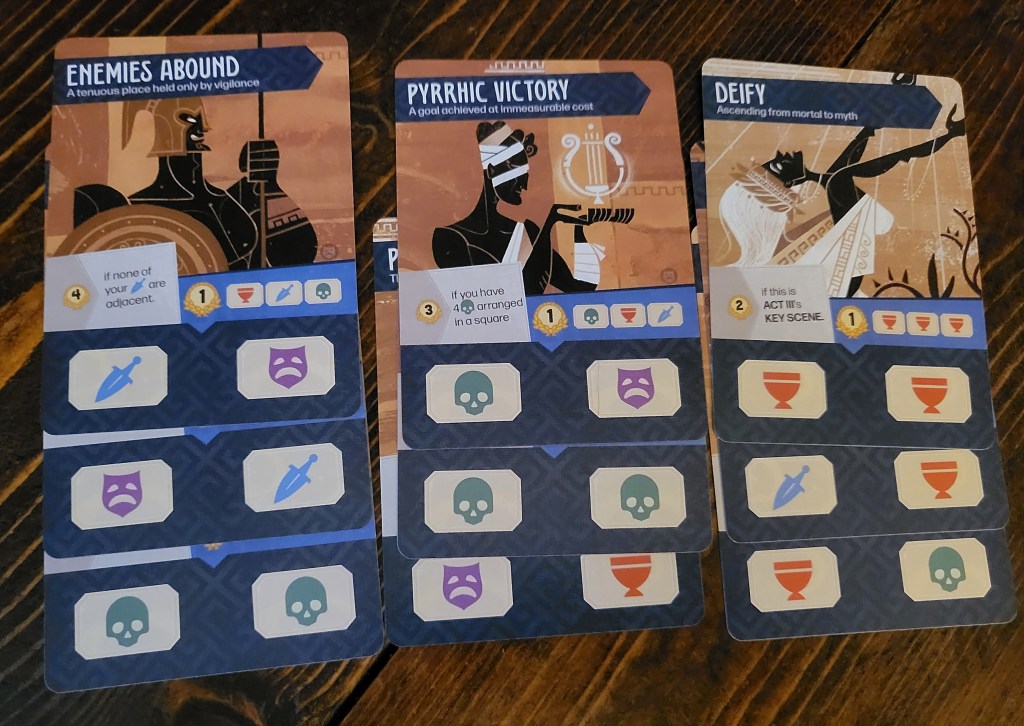
Outside of the game play, the cards have beautiful artwork and do create a nice table presence once both players have all three acts completed.
Also, one other aspect I really enjoy is the two different ways players score favor. They do create two unique goal categories that can be focused on, and it can be fun to try to determine which card would be most beneficial for one or more of the scoring conditions and required patterns. I do see the cleverness of this design and how, in theory, deciding the combination of scoring conditions, patterns, and actual symbol layout could be tactically (and strategically) enjoyable, but it wasn’t expressed in a way that resonated with me.
Well, sorry everyone, especially the Button Shy crew and designers for this being so negative. If you look at our other reviews, I (we) genuinely try to be positive (and there are some positives of this game), but this one really disappointed me, and I think it’s important to have honest reviews. It is very possible that this game will get better with another human player, but I truthfully don’t know if it’s worth an attempt. Please let me know if it is and I will try to give it a go!
 The Adventures of Yogi Bear and Delaware
Leave a comment