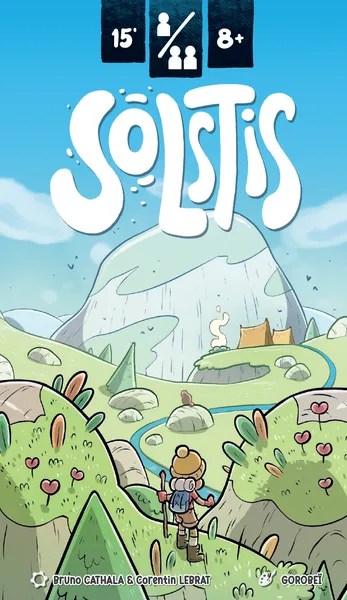
Image taken from https://boardgamegeek.com/image/8548331/solstis
Designers: Bruno Cathala, Corentin Lebrat
Publisher: Lumberjacks Studio
Artist: Manu Gorobeï
For some reason (I say this because this game is good but it’s not a masterpiece) I am literally obsessed with this game, and it is a top contender for what will be my most played game of the year. I learned it and started playing it on BGA and fell in love with it, so I needed a hard copy (especially since it’s a pretty cheap game). It’s super easy and quick to play, but still thinky and puzzly, so it’s been hitting the sweet spot for me.
Solstis is a tile laying/pattern building game with different color tiles of different numbers that, when combined, form a pyramid (this’ll make sense when you see pictures). Each player starts the game with three tiles in hand and some also get drawn to make up the display. Every turn, a player selects one of the tiles from their hand and selects one of the tiles in the display that matches either the color and/or the number of the tile in hand. Then both of those tiles get added to that player’s personal tableau.
If at any point, a square of four tiles is formed, that player gets to add an animal spirit to that location. Animal spirits can either help at the current moment or can provide additional scoring at the end of the game. Also, if you can’t match a tile from hand with one in the display, there’s a second chance mechanic where you discard a tile from hand into the display to draw a tile from the top of the stack and then evaluate if that can pair with any in the display. If there still are no options for tile capture, that player gains a rainbow tile which is basically wild and can therefore be placed anywhere in their landscape.
That was a very brief, rather undetailed overview, but hopefully it gives you the general idea of the game. I’ll explain a few more things as the review continues!
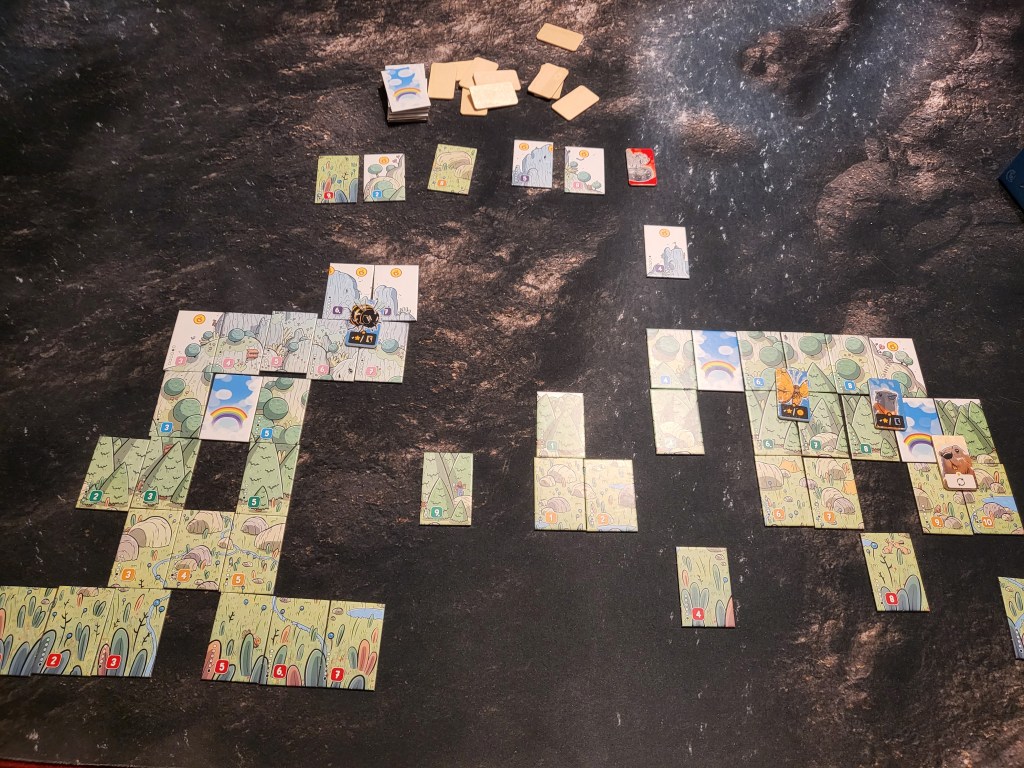
One quick thing I do want to mention is scoring. Players score one point for each tile in their largest continuous section, some animal spirits can score points, and lit fires are each one point. Some tiles have fire icons on them which are considered lit if there is a path from that tile to a tile in the bottom row. I have to say, the fires are an interesting twist. You want to get them but also have to make sure they’re lit unless you can get a spirit to help and/or compensate.
The solo and two player modes play very similarly, but in the solo version, the evil spirit always has a hand of three tiles, and the leftmost tile (which rotates) is used each turn to try to capture a tile to add to its tableau.
Though simple, the mechanics of this game are pretty neat to me. There is definitely some strategy in which tile to get, which to play from your hand, when to block your opponent, when to get a second chance, where to place rainbows, and which spirit to select, amongst other things. Additionally, I appreciate that there are a few different avenues to try to score points in terms of areas of the board, amount of aggression, personal growth vs. sabotage, and more. I also find it clever that there’s only one of each tile, so you can look at the other players’ tableau and see what they have, what they may be going for, and what you won’t be able to get. It can shape strategy and help guide some decisions.
Besides the mechanics, the components of the physical game are quite nice. The tiles are thick, and the spirit tiles are actually wood. There is also a good player aid and solid explanations in the rulebook. I’m terrible at remembering what each spirit does, but that information is prevalent on the player aid and in the rules if necessary.
Now there are a few parts of this game that are admittedly far from perfect. The first is the massive luck factor in terms of which tiles you have in hand, which are available in the display, the location(s) of placed tiles are in your tableau, which spirits you draw, etc. It is very possible you can lose a game quite badly based solely on poor luck. There is a moderate amount of potential mitigation, but not enough to override the fact that luck is a huge aspect of this game. Also, a few of the spirits seem a little overpowered which can add to this luck negativity.
I also want to point out that while there is a weak semblance of a theme, this game is quite abstract. The story is related to climbing a mountain or similar, but you’re basically just laying tiles based on color and number. The animal spirits are probably the most thematic element, if they can even be considered as such.
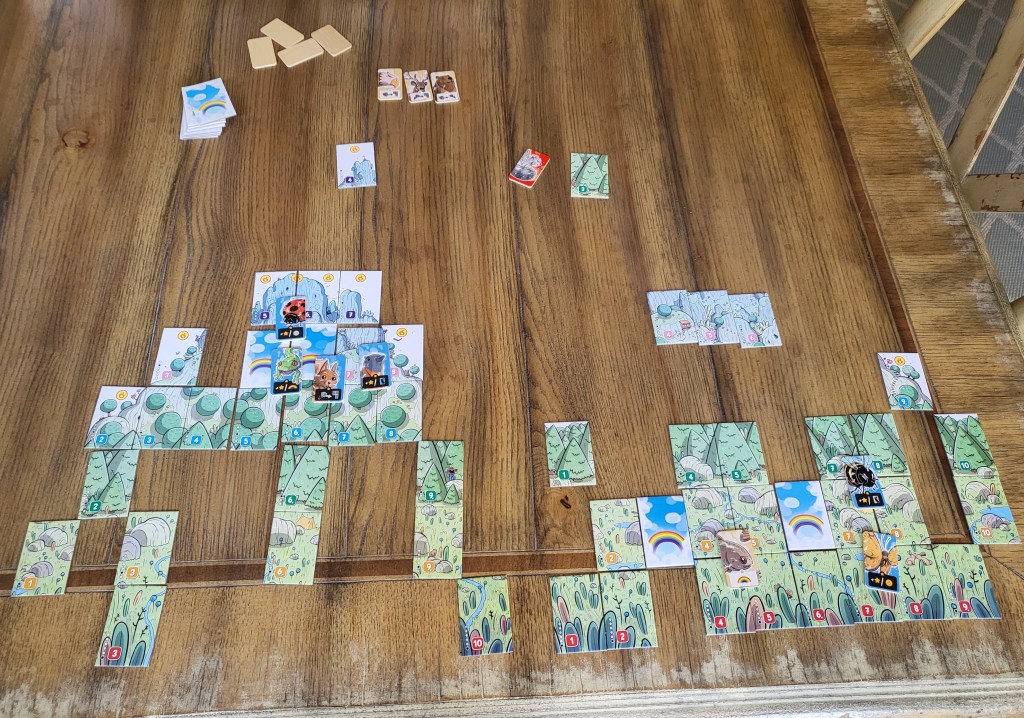
Truthfully, it’s not one everyone will love and I understand that; it’s not complex and there is quite a bit of luck, but I feel like there are enough options most of the time to not fall too far behind unless your board is all over the place (but in theory you can try to minimize that) or you get very unlucky with your tile draws. It’s nothing mind blowing, but I just really enjoy it, it’s quick and easy to play, and makes for a fun fifteen minutes (or less!).
Evidently, an expansion is coming out for this game this year. Don’t worry, I’ve already preordered it and had the chance to play on BGA. If you like Solstis, the expansion seems worth it. It doesn’t change gameplay much but adds more variability in terms of animals and a cool little firefly mechanic.
 The Adventures of Yogi Bear and Delaware
Leave a comment