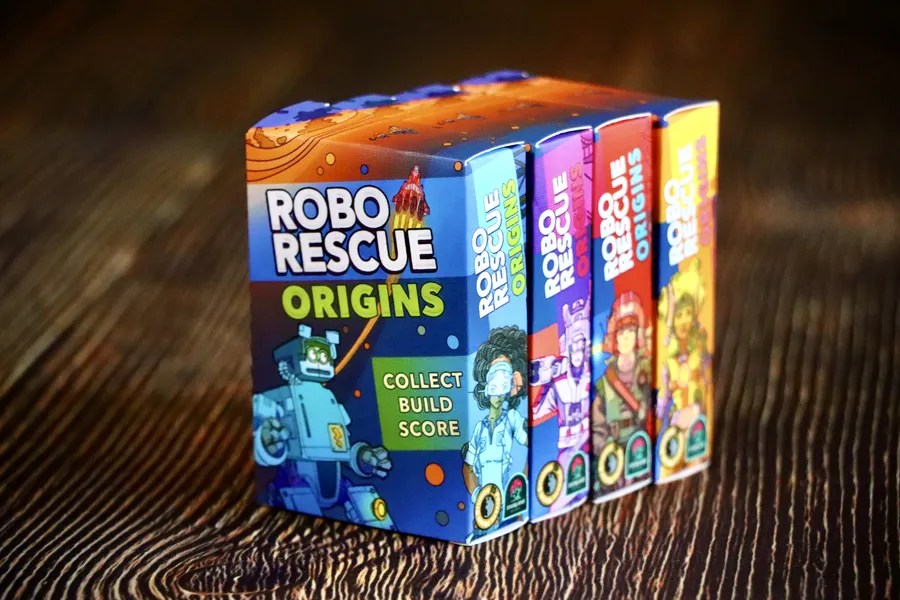
Image taken from https://boardgamegeek.com/image/8886002/robo-rescue-origins
Designer: Pierrot
Publisher: Everland Studio
Artist: Zoltán Nagy
Robo Rescue: Origins is a game that I found on Kickstarter a little while ago that got my attention for one main reason: the game was free. Well, one deck of cards (which means you can play solo) was free (but you had to pay for shipping), and then you could add decks for literally $1. Evidently, the idea is to encourage people to check out the full Robo Rescue game that’s launching on Kickstarter at some point. Anyways, I got four decks for less than $20 which I thought was a steal. I’m not saying I had low expectations, but because of the nature of the campaign, I was trying to be realistic with my expectations of the game. Turns out, it’s actually pretty fun!
The mechanics for this one are interesting and somewhat unique. Each round, players draw cards from the deck and place those cards in one of four areas in front of them (called their labs). The first two turns, two cards get drawn from the deck and both get placed, where on the second two turns, one card gets drawn from the deck and then the player can decide to take another from the deck or select one from three face up cards in a display area.
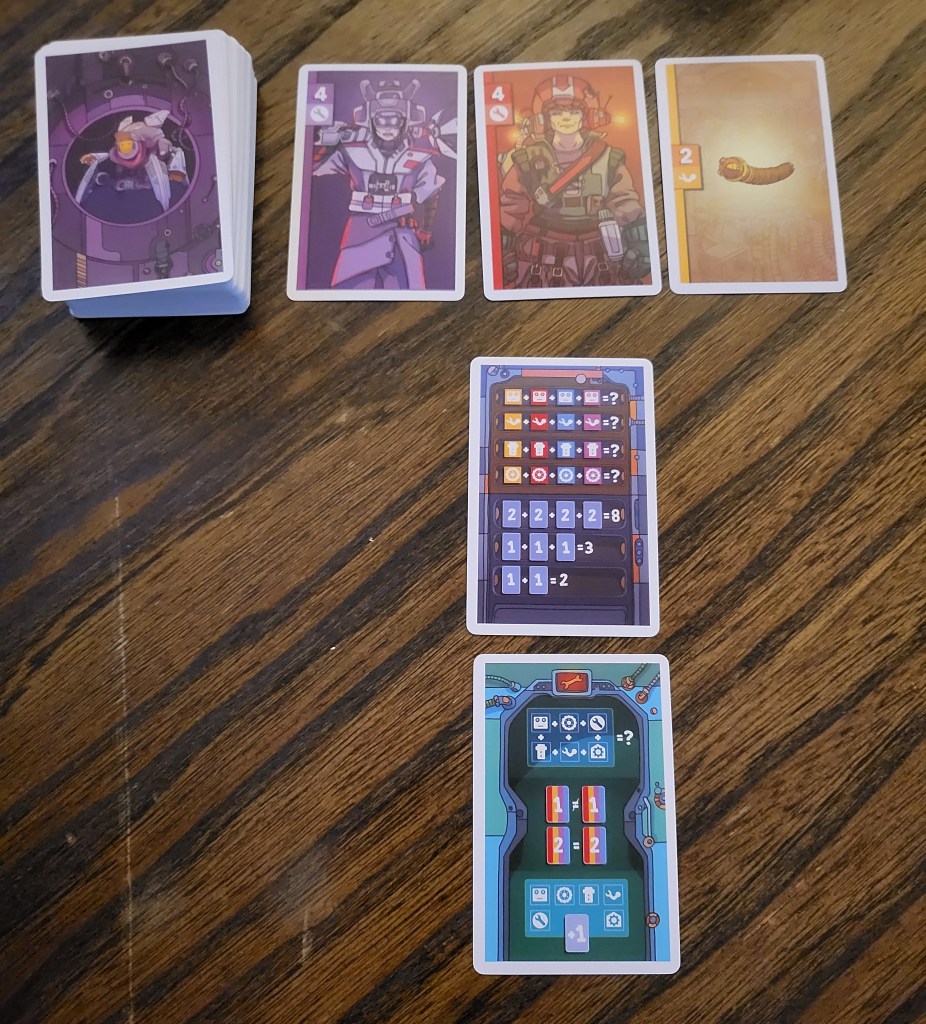
The tricky part is obviously in the placement of the cards. There are four areas, but they are basically separated into a top and bottom – the storage areas on top and the workshop areas on the bottom. In the storage area, you want cards that share icons (representing robot parts), but they have to be all different colors. In the workshop area, you want cards of the same color, but you can’t have any repeating parts or symbols. There’s a little more to scoring than that, but that’s the general idea.
While it’s not the best game ever, I think it’s enjoyable and decently well designed, especially for the price point. The different rules and scoring conditions for the storage and workshop areas are neat, and make you think on each turn, but it’s still very light. The art is also pleasing and suitable for the game. The iconography is also very good on the robot cards themselves, but it gets a little jumbled on the player aid cards (these cards are helpful but only after you’ve played a few games and understand what the iconography is indicating). The solo mode is also really good and very easy to implement. Truthfully, this game is very multiplayer solitaire (at least from what I can tell), so it’s super easy to play solo. Keep that in mind, though, if you’re more of a fan of player interaction.
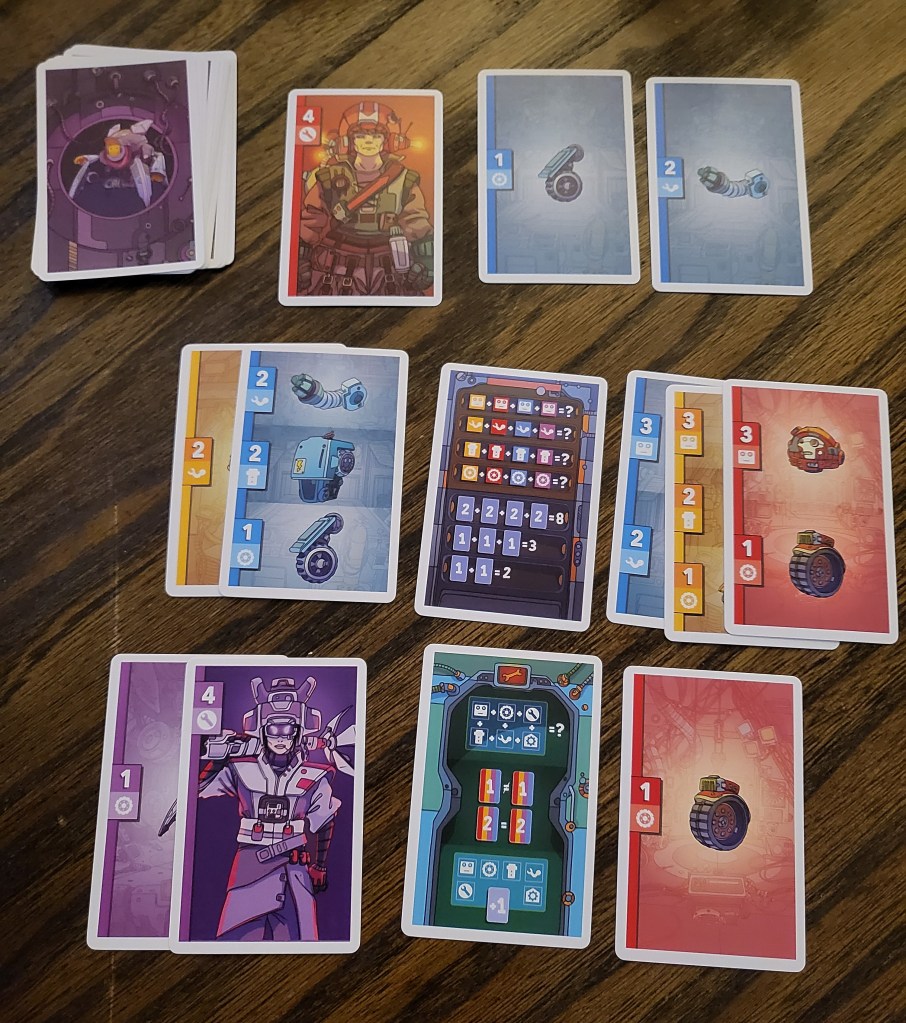
The artwork is also really nice!
I got four decks which means up to four people can play, but I do wish the four decks had unique and variable constitutions and weren’t just different colors. Also, the workshop areas definitely seem to be more powerful in terms of scoring points (or at least easier to score more points in) than the storage area unless you can play a lot of cards in one storage area, so some decisions are pretty no-brainer-esque because of that. As with any card game, there is also quite a bit of luck involved based on the cards you draw, but having open information in the display for the last two turns of a round helps. Additionally, the scoring is pretty confusing initially; after a few games, it makes sense, but those first few games were a bit of a stab in the dark in terms of figuring out which cards to play where and when to maximize points. There is also a rule where if you can’t legally place a card you have to select one of your four labs to decommission essentially removing it from the round. I found this weird, though, because you only score two of your four total areas each round, so decommissioning one isn’t really that detrimental usually. Or at least it hasn’t been an issue for me yet.
Besides the natural randomness of the cards, there’s not a whole lot of variability in the game. The same things happen each round and each game, it’s really just optimizing the cards you draw. That said, I’ve played ten times and I’m not completely tired of it yet. There’s also an advanced variant included in the rules that really ups the difficulty level.
Overall, Robo Rescue: Origins is really cute and quite fun. Besides the challenging scoring, it could be a good gateway/family game, and it plays quickly which helps as well. It’s somewhat strategic, but mostly tactical; regardless, there is some decent decision making needed, but still very light and smooth and breezy. I’m honestly interested to see what the full board game is like!
 The Adventures of Yogi Bear and Delaware
Leave a comment