Image taken from https://boardgamegeek.com/image/8593669/farm-hand
Designer: Craig E. Somerton
Publisher: Grail Games
Artist: Samuel Bouvant
Farm Hand is a family friendly trick taking game that’s quick and easy to play, but still very fun and creative. Each round, players bid on how many tricks they will win, then the round plays out, and players score based on if they bid correctly. After six rounds, the game ends, and the player with the most points wins!
While this is a pretty standard trick taking game, there are a few design choices and inclusions that make it unique. First, the number round it is (1-6) is how many cards each player gets dealt (in 1-3 player games, higher counts are a few less cards). Also, if you successfully bid the number of tricks you win, you score points based on what round it is (ex. six points in round six).
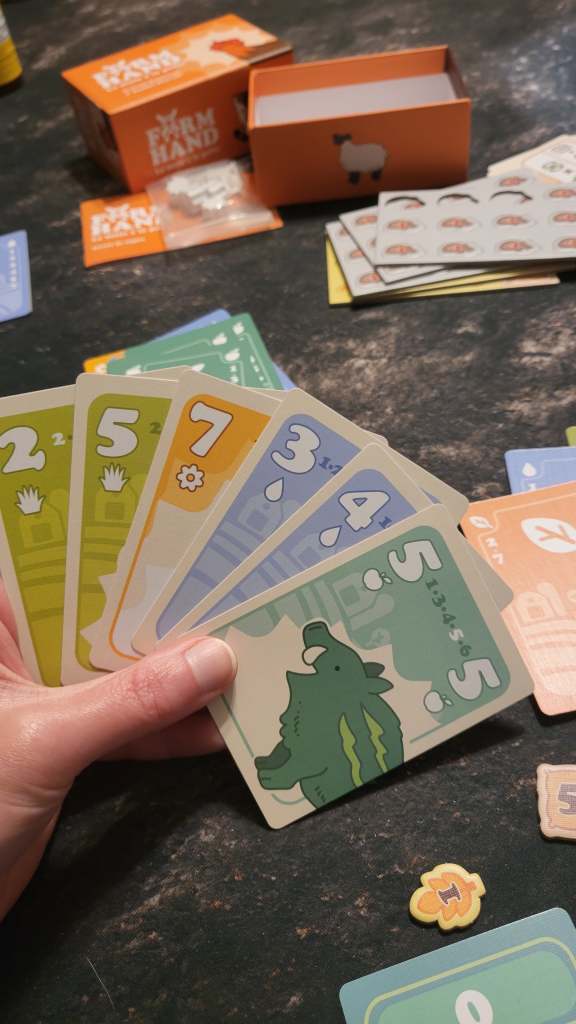
In terms of the actual trick taking, it is a must follow but, as almost always, if you don’t have any cards in that suit, you can play any card from your hand. Usually this means you’ll lose the trick, but this game has a nice twist in this department: regardless of suit, the highest number played wins the trick (so it wins even if it doesn’t match the lead suit). One other fascinating bit is that there isn’t even card distribution – one suit has one card, one suit has six cards (I think) and then everything else in between. While there is a player aid that lays out this information well, the card backs also list all possible values that card could be based on its suit. It’s honestly really interesting!

There’s one more special rule that I want to comment on. If during any trick two or more players tie with any value, those cards get cancelled and the next highest card wins the trick. For example, in a three-player game, if two players play a six hoping to win the bid and the other player plays a one, the one will actually win the trick. Not only does this mean you can potentially lose tricks you want to win, but it also means it’s possible for you to win a trick you want to lose.
I mentioned scoring briefly but left out some information. If you bid correctly, you get points based on the round number. I find this intriguing because it’s harder to guess and win an accurate number of tricks the more cards you have, but also the stakes increase as the point values go up when it gets more difficult to predict the round’s outcome. If you do not bid correctly, however, by either being too low or too high, you gain negative points equal to the difference between your bid and the number of tricks you won; no positive points are awarded.
In general, I quite enjoy this game. The bidding is fun, the trick taking is straightforward but still unique and strategic, there are some interesting additions that make it different and special, the artwork is adorable, and it plays quickly, takes up minimal space on the shelf and on the table, and would be a great travel game! I also think this is one for younger kids (not that adults won’t enjoy it); I could see this being a nice gateway style game for trick taking. While the artwork is precious and the theme is cute in theory, the game is quite abstract – it’s a trick taking game, the suit representation doesn’t really matter.
In terms of player count, this game is better with more players but it’s still fun at smaller player counts. While we haven’t played at four or five players, three players was definitely the most enjoyable, fun, engaging, and strategic. In a two-player game, there’s a third bot-style player named Mac that follows suit when possible but essentially just randomly pulls cards from their hand to bid. There is also a chart in the rulebook that outlines what this third player’s bid is each round. Thankfully, this nonexistent player is very easy to facilitate, but it’s not the best in terms of competitive game play. The game is much better when the third (or fourth or fifth) player is making choices based on their hand and not just arbitrarily selecting cards. The same goes for the solo mode, but there are two dummy players (this time Mac and Donald). I love that a solo mode is included, and it’s actually still pretty neat, but it’s certainly not the best way to enjoy the game. Honestly, though, I learned the game solo and it’s more fun than I was expecting, especially for a trick taking game.
Overall, there is enough originality in this game to keep me wanting to play. It’s not something I’d put out regularly, but like I said, it’s really easy to travel with and also a cinch to teach, so there are many applications in which this game can really shine.
 The Adventures of Yogi Bear and Delaware
Leave a comment