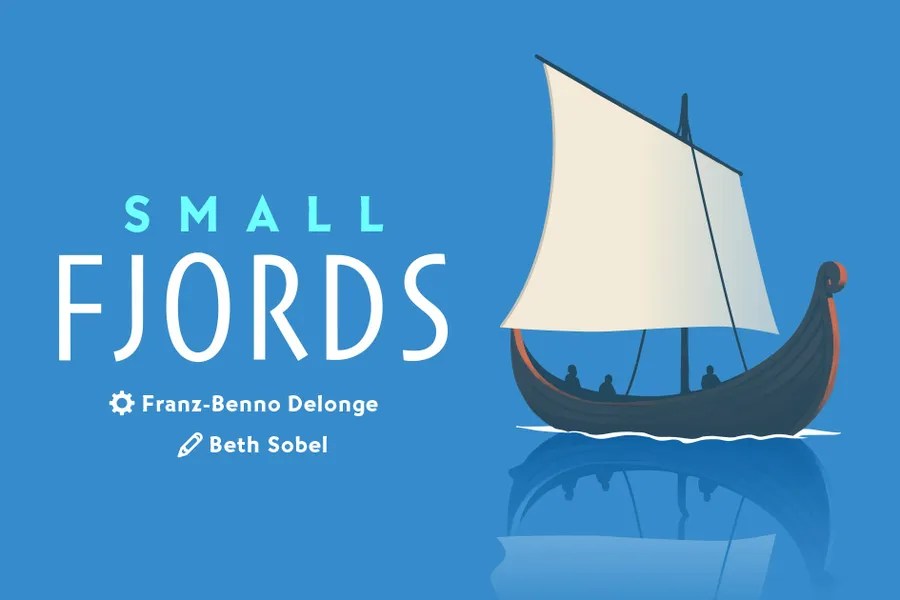
Image taken from https://boardgamegeek.com/image/8639545/fjords
Designer: Franz-Benno Delonge (Solo designer: Arnaud Charpentier)
Publisher: Grail Games
Artists: Jörg Asselborn, Beth Sobel, Christof Tisch
I have to start by saying this: the rules for this game are quite simple, but somehow, in our first game, the husband and I both incorrectly placed tiles in two different ways! There I went building a second land mass, and there he went not matching all sides of the tile. This is why we can’t have nice things.
Small Fjords (or originally just Fjords I believe) is a cute little tile laying game where you are either constructing some fjords yourself or competing against another player to have the most control of the region. Each turn is simple: you draw a tile and place a tile ensuring all sides match any surrounding terrain and that you aren’t starting a second landmass (yes, we really messed up the only two rules in the game). Oh, and the new tile must touch an existing tile on at least two sides (at least we go that one right).
Besides the tile laying itself, there are two other small strategic components to this game. The first is the longhouses. Each player starts the game with four longhouses, and they can be placed on any tile immediately after it’s played as long as it has some green field terrain on it. In the solo game, Viking cubes are placed around each adjacent tile to the longhouse immediately after the longhouse is added. The goal of the solo game is to get out as many Vikings as possible. In the two-player game, at the end of the game, players alternate placing one Viking at a time on a tile that is adjacent to one of their longhouses and/or an already existing Viking. The solo game is a beat your own score thing, but the more Vikings you deploy, the higher your score will be. In the two-player game, the winner is determined by whoever puts out more Vikings.
As you can see, the solo and two-player games play quite similarly, but the change in the Viking placement is actually rather significant. In the solo game, you want your longhouse to be as surrounded as possible when played, where in the player vs. player version, you want your longhouses to be spread out and strategically located as it’s much more of an area control battle. The longhouse and Viking placement is what really makes the game in my opinion. Yes, it’s a tile laying game, but there’s not as much strategy necessary in that aspect.
Overall, I think I like the game better solo, but I do appreciate the varying strategies necessary for the two different player counts. The mechanics are simple and it’s easy to teach, but there is still a nice puzzle to solve. That said, there is some luck in the tile draw which can somewhat impact the game. I also love the small box and decently small table footprint, especially for a tile laying game. It looks pretty on the table and the colors are very deep and rich.
We got this game as a part of the Grail Games Kickstarter that included two other games. We will be reviewing those shortly, but even though I was expecting to enjoy this one the most, especially because it plays solo, this is actually my least favorite of the three. That’s not to say I don’t look forward to more solo and head-to-head plays, though!


 The Adventures of Yogi Bear and Delaware
Leave a comment