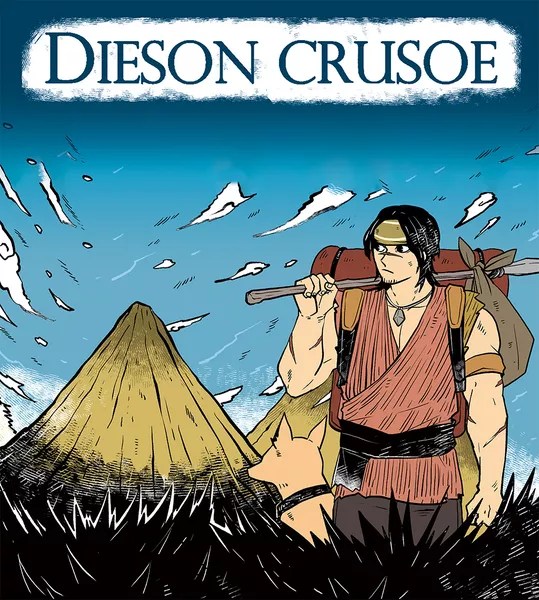
Image taken from https://boardgamegeek.com/image/7189728/dieson-crusoe
Designers: Jinhee Han, HaeYo
Publisher: Best With 1 Games
Artist: PASIO
As a lover of Robinson Crusoe, when I saw this game being re released with another solo game of the month, I had to snatch it up. It gives the feeling of playing Robinson Crusoe with significantly less set-up and play time, fewer components and mechanics, and a less mean design to make losses a little less painful. If you like Robinson and play solo games, definitely check this one out!
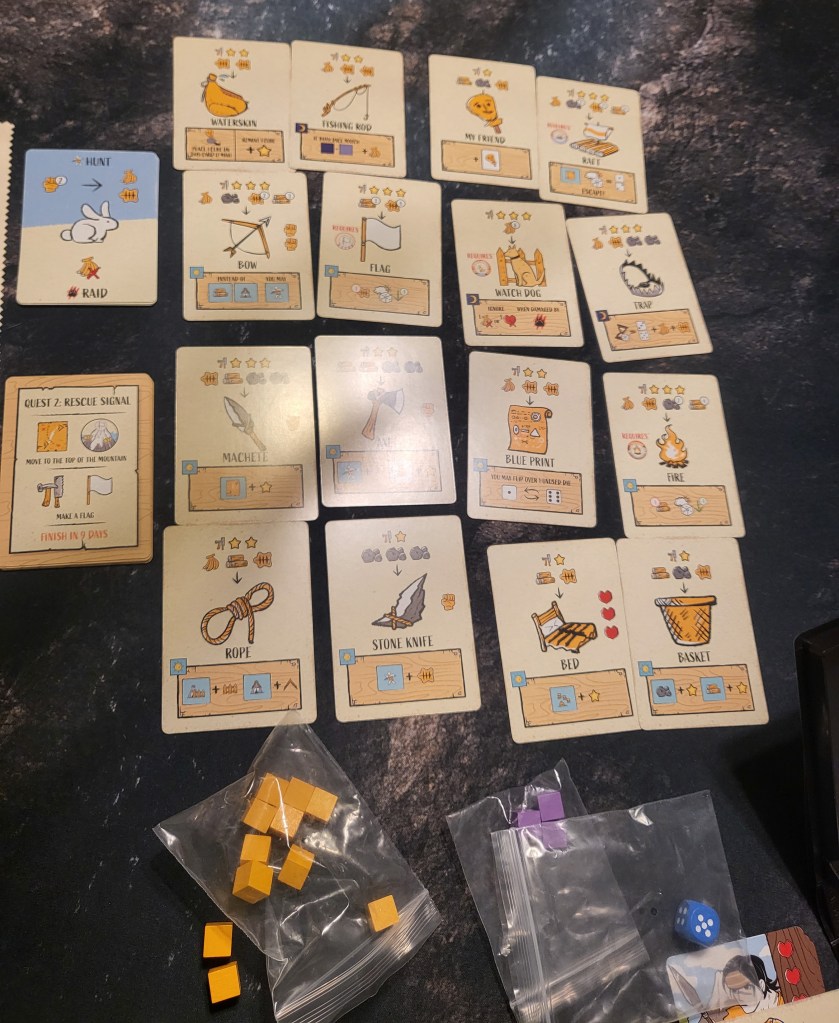
Dieson Crusoe is a solo-only dice-based implementation of Robinson Crusoe. At the start of the game, two microfiber boards are placed on the table – one is a map, and the other is the main player board. Similar to Robinson, tool cards get placed out that are available to build over the course of the game. Players also get to select a character card, each with a different bonus, as well as a friend, also which all have unique abilities. The other selection is for the player to choose a quest – there are seven, each different, and they mostly increase in difficulty as you ascend in number. Once all these selections have been made, the player rolls two yellow dice and one gray die which will be the three dice available in the first round.
The game is played over a certain number of days depending on the chosen scenario (quest), and each quest has specific conditions that need to be met. Each day, the player rolls the dice and advances the event disk, utilizes the three dice to complete actions, and then an end-of-the-day phase occurs which is basically the survival and maintenance step.
Alright, so, step one: to roll all three dice. This is pretty self-explanatory, but it is important to mention that you can use stone acquired in the game to reroll dice at this step if desired. After the dice are set, the event disc advances a number of spaces equal to the smallest die value of the unused dice (I will explain this more later). As expected, the events can be positive (gain resources, get help from your friend, etc.), or negative like increasing the weather dice values or requiring the player to discard food or shelter. One thing to note: at any point in the game, if the player cannot pay the required resources, their character loses one health, and as you can guess, no health means you lose the game.
Before I get into the actions, let me circle back on this event disk advancement situation. There are six dice used each game – five yellow and one gray. At the start of the game, the other three yellow dice (that you don’t initially roll) are placed on three spots on the player board that represent the advancement of the event track, the weather at the end of the day, and the raid situation at the end of the day. I’ll explain these “at the end of the day” actions more later, but the interesting thing about this mechanic is that the dice used in a round for actions become the dice that will be triggered at the end of the following day. Example (see pic below) – the three dice on my player board were the values I rolled the previous day and used to complete actions. The order in which you use the dice determines the spot they get placed on the moon track, so the first die you use will always correspond to the event track movement, the second weather, and the third raiding.
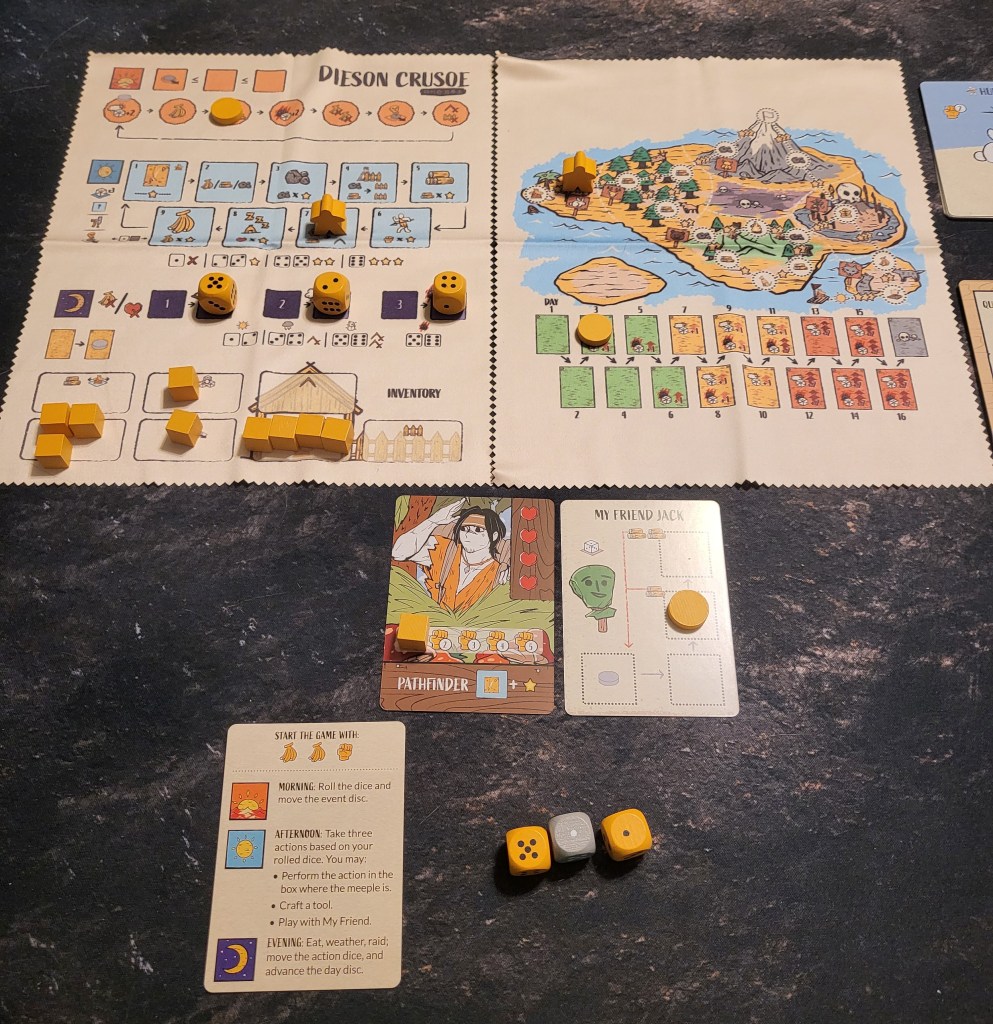
The action phase is the bulk of the gameplay, but as you can see, there are really interesting decisions throughout the whole game. For each of the three rolled dice available, the player selects one and moves their meeple on the action track the corresponding number of spaces (based on the value of the die). The dice typically moves the meeple clockwise, but if the value is one or if it’s the gray die, you may move clockwise or counterclockwise. Also, if you spend one wood resource, you can move the meeple to an adjacent box on the track. Then, you have three options: perform the action in the box where the meeple is, craft a tool, or play with your friend.
There are a variety of action boxes, but they include things like exploring on the map, building fences and roofs, gathering resources, hunting, and resting. I won’t go into detail here, but there is an interesting twist built-in to the action track. Some actions require stars, and when performed, the result depends on the number of stars obtained, which is contingent on the value of the selected die. A value one die = 0 stars, two and three = 1 star, four and five = 2 stars, and six = 3 stars. You may spend one food to temporarily increase the value of the action die by one to gain more stars. An example of when this is important is exploration: each “trail” to the next spot has a specific number of required stars necessary to traverse it. Or in hunting, each animal has a difficulty related to a number of stars, so you must have enough stars to kill the animal.
Honestly, crafting a tool is pretty self-explanatory – you spend the necessary resources to construct something. It’s important to note, though, that some tools require a certain number of stars to be built.
Playing with your friend is mechanically simple – you advance the disc on the card one space. At any time, you can spend one leather to advance the disc one space (or an additional space if you take this action). The benefit of playing with your friend is that each can give you two specific bonuses based on where your disc is located on the card. For example, in my picture, Jack helps me gather wood. At any time during my turn, I can return the disc back to the starting spot and gain either one or two wood.
Once the action has occurred, the dice gets moved to the 1, 2, or 3 space based on if this is your first, second, or third action, respectively. The 1, 2, 3 spaces are those aforementioned spots that correspond to the event disc, weather, and raid situations.
After all actions have happened, the player moves into the evening phase which is where the majority of the negative occurrences can happen. First, you have to eat and therefore lose one food or one health. Then the weather penalty gets applied which is determined by the value of the dice in that spot. The higher the value, the worse it is – a value 3 or 4 means you lose one roof or one health, and a value 5 or 6 means two roofs or two health. Then the raid die comes into play. If the raid die has a value of 5 or 6, you apply the raid penalty based on your current area on the map. Most of them require losing food, health, fences, or some combination of those. Again, anything you don’t have makes you lose health. Lastly, the dice get reset (the ones in the event, weather, and raid spaces get removed and become your dice for the next round, and the ones you just played for actions get advanced into the event, weather, and raid spots), and the day tracker advances (some days have negative effects on them as well which get applied here). The game ends when you either run out of health, run out of time, or successfully complete the quest in the required amount of time.
I apologize if some of that was confusing, but hopefully it gives you a decent overview of the game.
As I mentioned, this is similar to Robinson Crusoe but lighter, faster, less punishing (but still difficult), less involved overall, but there is also less variability. There are seven quests which I like, but you’re doing very similar things in each one – basically travelling to a specific location on the map and building a specific tool or two. They also aren’t anything like the scenarios in Robinson with any sort of thematic elements or story, so the quests can get a little boring and repetitive. They are different enough to warrant trying all of them, in my opinion, and they increase in difficulty at a good rate, just be prepared for some rinse and repeat feelings.
Another note on replayability: besides the seven quests, there is also a standard mode and a hard mode which increases the variability and challenge levels, and there is an alternate rule you can incorporate which replaces a die with a blue die that can be flipped to its opposite side before using it. Also, there are multiple different characters and friends, so the combination of the two can vary over the course of many games, but they’re all similar enough to still feel familiar (which is good for rules overhead but more negative in terms of variety).
The componentry is really nice, especially for the price point of the game. The microfiber playmats are lovely and pack up easily, and there are nice, thick, wooden player pieces. The box is small (a VHS case), and it also doesn’t take up much space on the table, especially in comparison to Robinson Crusoe. The player aid is also amazing. Once you’ve played your first game, besides referencing the rulebook for a card or symbol here and there, basically everything you need to play is on the one-card player aid.
I found the mechanics of this one very clever and the gameplay quite fun. The mechanics themselves are easy but there are still a lot of tough choices. The balance between needing high rolls to get stars with not wanting to place high-valued dice on the weather and raid tracks makes for a really interconnected and intriguing decision space. The action track itself is genius, the event track and day track are thematic and challenging, and the raids changing as you progress across the map is cool.
It’s honestly hard to explain, but everything in this game is so intertwined and every single decision matters, even when selecting your character and friend at the start of the game, so it’s way more strategic and tense than I expected. Not only do you have to try to stay alive, but your dice rolls matter, your resource management matters, your action selection matters, your dice timing and placement matters – it all matters and it’s such an incredible experience and design! Beside the overall minimal variability, Dieson Crusoe is the perfect fun, quick, challenging, simple yet thinky/puzzly solo game.
 The Adventures of Yogi Bear and Delaware
Leave a comment