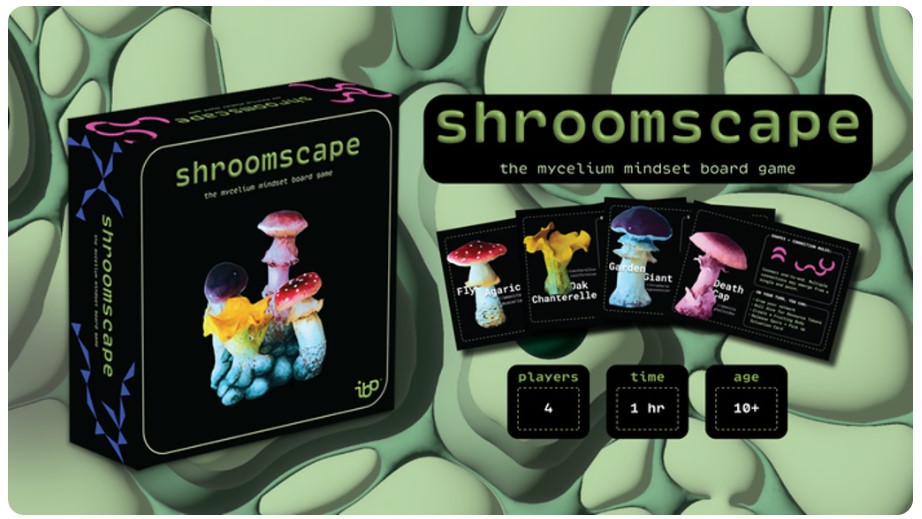
Image taken from https://www.kickstarter.com/projects/shroomscape/shroomscape-the-mycelium-mindset-board-game?ref=nav_search&result=project&term=shroomscape&total_hits=1
Designers: Aloma Antao, Natalie Chester, Camille Girard
Publisher: The Interbeing Project
Artists: Aloma Antao, Natalie Chester, Camille Girard
Before we get into this review, I want to give a massive “thank you” to The Interbeing Project team, as they have been very responsive, flexible on timing, and were gracious enough to send us a copy of this game for an honest review. Also, please note that anything you see and/or read about here is subject to change before final production (ex. the fruiting bodies will match their respective colors better).
With that out of the way, I have to say, I was really surprised by this game. I’m not saying I had low expectations by any means, but we actually had a great time with it! We usually tend to stay away from games that don’t play two players or less since it’s usually just me or the two of us playing, but I’m very glad we’ve been able to experiment with this one. While the game definitely works best at four, our first game we were able to play with three players no problem (you basically only have to ignore a few of the cards – we’ll come back to these).
The main idea behind this game is that each player represents a different type of mushroom that has its own rules for laying down tiles on the board. Over the course of the game, players use their player pieces to form patterns and connections to the different resource locations on the board. With resources, players can put out fruiting mushroom bodies and eventually spores. The first player to place five (or eight for a longer/more advanced game) spores on the board wins.
At the start of the game, each player selects one of the four asymmetric mushroom characters: Fly Agaric, Oak Chanterelle, Death Cap, and Garden Giant, each with their own associated color and mycelium player pieces. The player pieces are different colors, but each mushroom also has its own unique shape and placement rules. For example, the Oak Chanterelle has yellow, cross/plus sign pieces that must be placed end to end on the board, but the Garden Giant has blue triangles that must be connected point to point and with alternating sizes.
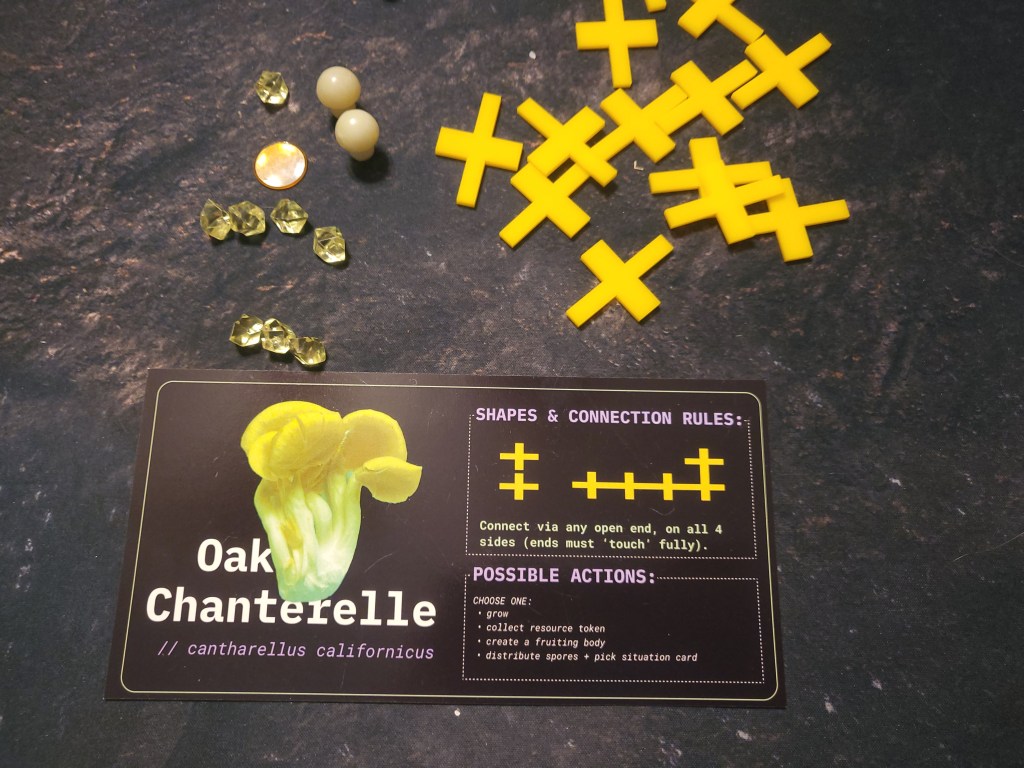
These asymmetrical fungi characters and their related patterns are really the crux of the game. As mentioned, the goal is to use your mycelium pieces to travel across the board to the five different resource locations (a pine tree, an oak tree, a carcass, and heap of manure, and a compost bin), gain resources, and then use those resources to form fruiting bodies and/or expel spores. You’re forming a shroomscape – get it?!
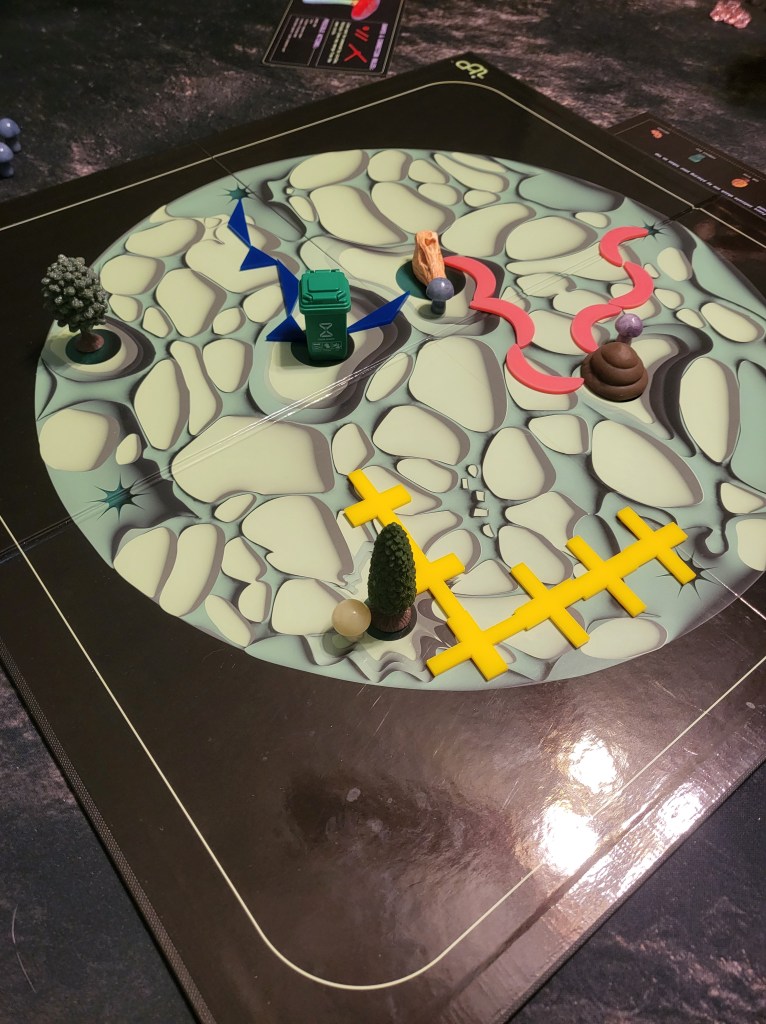
Each turn, a player can either grow their mycelial network by placing a mycelium shape onto the board following the connection rules, collect resource tokens from the locations through the roll of a die, create a fruiting body at a resource spot by spending resource tokens, or distribute spores at fruiting bodies and then draw a situation card.
Growing is pretty self-explanatory, but gaining resources has a few details. First, only one player can acquire resources from a spot each round (two players can’t exploit the same area). Also, when taking this action, a die is rolled – if the value is even, the player gains one resource token, and if the value is odd, two resource tokens.
Creating a fruiting body is easy – you discard two resource tokens to place a fruiting body (a cute little 3D mushroom) next to a resource spot you are already connected to. There can only be one fruiting body per resource spot per player.
Once you have one or more fruiting bodies out, you can alternatively exchange two resource tokens to place a single spore next to an existing fruiting body. There is a limit of two spores per fruiting body, and you may place one spore per turn. Once a spore is placed, that player draws a situation card. Each situation card has a form of action, either immediate or ongoing, that can impact all players or a certain group, or even an individual player. Regardless of if the effect is instant or lasting, that card remains in front of that player until they choose to perform the spore action again and draw a new card to replace it.
Honestly, that’s basically it! It’s very easy to learn and teach, but it’s still strategic and puzzly. The thematic integration helps, but the rules are also quite straightforward, and the rulebook is laid out well and explains what it needs to in detail.
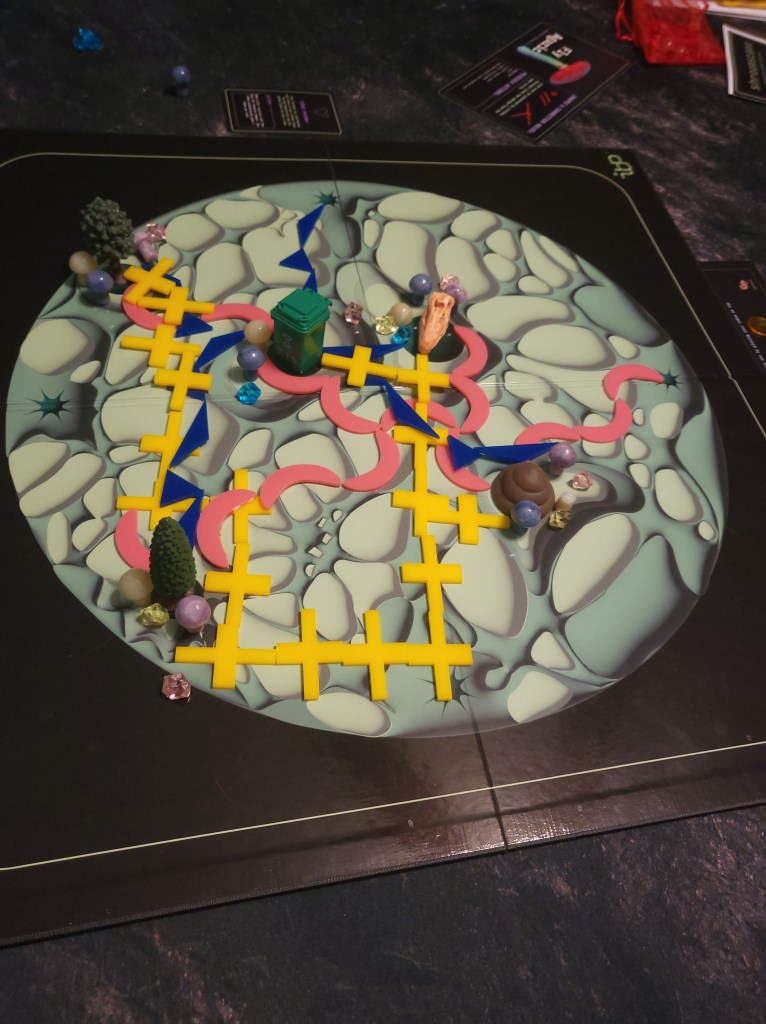
There are honestly a lot of things I enjoyed about this game! Here they are in some semblance of organization:
1) The play time is perfect. We’ve only tried it at the five spore length, but it got tense towards the end and didn’t feel too long or too short. There’s a really nice build over the course of the game that helps with this.
2) The asymmetric fungi and their unique patterns are really neat. Automatically, it provides some nice replayability in the game, as you could play four times with the four different mushrooms and have varying experiences just based on the tile shapes, pattern rules, and the interaction(s) between some cards. For example, some cards only target certain mushrooms, others allow you to form partnerships, and there are even some that can influence the players your mycelial network is connected to on the board. It’s quite thematic and very clever!
3) The cards really make the game. I absolutely adore that they’re all different and I also appreciate that it takes a second for them to get added into the game. Since there are quite a few steps players need to take before they can start distributing spores, the game start off a little slow, but once the cards incorporated, they help speed up the game and make it more interesting and wild. The fact that they remain in the game until another card gets picked is also ingenious, especially since you have to release spores to win. Of course, if you have a negative card, you want to try to get rid of it, but you still must make sure you have the necessary resources and fruiting body to make that happen. On the other hand, if you have a positive card, it can be challenging to balance the timing in terms of when it’s worth it to replace it to get another spore on the board. The cards also seem to help in preventing one player from really running away with the game. While there is some luck in this game, the cards seem to help override any extreme luck (always a plus).
4) The action selection part of this game is pretty cool. There are obviously some natural choices, especially towards the beginning and end of the game, but there is still quite a lot of decision making and turn optimization which I love. The actions are also very thematic which helps them make more sense and be more enjoyable.
5) There is really nice player interaction in this game. It’s present but not overwhelming, and there can be some mean cards and selfish choices, but they’re not savage. There is also enough positive interaction in the cards and through the interconnectedness of the mycelial networks that the negative can be balanced well, and potentially even outweighed.
6) The componentry is stellar!! Everything adds a nice tactical element to the game that increases the thematic immersion and enjoyment of the game. The resource tokens are chunky, the mycelial pieces and spores are cool, the 3D fruiting bodies are adorable and appropriately shaped, and the resource spot items are phenomenal! The recycling bin can literally have stuff put in it, and the pile of poop is legitimately squishy! It’s so fun! The art is also very pretty with the inclusion of psychedelic colors.
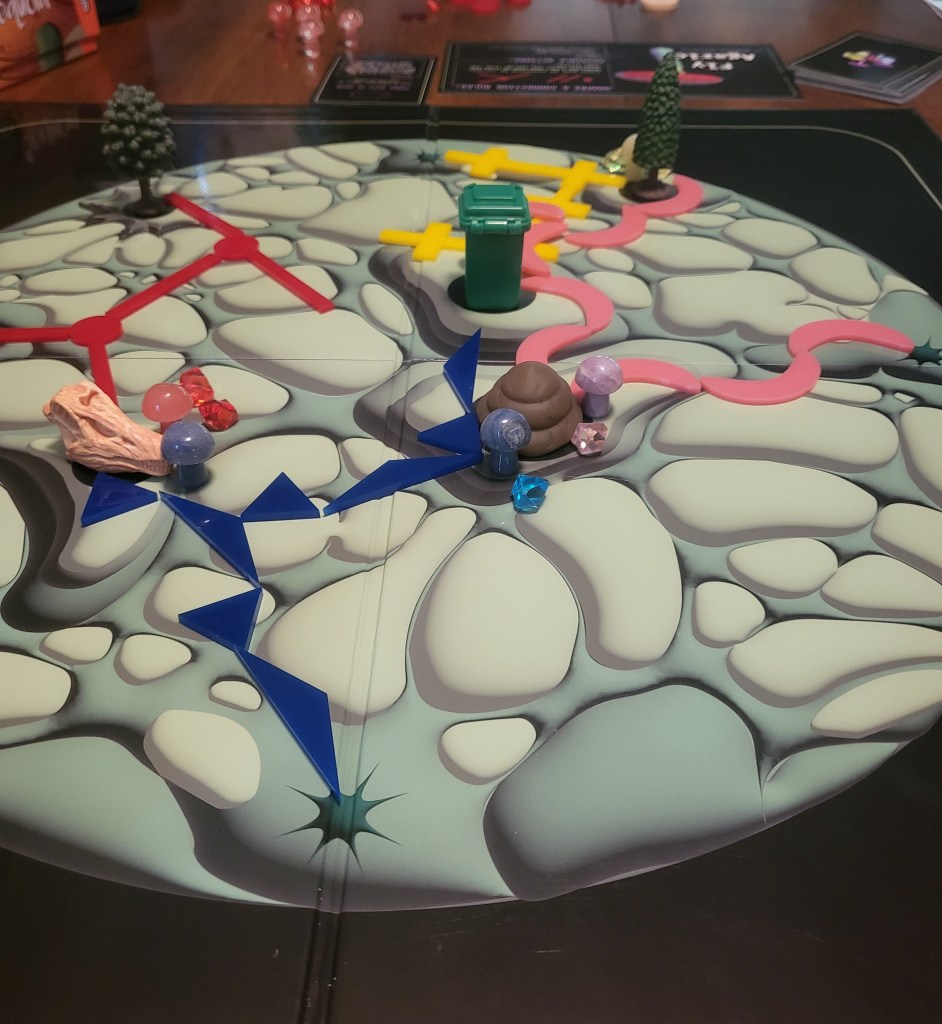
They are minimal, but we do have a few minor critiques. First, the Death Cap’s pink banana-shaped mycelial pieces seem easier than any of the other mushrooms. They have minimal rules and the shape provides a lot of accessibility across the board, so they seem to be a little unbalanced. Also, while the replayability here is pretty solid, if you played the game too much, I think the situation cards could get a little repetitive. Also, knowing the cards too well could influence mushroom selection at the start of the game since you would know many of the partnerships and outcomes. That said, there is some strategy that could play into that as well. Who do you really want to be partnered with, how big of a challenge do you want, and which card effects do you want to impact you? Lastly, and maybe most importantly, while it is fun and rather tactical, there’s really not a lot of strategy to the game. There is some solid decision making required in terms of action selection and overall timing, but much of what happens gets determined by the game itself – you can only plan so much.
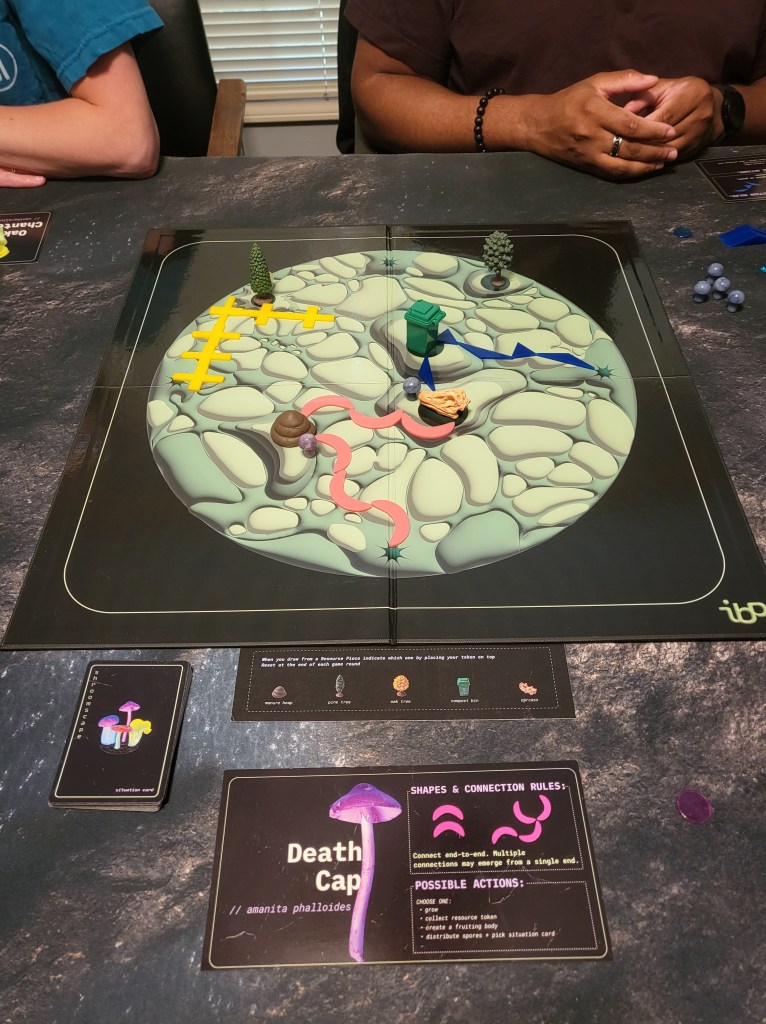
Overall, this game is very interesting and fun. In terms of mechanics and game play, you definitely have to try plan ahead, but there are also interesting tactical elements in terms of the situation cards and based on what other players are doing. It’s slightly abstract in the mycelial pieces aspect, but exceptionally thematic otherwise. It provides a really neat twist on a standard pattern-driven tile laying visual puzzle style game with a well-integrated and well-thought-out theme, and an interesting decision space. The cards keep it exciting and fresh, there is solid player interaction, and the components help keep you immersed in the game, even during the more abstract parts.
As my friend summed it up, this game is about three things: grow, expand, explode.
We highly recommend checking this one out when it comes to Kickstarter this fall!
 The Adventures of Yogi Bear and Delaware
Leave a comment