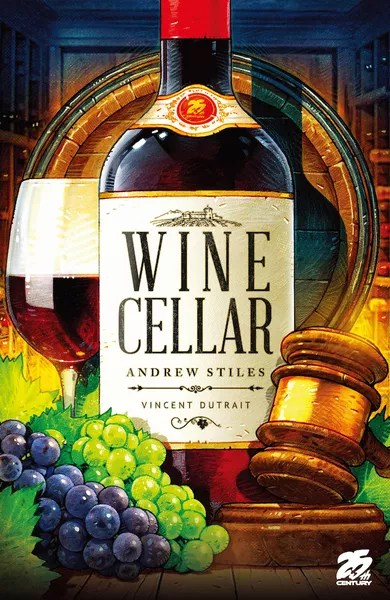
Image taken from https://boardgamegeek.com/image/7960466/wine-cellar
Designer: Andrew Stiles
Publisher: 25th Century Games
Artist: Vincent Dutrait
The first thing you should know before reading this review is that the husband and I are huge wine fans. We aren’t usually big on bidding games, but once I saw the theming (and price, honestly) for this one, I preordered it immediately, and I’m so glad I did!
Wine Cellar is a simple bidding game that plays 1-8 players. In the box, there are client cards (we will come back to these), seventy-two different wine bottle cards numbered 1-72, a scoring sheet, and it even comes with a pencil! Depending on player count, at the start of the game, a certain number of wine bottle cards get shuffled, and each player receives eight. There will be enough left over for one bottle per player to be placed in the central bidding area. After all players have their bottles, they also receive two client cards, choose one, and discard the other. Each client card identifies specific wine types and countries of origin that person likes. One of the goals of the game is to acquire wine bottles to make your client happy based on those preferences.
Now that everyone has picked a client and has eight wine bottles to use for bidding, the first round begins. Each player selects one wine card from their hand and places it face down, then all players reveal simultaneously. The card’s printed numerical value is its bidding value. Then, in descending order, players select one wine bottle card from the central area starting with the highest bidder. As players acquire wine bottles, they start a wine cellar on the table in front of them by placing the wine bottle on its side (how it’s supposed to be stored). Once everyone has a wine bottle and has placed it in their cellar, the next round begins.
This is where it gets interesting. The cards used to bid in the previous round become the new bottles for auction. For example, if the 17 gets played as a bid, the next round, 17 is up for auction. Play continues as such until everyone has bid all their cards and has eight wine bottles in their cellar. However, there is one other clever mechanical caveat. As the players accumulate wine bottles, they must be placed in their cellar adjacent to one that is already in the cellar (besides the initial one of course). But, once two bottles are next to each other, no new wine bottle can come between them. Basically, the bottles must be added to the top or bottom of the current stack, never in between.
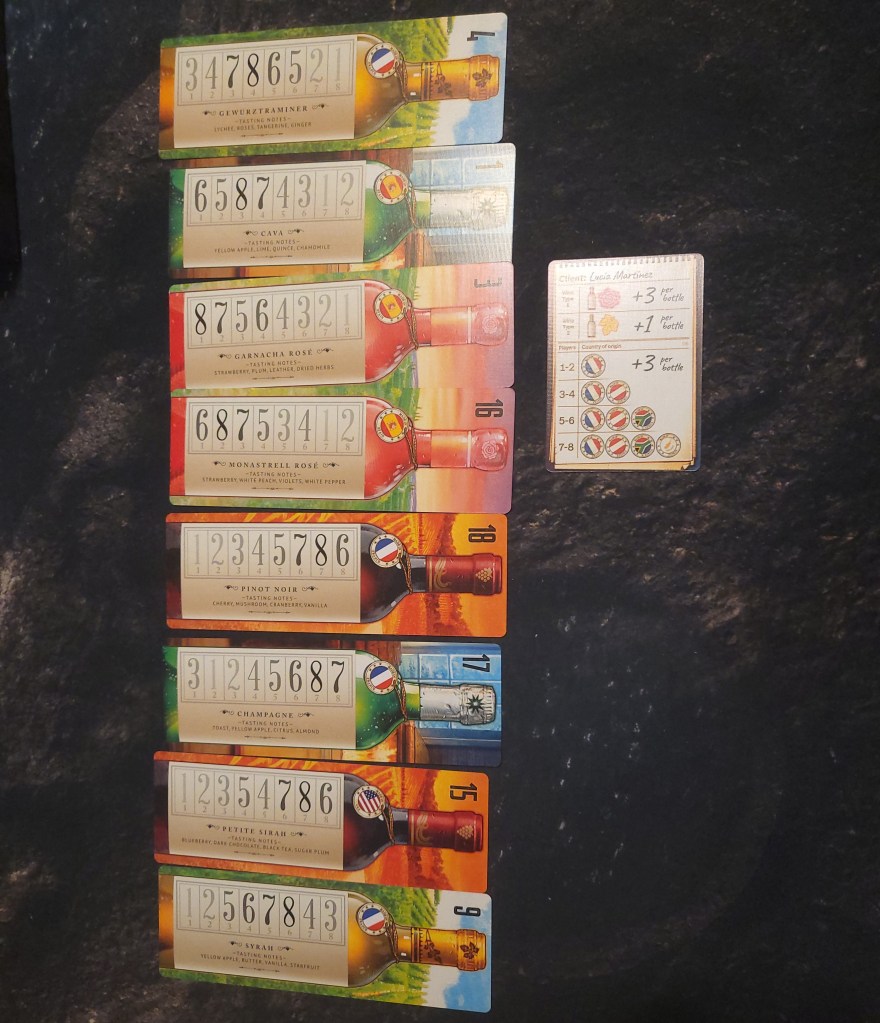
Why is this important? For scoring! Besides the points achieved based on how well your cellar aligns with the preferences of your client, you also score points from the bottles in your cellar. Each bottle features a row of eight “Age Scores” representing the quality of wine at the time of opening. Starting with the top bottle, each player scores the associated value with where it is placed in the cellar. In the example below, the Gewurztraminer scores 3 points for being in the first spot, the Cava 5, etc. all the way to the Syrah with 3 as well (basically it scores on a diagonal from top left to bottom right).
As (almost) always, the player with the most points wins! Truthfully, most games we have played have been very close in scoring, which I like. It’s not a super tense game (which I also like), but there is still a puzzle to solve, and some strategy involved in trying to optimize your wine cellar.
Overall, this is a gem of a game. It’s simple to teach and quick playing but still offers some interesting decisions and the opportunity to strategize and plan ahead. The wine bottle cards are all unique and have information on the wine including type, country of origin, and most important, tasting notes! This game can actually be used as a wine education tool, and the cards are also gorgeous and could be made into a collage and framed as art (seriously). Additionally, the theming is great and, while it’s not really relevant in the bidding process, the cellar formation is rather thematic. Wine Cellar also has a great player count range and doesn’t increase the playtime too much with more players.
The solo mode is interesting. Essentially, you pull random cards from a stack of eight (technically the hand of a player named Eno) when bidding and still build a wine cellar as normal. In the first round, Eno flips over two cards (to your one) and you compare your bid value to both of those showing on his cards. If your bid is the highest, you choose the bottle you want, and Eno gets the other. As always, the card you bid goes in for the next round of bidding, as does Eno’s lowest value bid. If your bid is lower, however, Eno takes first pick based on his client’s preferences, and then his higher value bid is what enters the next round’s bid. At the end of the game, you compare your score to a beat your own score chart and figure out how successful a sommelier you are. I’m not saying the solo mode is great, but I really appreciate the inclusion of it. It’s still fun, easy and quick to play, and a fun way to explore the game a little more.
One other noteworthy part of this game is the replayability aspect. The more players you have, the more wine cards get used (and they’re all unique), and the more combinations you can have. The different clients also provide some variability from game to game and can help guide your strategy making each play feel different enough. There’s also an advanced three game variant included in the rules that we have yet to try, but it seems neat!
Honestly, we can’t recommend this enough unless you really hate wine. 😂 It’s fun and there is more strategy than initially meets the eye. The formation of the wine cellar is tricky and getting it perfect seems nearly impossible to achieve, but the scoring of that section is very cool and innovative. It’s a winner!
My only teeny tiny complaint – why are there so few sparkling bottles?!
 The Adventures of Yogi Bear and Delaware
Leave a comment