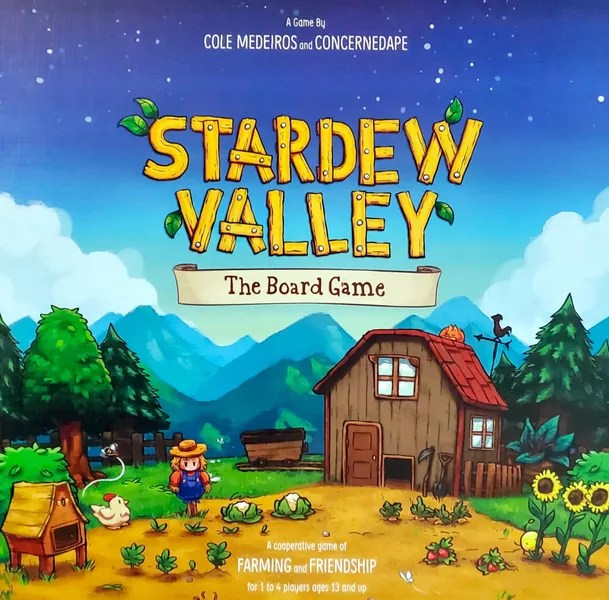
Image taken from https://boardgamegeek.com/image/6037615/stardew-valley-the-board-game
Designers: Eric Barone, Cole Medeiros
Publisher: CorcernedApe
Stardew Valley (the Board Game) is a sandbox-style game where players work together to achieve goals and help the town. In the solo mode, gameplay is exactly the same as multiplayer except, in the set-up, you can choose a profession instead of automatically getting the one associated with your player board. Everything in this game is done by player count which is why the solo experience is identical – the goals get proportionally “easier” because you only need to achieve them for one player. It’s honestly a pretty clever idea.
I’m not going to lie, the set-up for Stardew Valley is rather tedious (think Robinson Crusoe level). There are a lot of pieces and cards that need to be placed, shuffled, organized, etc. After that, though, I find the gameplay very smooth, enjoyable, and rather relaxing. You’re working towards goals, but one thing I love about this game is that it really encourages the players to just enjoy the adventure and not stress about competing against others or rushing to finish everything. Obviously, those that are competitive will want to win (and I’m not saying I don’t), but most of the time, I just do what I can and see what fun experiences I have. With varying levels of difficulty to try and numerous card and tile combinations, no two games are truly the same. Gameplay can get slightly repetitive but the unique set-up and construction of each game eases that some.
Each game, you play rounds through the four seasons where you take actions and move around the board to achieve grandpa’s goals and help restore community rooms. Each round has three phases: the season phase, the planning phase, and the action phase.
In the season phase, you flip over a season card from the season deck and follow its instructions. The season deck determines the number of rounds – once you get to the bottom, the game ends. Thankfully, for the season phase (and the action phase), the rulebook provides ample information on what each symbol means, so everything is easy to carry out.
For the planning phase, the players discuss which actions they will do this round. In solo game play, this is all self-dialogue, so this phase takes about thirty seconds (or five if you’re like me and you decided at the end of last round what you want to do).
The action phase is the meat of the game! Here, you have the option to take an action, move, and take another action, or you can remain in one location and take two actions. I won’t go into much depth on any of the actions, but hopefully this will provide an idea of the feel and structure of the game. In the farming department, you can water crops, buy buildings, buy animals, collect from animals, and buy and plant seeds. In town, you can make friends and donate to the community rooms (called bundles). Around the board, you can explore the mine, open geodes, donate to the museum, or go fishing in three different locations. There are other occurrences in the game when you move and at the end of the round, but this covers the majority of gameplay.
Grandpa’s goals and the community bundle requirements all revolve around one or more of these actions. For example, I played a game where grandpa’s goals were to have (at the end of the game) ten gold per player, one building per player, three friends per player, and one animal per player. The bundles work the same – everything needed to restore the rooms is determined by player count and can be encountered in the game.
Truthfully, I’ve never played the video game equivalent, but I have to say, I really enjoy the board game. With grandpa’s goals and the bundles, you have achievements to work for that can guide your actions, but you could also just frolic around the board for fun if you want! It’s a very unique and pleasurable gaming experience. It’s perfect for when I want to smile, chill, and pretend I’m a farmer. 👩🌾 Oh, and the box comes with FABULOUS organizers – major bonus!!!
 The Adventures of Yogi Bear and Delaware
Leave a comment