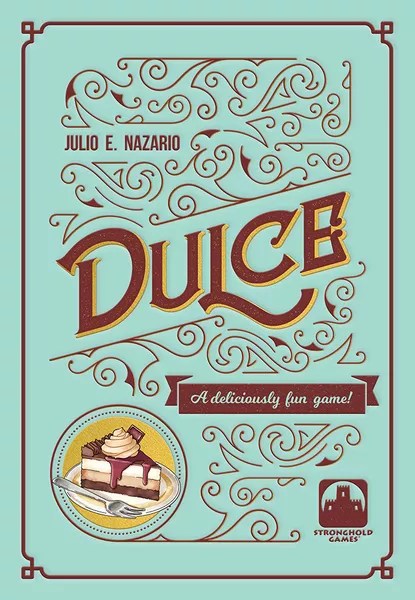
Image taken from https://boardgamegeek.com/image/6978821/dulce
Designer: Julio E. Nazario
Publisher: Stronghold Games
Artist: Justine Nortjé
In Dulce, each player gathers resources and constructs cafés to produce confections and score points. Every round, players draw a card and simultaneously decide if they want to use that card to plant fields, harvest crops, or build a café. Interestingly, all players will be using the same card each turn, so the only way to win is to optimize the cards and build a better engine than other players. The solo game is essentially identical to the multiplayer version with a beat your own score chart for comparison.
Here is the flow of each turn:
One person draws a card and each other player finds their respective matching card. Each player then decides if they want to play it as a field, use it to harvest crops, or construct a café.
If you choose to plant a field, the card gets played on your player board with the field/resources side up. Each card has four fields/resources, so once your card gets played, you gather those four resources and place them on that card. If you place a card so that a field matches the field type directly below it, you get an extra resource on the new field. Cards can be rotated and can either fully or partially cover previously placed cards and/or the four starting cafés on your player board. If you place one that covers a field with an existing resource, you get to use that resource to feed your chickens (we will come back to this later).
If you choose to construct a café, you play the card to the side of your board with the café side up. Each café has specific ingredients needed to produce confections.
The last option is to harvest crops. With this action, you discard your card and select one row or column in your field that you would like to gather resources from. Once you have the resources, you choose which café(s) in which you want to utilize those ingredients. As mentioned, different cafés have unique ingredient requirements, but also, each café needs a certain quality of these ingredients. For example, the starting cafés all need the highest quality ingredients which are represented by three rings around the ingredient symbol. Other café cards could have ingredients with one or two rings meaning they can use the byproducts of the original quality ingredient. So, if you use one of your starting cafés, you can then move that resource onto another card that has that same ingredient with one or two rings, and it can be used again. Similarly, you can move an ingredient from a two-ring spot to a one-ring spot. Each café that gets completed provides one victory point (cafés are the only way to score points in this game).
If you replace a field with resources (as previously discussed) or if you have a two-ring or higher resource you cannot utilize in a café, you can use those to feed your chicken. Your chicken advances on the same track as your meeple (your meeple keeps score), and at any time when filling your cafés, you can move your chicken back three spaces and take an egg, which is a wild resource. It does not follow the usual pattern for the rings – eggs are always one and done.
The strengths of this game lie in the fact that it’s easy to learn and teach, it’s quick, light, and it’s a nice little baby engine builder (or it could be a good introduction to engine building). It’s not spectacular, it’s not a major brain burning puzzle, it’s just a chill game with a nice theme. As someone who prefers more puzzly aspects to board games, this one didn’t totally hit. I didn’t mind it, but it’s not one I can see myself consistently wanting to play.
It’s very much a multiplayer solitaire experience. There is zero player interaction at any point in the game other than matching cards. Also, even though it’s a lighter game, we found it challenging to still socialize while playing because turns can substantially vary in time/length.
The components, especially the resources, are very nice and thematically shaped. But why are the resources bigger than the chickens?! And why are the chickens bigger than the people?! I understand the meeples need to be small to fit on the player boards, but it’s a little ridiculous.
The solo game is enjoyable, but again, it’s not one I want to continually play. It was fun to try out the puzzle a few times, and I definitely didn’t get any scores high enough to be on the top level of the score chart, but there isn’t enough mechanical substance to keep me coming back to try for a better score. With only one scoring condition, so there aren’t many different strategies to try.
Overall, thematically, this game is great. For a light, simple, intro engine builder, it’s perfect, but for anyone wanting anything more than that, I’d look elsewhere.
 The Adventures of Yogi Bear and Delaware
Leave a comment