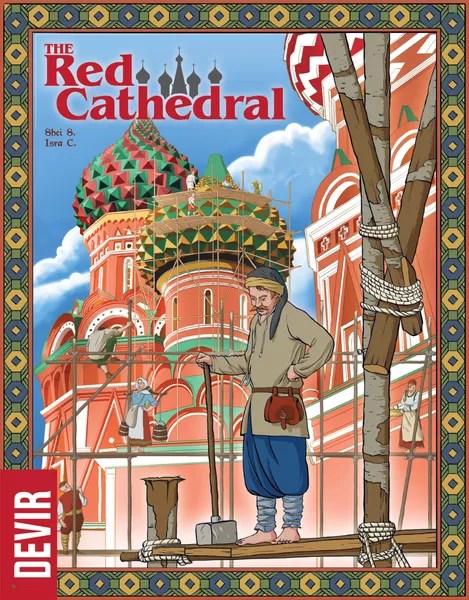
Image taken from https://boardgamegeek.com/image/5556025/the-red-cathedral
Designers: Isra C., Shei S.
Publisher: Devir
Artists: Chema Román, Pedro Soto
The Red Cathedral is a game about, well, constructing the Red Cathedral (shocking, I know). Over the course of many quick rounds, players gain resources and work to build sections of the cathedral and adorn it with ornaments and decorations. To do this, players move colored dice around a rondel, acquire resources, gain bonuses, and activate workshops. Once one player has completed six sections of the cathedral, the game ends.
Let’s talk about this dice rondel for a second. First of all, I love a good rondel. I find the general mechanic of a rondel amazing, but The Red Cathedral really has a solid implementation of it. There are five different colored dice, and each turn, if the player chooses to use the rondel, they select one die and move it based on the value (number of pips) of the die. Wherever they land, they gain the associated resource where the quantity they receive is based on the total number of dice in that location. Then they have the option to perform actions available on a card in that quadrant, and they can also choose to activate that color die’s workshop on their player board (we will come back to this in a bit).
The brilliance behind this stems from the interconnectedness of the dice and the outcome. The fact that the die moves the number of spaces based on its value, then allows the player to gain resources based on how many dice are in that location, and then the player can choose to activate that workshop means there are multiple layers to the strategy behind this. And that doesn’t even include the use of the card in that quadrant nor, one thing I didn’t mention, players spending money to move the die associated with their player color additional steps.
Next, I’ll discuss the action of claiming a section of the cathedral. If a player doesn’t want to use the rondel, they can take one of the banners from their player board and place it on any of the cathedral cards to claim it. When a section is claimed, it means no other player is able to build that section, but they can still add decorations after it’s built. Besides the actual claim, the other important and intriguing aspect to this action is that each card constituting the cathedral has a workshop tile on it (at the start of the game). When a player claims a card, they can either discard the workshop (removed from the game) or they can pay money to place it in one of the spots on their player board and immediately activate it. These workshops can provide resources, points, or have a specific die on it. If there is a die, it means the player gains the resource associated with where that die is in the rondel. Like I said, it’s all intertwined! This is the same workshop I previously mentioned that can be activated during a rondel turn.
The last action option is to spend resources to build sections of the cathedral. This is pretty self-explanatory, but I do want to point out one interesting caveat. Each time you build, you are allowed to spend up to three resources, and you can split them amongst your claimed cards however you choose. But, besides placing them on your card sections, if any section is already completed, whether by you or an opponent, you can spend one or more resources to decorate instead of using them for your cathedral section (as in this would count towards the three you can spend). As the game progresses, this creates a precarious balance between spending resources to complete sections (and how quickly you want the game to end) and trying to utilize the ornaments, as they help score points.
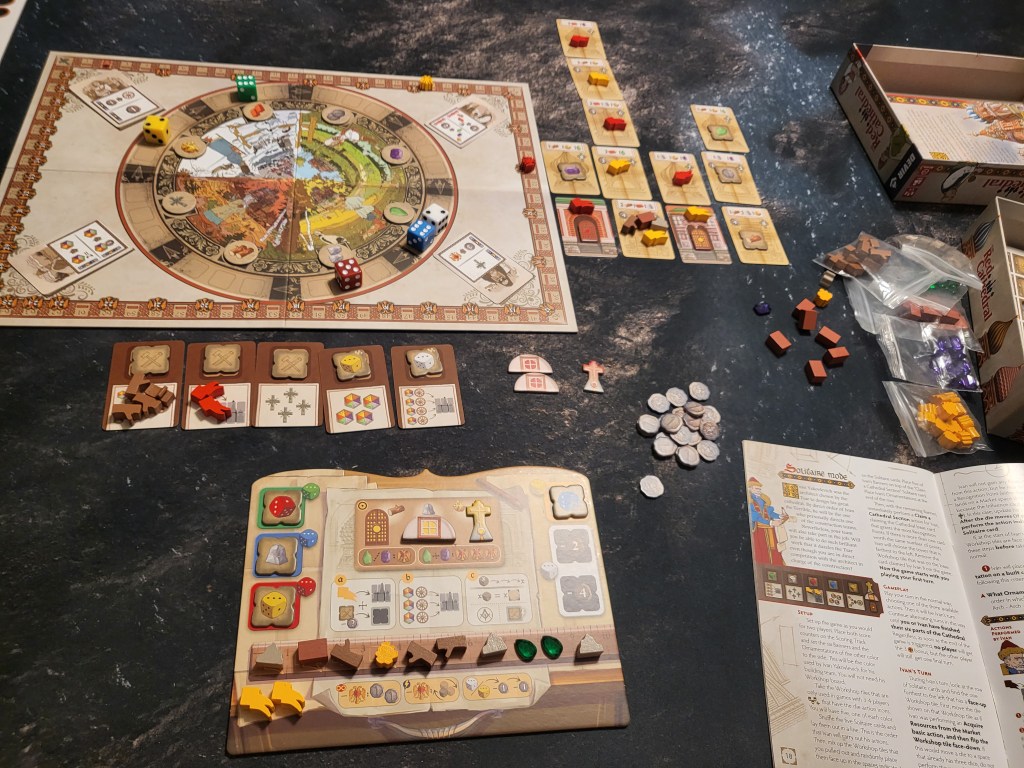
I won’t get into the scoring, but there is one interesting aspect that I want to call attention to. Throughout the game, there are ways for players to score points as well as prestige, which are two different things. Points move your scoring marker up one space each time they are gained, but prestige has specific markings on the scoring track that can have varying distances between them. At the lower numbers, the prestige markers are more spread out, and towards the higher numbers, they basically become the same as points, as there are no extra spaces between them. The reason this is so intriguing is because at certain times in the game, when you gain prestige, that can mean very different things. It could be the same as five points or one point, so the action selection and related outcome(s) are consistently crucial to consider.
Now that I’ve gotten my short and holey explanation of this game out of the way, I need to share some thoughts. If you can’t tell, I find the mechanics of this game very clever and well designed. I adore games with an interconnected nature, and this one fits that perfectly. I also appreciate how the end game gets triggered and how much control the players have over it. And the two different scoring tracks are also really fascinating.
Besides the mechanics and design, I also find the theme and artwork lovely (very fitting for the theme and its represented time period) and the componentry is stellar, especially for a game at this price point. Nice chunky resources, smooth gems, thick player pieces – they’re all great. The turns are also quick causing very minimal down time between player actions. This also helps in terms of play time – it can be a 60-90 minute game but it goes by quite quickly.
Regarding player count, it worked well both solo and with two players, but I could see this being even more interesting with more players. The time would likely increase some, but there’s enough interaction with claiming and building the cathedral, it would be fun to see how that plays out. I like that this game has solid player interaction, and while it can be directly mean, it’s not to only punish the person; you still get something out of it.
Success in the solo game is quite dependent on luck. I’m usually not one for a lot of luck in my games, especially euro style games, but this luck is potentially manageable. In the solo game, you play against Ivan himself, and his turns are dictated by five cards that get shuffled and randomly placed in a line. Each of his cards has an action on it – gaining points, gathering resources, moving resources onto the build card, using those resources to build sections of the cathedral, and claiming a cathedral section. Because he needs to claim a section, then gather resources, then move the resources onto the build card, and then use them to build, the order of the cards can significantly impact how quickly he can start constructing.
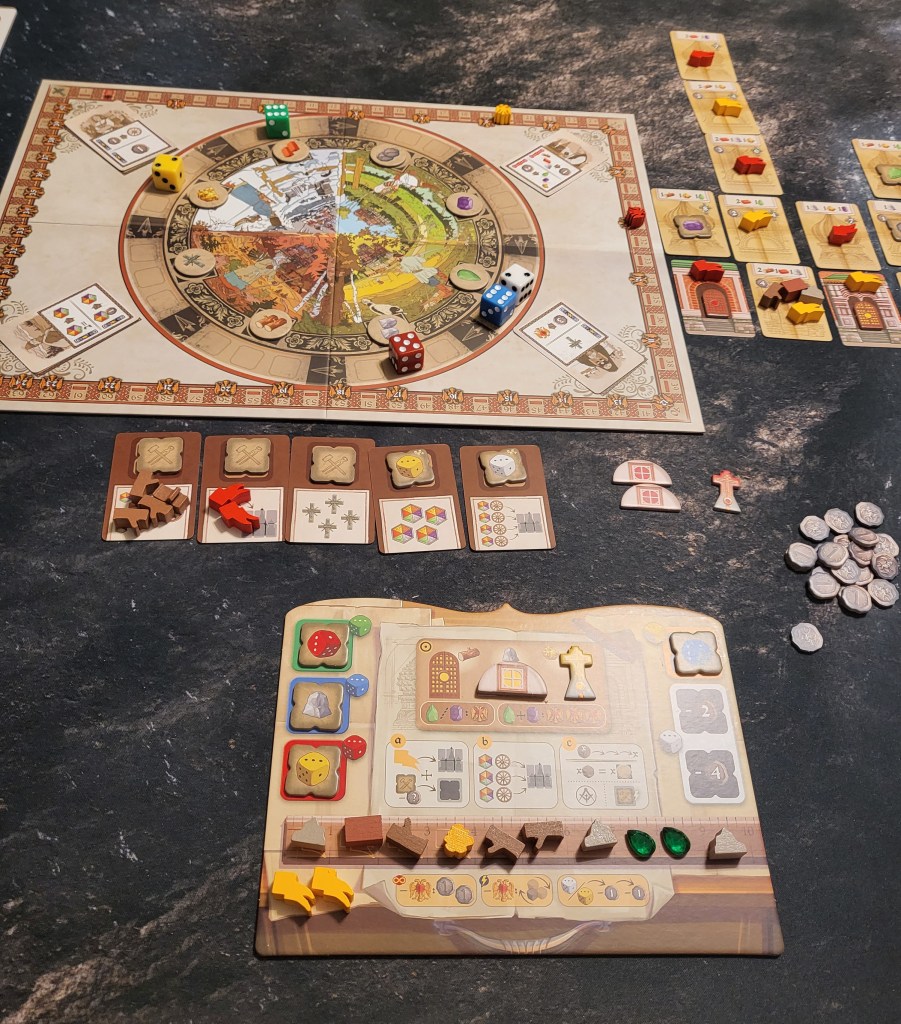
Having said that, there is one important detail. Because you know the exact order in which he will take his actions, it is possible to plan ahead and incorporate that open knowledge into part of your strategy. In a multiplayer game, what your opponent does is completely unpredictable, but that’s not true for Ivan. A huge chunk of strategy in the solo game stems from understanding Ivan’s turns and how you can maximize your turns while keeping an eye on him. I truly love solo modes that do this – it makes the game so much more strategic without adding complexity. I will also add that his “bot” is very easy to facilitate and maintain, which is always a plus.
The other intriguing aspect of the solo game is that each turn, based on a random distribution, Ivan also moves one die based on the standard movement rules. I’m glad they included this because the rondel would get very stale quite quickly if he didn’t move any dice. Even though they get rolled after moving, only having one person alter the state of the rondel could be challenging to overcome.
My only real complaint with this game is that I wish there were more artisan cards for more variety, as well as two player cathedral layouts. I think it would make games feel less similar and slightly more exciting and variable.
I find the game overall unique in terms of how the dice are used and relocated on the rondel, how resources are acquired, how they need to be spent, etc. It gives me some Crown of Emara vibes, but I think I enjoy this one slightly more, though I like both. I also have to say it was lighter than I was expecting, but not in a bad way. I assumed it would be more on the medium euro level, but despite the need for interesting strategy and decision making, it’s not a complex or particularly challenging game. It’s quite accessible for those that typically prefer lighter games and want to experiment with slightly longer, more in-depth games, but heavy gamers will also find it enjoyable.
I know I’m a little late to the game with this one, but it seems rather timeless. It’s just very elegant in terms of design, game flow, and artistry, and I really appreciate everything it offers.
P.S. In case you missed it, there is a fan-made story campaign for this game on BGG that seems really neat. I tried to play it solo, but it’s definitely intended for a multiplayer game.
 The Adventures of Yogi Bear and Delaware
Leave a comment