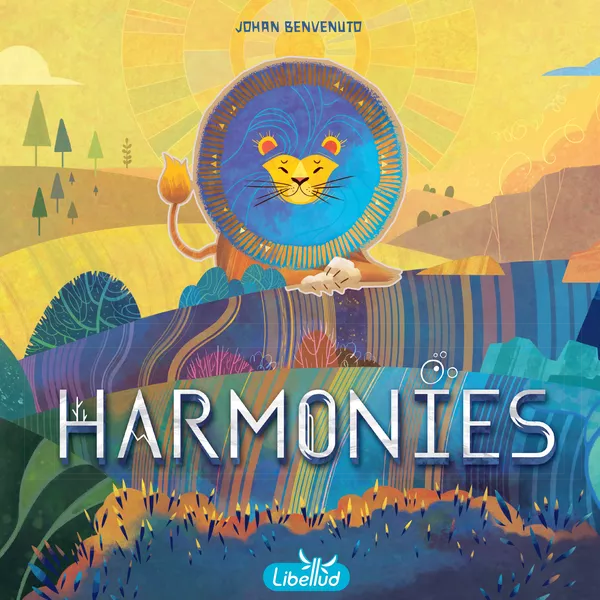
Image taken from https://boardgamegeek.com/image/8026369/harmonies
Designer: Johan Benvenuto
Publisher: Libellud
Artist: Maeva da Silva
This game makes me so happy. People talk about those feel good, cozy games, and this is a prime example. The first time I learned about this game, I knew I wanted (no, needed) it. I preordered it, but I ended up buying a copy on Amazon as well because I grew impatient. 😂 I obviously found a loving home for the second copy, but I’m so glad we got it when we did. We were able to take it to a gaming weekend with some friends and we all really enjoyed it! I’ve also played it solo many times (through the Melodies solo campaign that can be found on BGG), so we have already gotten serious use out of this one! What’s not to love?! The artwork is beautiful, the game has quality components, it’s very accessible but the design and mechanics create multiple avenues to victory and multiple strategies to explore, and each game feels very different lending itself to great replayability.
In Harmonies, the players draft tokens representing different landscapes (five total, hence the quintet title) to build a harmonious (pun intended) environment for creatures to live. Each turn, players draft three tokens from a center board (the drafting has been likened to Azul). In the multiplayer game, there are five groups of three, in the solo game there are three groups of three. Once a group is selected and drafted, the players must place all three tokens on their player board. There are no restrictions to where you can place them as long as they follow the standard rules of the game. My favorite part of the token drafting is that once a spot has been taken, the board gets refilled before the next player’s turn, so there are always five options available. This is different (and in my opinion better) than Azul because now there’s a significantly smaller chance you’ll end up with tokens you can’t use. At the end of the game, each environment type scores differently (and the streams score differently depending on which side of the board you use!), so there is actually a lot of strategy that goes into the placement decisions. For example, the mountains only score if there are one or more of them adjacent to each other (thematically, you have to at least have a small mountain range, you aren’t able to score a solitary mountain).
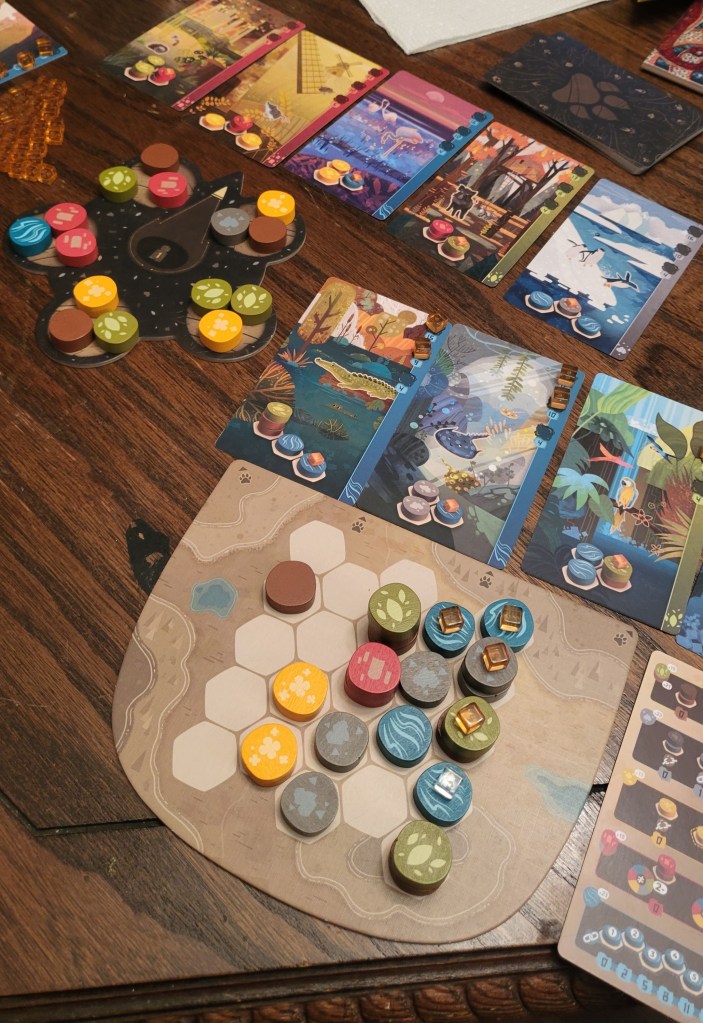
Besides the physical environment, the other main goal of the game is to collect animals and place them in your habitat(s). Each animal card has a specific pattern of terrain tokens that must be present on your board to have that animal live there. Each animal card has spaces for cubes (somewhere between two and five, depending), and when the specified pattern is achieved, you remove a cube and place it on your board on the location identified on the card. You’re only allowed to have a maximum of four animal cards at a time (including any Nature’s Spirit cards which I’ll come back to), so you have to be conscientious about which animals you can likely actually fulfill. There is no limit to the number of animal cubes you can place per turn, but you can only get a maximum of one new animal card each turn.
The other tricky part about the animals is the placement of the cubes. Often, there will be animals in the display that have overlapping/similar habitat needs, but it’s also possible that the cube for those animals will need to be placed on the same location (even more to think about!). Only one cube can be placed on each token, and once a token has a cube, you can’t build anything on top of the cube.
One other small caveat: there are also Nature’s Spirit animal cards you can elect to incorporate in the game. If you want to add them in, you simply deal two to each player before the game begins and they choose one to keep. These animals work similarly in terms of needing a specific pattern, but they only have one cube, so once you meet the pattern, you can move that card and make space for another animal. Each Spirit card has end game scoring conditions that add an extra layer of challenge and strategy. I like playing with Spirit cards now that I know how to play, but I admire that the base game doesn’t need them because it was easier to learn (and teach) the game with the standard animal cards only.
The solo mode is very similar to the multiplayer, but you’re basically working to beat your own score. The other main difference is that instead of just refilling the one spot of tokens, the whole board gets reset. This can be tricky – you have to balance which tokens you can sacrifice by not taking them vs. which tokens you need to use. I also appreciate the constant refreshing to allow more consistent variability and options. The Melodies scenarios create a campaign where you are given certain animals that you must finish (as in all the cubes need to be on your board) in order to complete that chapter of the campaign. It’s very well designed in terms of animals that cohabitate well together, and it also allows you to play with every card in the game, so you really get a chance to experience the game’s full breadth.
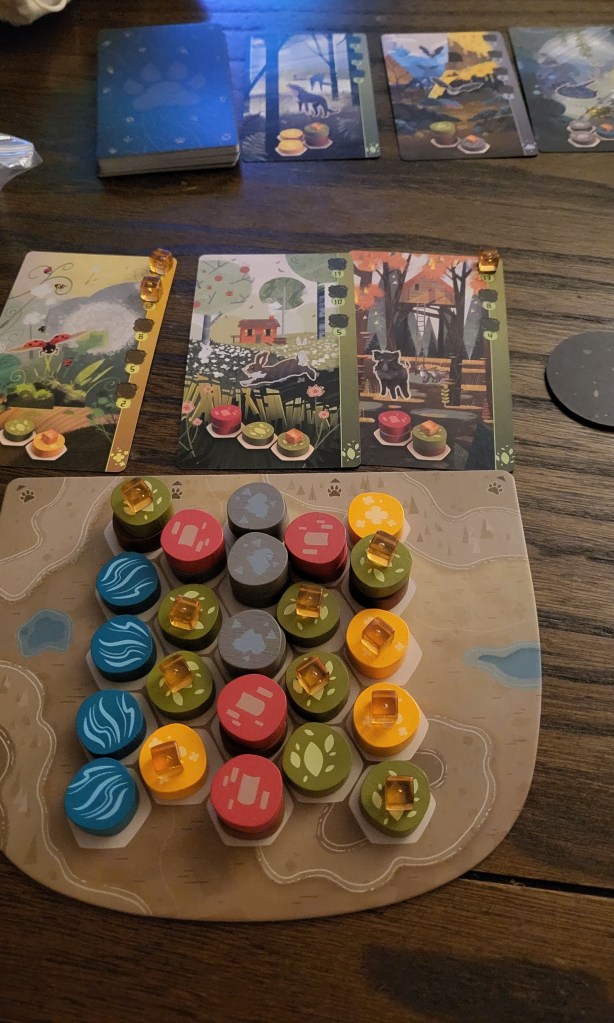
I feel like I did a terrible job of explaining the game, but overall, it’s very simple but it has a really good amount of puzzliness. The only negative is that, selfishly, I wish it played five players because our usual gaming group is five, but that has absolutely nothing to do with the quality of this game (I had to come up with at least one con, right?). It’s super cozy and happy, the game length is perfect, it’s easy to teach, hard to master, has lots of scoring possibilities and strategic avenues, high replayability, solid componentry, scales well across player counts, is very easy to get to the table, it’s reasonably priced, and is a real crowd pleaser. The husband and I both highly recommend this one!
 The Adventures of Yogi Bear and Delaware
Leave a comment