Image taken from https://boardgamegeek.com/image/8156363/deep-regrets
Designer: Judson Cowan
Publisher: Tettix Games
Artist: Judson Cowan
Deep Regrets is an original, goofy, strategic, fun game about regrets, fishing, monsters, and more! The solo game and multiplayer game play very differently, so this review will essentially be separated into two parts. Overall, though, this game is a keeper!
Because I learned it solo and played many-a-game solo before experimenting with it multiplayer, we will start with an explanation of the solo mode and my thoughts on it. The solo mode (can be played as a cooperative multiplayer option), entitled “Ocean Survey”, is a campaign style game but with no story. The aim of each individual game is to discover, catch, and bring back as many fish as possible from the sea to catalog each species.
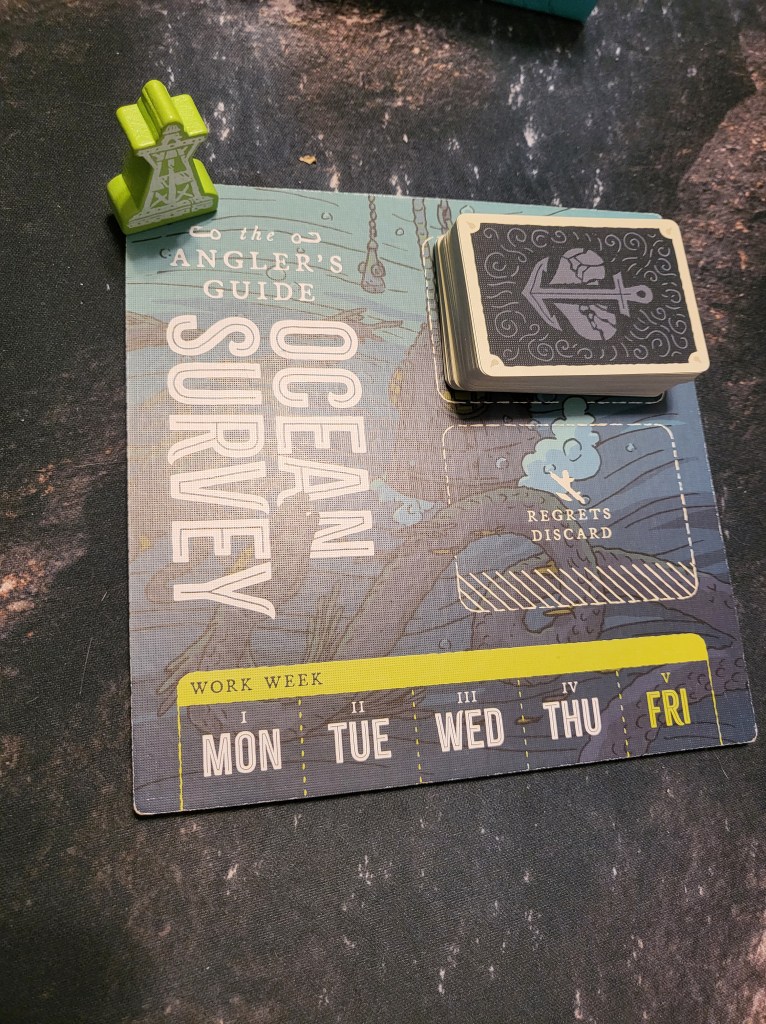
To accomplish this, players take their boat out fishing over the course of a five-day work week and try to catch as many fish as possible while also minimizing the number of regret cards they draw. Fishing itself is overall simple and straightforward: the player rolls their three player dice (and any additional which we will come back to) then uses the dice values to catch fish. There are three levels/depths in the ocean, each with small, medium, and large fish (can also be objects, monsters, etc.). As expected, the larger the fish, usually the higher the catch cost. As you travel further down in the sea, the fish values increase (mostly) and there are fewer fair fish, which typically don’t negatively affect the player, and an increased number of foul fish which are the tricky beasts that usually make the player draw one or more regret cards, among other things. If for some reason you don’t have enough value on the dice to catch the fish, you draw a “complementary” dink card that could have a small benefit on it or could be completely useless.
In the solo game, after the five days of rolling dice and fishing, the player returns to shore and tries to catalog all their fish. If any regret cards remain in hand, however, fish must be discarded (jettisoned thematically) in any combination with a total value (collectively) that is equal to or greater than your total value of regrets. This means it’s possible to catch a fish but still have to re-catch it later and try to haul it in; all for the sake of science of course.
Once any remaining fish get checked off your survey list, the player can use the total value of fish (including those jettisoned) to purchase various rods, reels, items, and/or more dice to be utilized in future fishing expeditions. Truthfully, all enhancements that you can buy are very helpful in the solo game, and I also appreciate that players can make an additional challenge of trying to unlock all items as well as catalog all the fish. That said, a few of the purchasable goodies are expensive! I never was able to get all of them, but I got most of them!
I have to say, I find this solo mode very creative and original in terms of design and implementation. Each individual solo game plays quickly (around 15-20 minutes) and the primary focus seems to be to create a more relaxing environment than anything particularly puzzly. While I usually like cozy solo games, this one got repetitive for me quite quickly, and the entire campaign lasted far too long, in my opinion. I probably played very poorly, but it took me fifteen games to finally catalog everything in the sea. Also, as the vibe is more relaxed, I didn’t find much strategy was needed, especially towards the end of the campaign when you were just hoping to find your missing fish. Most of the game is simply trying to collect what you don’t have via luck of the draw, and remaining at certain depths as needed to finish your catalog. As a person that enjoys at least some mental stimulation, this was a bit of a letdown. It’s basically luck and then using what luck you have to make the best of the situation.
That said, I find the three-depth concept a very solid design choice that really makes the game and sets it apart. It’s a really unique expression of the classic push your luck mechanic while still requiring some strategic prowess to decipher the best plan. A really fun balance exists between risk, reward, and a multitude of tradeoffs which really make the game.
One other small complaint with the solo mode is that not many aspects of the multiplayer game are incorporated into the experience, so I really feel like this should not be played as a purely solo game. Keep reading for more specifics on why, but the two versions truly feel like two separate games, and the multiplayer experience is significantly more enjoyable in my opinion.
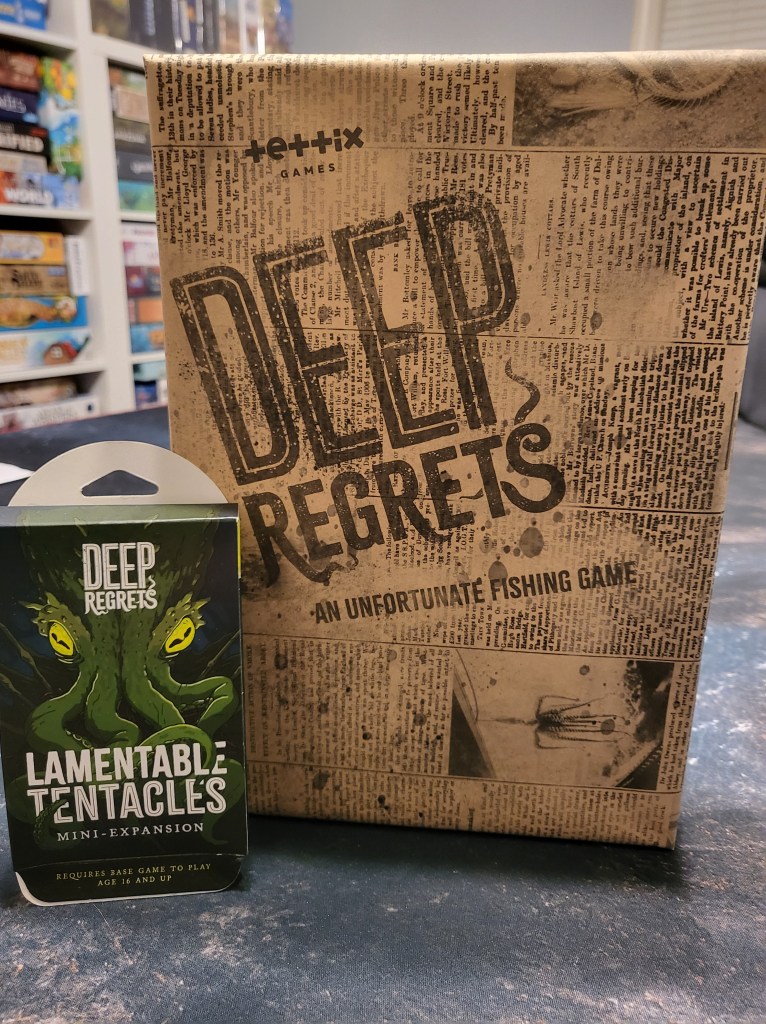
Apart from the actual gameplay, the artistic and inventive liberties taken and included in this game are amazing. Each regret card has a specific, mostly realistic, regret associated with it that adds to the humor of the game and the thematic integration. The artwork is also phenomenal – the concocted creatures are really unique and a delight to discover throughout the game (even if most of them are rather gruesome). I applaud Judson for the truly original theme and concept and the implementation of such to create an inherent goofiness and joy in the game. Also, the packaging of the game was incredible – cool newspaper wrapper!
Now onto the two-player excitement and opinions! Even without touching the game mechanics and design, the fun of the game that comes with discovering the creatures and being hit with wild event cards is significantly more enjoyable with more players.
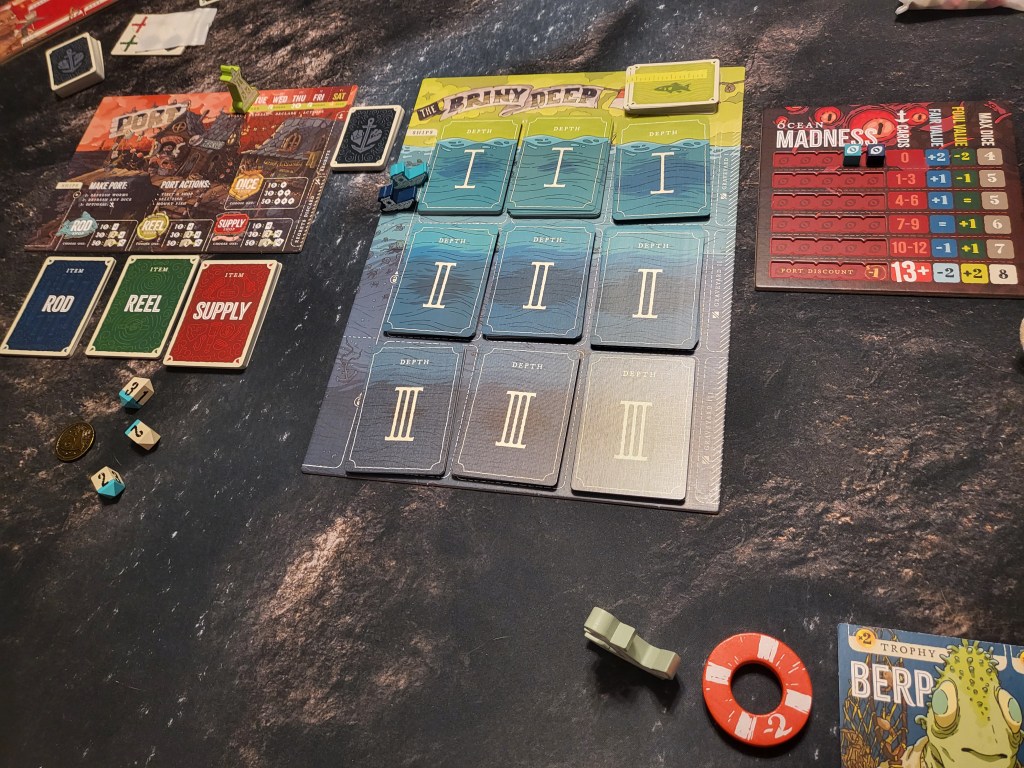
Before I go any further, let me give you a quick rundown of the competitive game and what it boasts that the solo game is lacking. First, there is an added port board, meaning each day (except for the first day when you have to fish) players choose whether they want to go fishing or go to port. Fishing is basically the same as the solo game; the port board adds in some really interesting action options and the ability for equipment upgrades.
When in port, there are multiple actions each player can take one time (no more than that in a single day): sell fish you caught for money, shop to buy rods, reels, items, and additional dice, and mount fish (these score points at the end of the game). When you go to port, you automatically get to discard one regret card as well, if you so choose.
When fishing, each fish you catch or try to catch is one action/one turn. In port, each action is one turn, where each of the four shopping options are their own action. You’ll see why it was important for me to draw attention to this momentarily.
Not only is an entirely new board option added, but there is also madness track that gets included in multiplayer games. This is when things get really spicy! The madness tracker keeps up with the number of regret cards each player possesses. With each range of card numbers comes corresponding increase and decrease value points for certain types of fish. For example, when you have minimal regret cards, your fair fish are worth more than their printed value, and your foul fish are worth less than their printed value (vice versa holds true for lots of regret cards). This madness tracker becomes a huge part of a player’s strategy and can really shape a game.
One other addition that I really like is the life preserver. This player token gets awarded to the player with the lowest total value of dice at the start of the day and can either be used to decrease the cost of a fish by two or decrease the cost of an item/enhancement in port by $2. While being a small, simple addition, it’s a nice sort of consolation prize for having the weakest dice. It evens out the playing field a little bit in a logical and straightforward manner.
Truly, the competitive version of this game is a real gem. In comparison to the solo game, there is an exponential increase in the amount of decision making and strategy required to succeed (there is still some luck of course). The player interaction in this game is also perfect for those that enjoy player interaction but don’t prefer direct attacking/meanness. While minimal, it can be quite interesting and effective. For example, if the regret deck and discard run out of cards, players must take regret cards from other players which can really mess with strategy. When the husband and I first played, I had to take three regret cards from him which dropped him back on the madness tracker and therefore foiled his plan at the time, ultimately leading to me winning the game. That obviously won’t always happen, but it’s a pretty powerful built-in interaction with no malicious intent involved.
While not direct player interaction, it’s also interesting that once one player passes (which usually happens when they don’t have the ability to perform any more actions), each other player is only able to take two additional turns before the day ends. Initially, that doesn’t seem like a big deal, but it can easily become a serious consideration for strategy and action planning. It creates a nice tension with what you want to do and the amount of time you have to complete everything; it’s really smart.
Moreover, when a player passes, they get to either discard a random regret card or draw a dink, and each additional turn they get skipped over, they get the same option. So, while one player completes actions, the other player can be discarding regrets or gaining benefits.
The conclusion: this game is worth checking out. The solo mode is a unique, fun inclusion, but this game really shines with multiple players. As we’ve only played at two thus far, I really look forward to future plays with more people as I think it would be better with even more players and more controlled chaos.
The Kickstarter had an optional “Lamentable Tentacles” mini expansion that is really fun. There are more cards to shuffle into each depth of the sea, but the important inclusion is the specific player abilities that get added. Each player gains one of these “biggest regret” cards which have abilities that are contingent on the number of regret cards the player has at the start of each day. These unique capabilities can influence strategy and increase the variability of the game. That said, these seem quite unbalanced, as some are significantly more powerful than others.
P.S. The Colossal Squid is a meanie head!
 The Adventures of Yogi Bear and Delaware
Leave a comment