Image taken from https://boardgamegeek.com/image/6682376/long-shot-the-dice-game
Designer: Chris Handy (Solo Designer: John Brieger)
Publisher: Perplext
Artist: Clau Souza
Let me just start by saying we are were obsessed with this game for quite a bit. I learned it solo, then I introduced it to the fiancée (now husband!) and we played it close to ten times that first week (yes, singular week 🙈). Then, we had a board game night and played it with six players, and now I’ve already ordered more horse mini expansions! We obviously love the game, but here’s why.
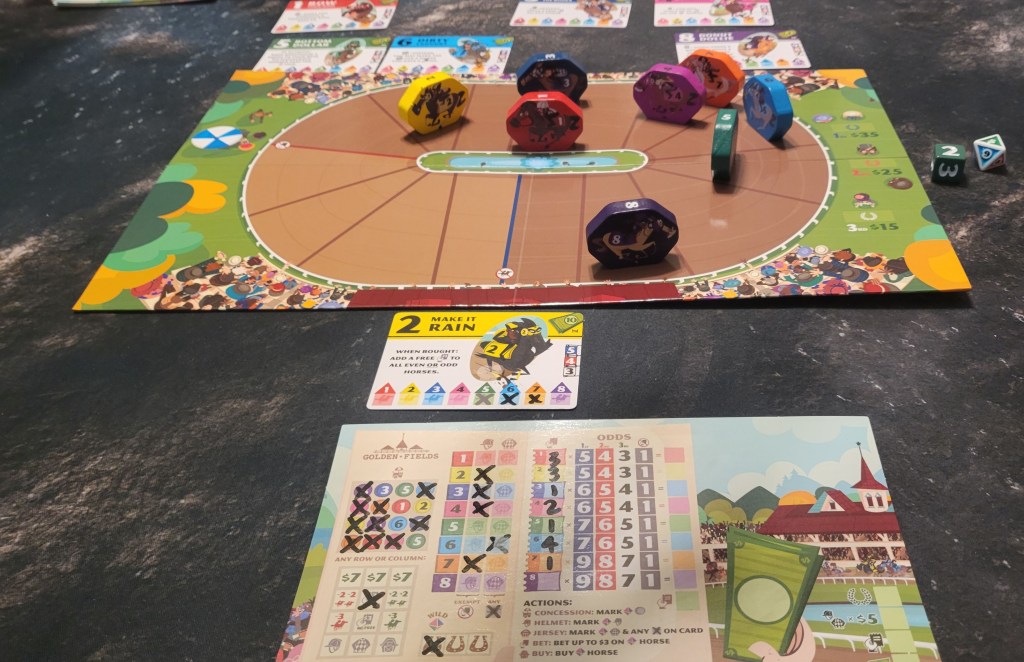
In Long Shot: The Dice Game (here on out, Long Shot), players roll dice, move horses around the racetrack, and perform actions on their player sheet. At the start of each round, the active player rolls two dice – one to determine horse number and one to determine the number of movement advances. After that horse is moved the respective number of positions, secondary movement occurs for some other horses as well. Each horse card has other horses marked on it that move one space when that horse advances. Then, starting with the active player, actions occur using the horse number on the rolled die.
One action option is checking something off at the concession stand, which is a grid of numbers and provides bonuses when rows and columns are completed. Another action option is to select and mark off the helmet for that horse, allowing you to place bets on it once it’s crossed the no bet line (as it nears the finish line). You could also mark the jersey for that horse and then mark a horse of your choosing on the rolled horse’s card (for the secondary movement benefit I mentioned). The other two options are to purchase the horse, which is useful because each horse has a specific ability, and you get money at the end of the game if a horse you own places, or you can bet up to $3 on the horse.
After the active player has taken their action, each player in clockwise order also takes an action using the rolled horse’s number. Once three horses have completed the race, the game ends and the person with the most money wins. Besides any leftover cash, you also gain money for owned horses that placed, bets on winning horses (and a small consolation amount for horses that crossed the no bet line but didn’t place), and pairs of helmets and jerseys marked off on the same horse(s).
In the solo game, you face off against Roland Wright (get it?) who has his own special player sheet to dictate his actions. Truthfully, it took me a second to completely understand each action when I was learning the game, but overall, the solo mode is very well designed and exceptionally easy to facilitate. The solo player is always the active player, but depending on the dice results, Roland takes a specific action (there are back up actions in case something cannot be performed). Besides that, it’s a standard game, which is super nice. Roland messes things up just enough to impact the game and feel as though you have an opponent while not being ridiculously challenging or brutal; he fits nicely into the nature of the game.
While the fiancée enjoyed this game more with six players, I actually preferred it at two and three. Yes, there is more chaos and fun insanity with more players, and there isn’t direct competition and sabotage like in the two-player game, but I felt that I had more control in the games at lower player counts, and I was able to own more horses and impact the game a bit more. That said, I’ll happily play this any time at any player count, and maybe as we get more plays at higher player counts, I’ll start to enjoy the madness more.
This game is just so clever! Yes, there is obviously luck involved with dice rolling, but besides that, there is a surprising amount of strategy while still keeping the game light, quick, and easy to teach. Deciding which action to perform when, which concession bonus to use, when to spend money, etc. is all a fun and interesting balancing act. Due to each player taking turns on each roll, there is not a lot of down time, yet there is also still a fair amount of player interaction as people vie for victory with their owned horses and the horses in which they’ve placed bets. I also adore that it plays one to eight players. Not only can it accommodate a pretty large play group, but it’s pretty rare to find a party-style game that plays solo.
We bought this to have at our wedding to hopefully play with guests (or have guests enjoy), but I am so glad we’ve been able to play it in the meantime. The game play does remain pretty similar from game to game, but the randomness of the dice helps alleviate repetitiveness, and the box has multiple sets of horses included that also increase the variety. As aforementioned, we also purchased some horse expansion packs and an event expansion pack. They were a little pricey (relatively speaking), but for the number of times I foresee us playing this game, I think the added variation will be welcomed.
If you’re needing (or even just looking for) a game that’s fun, unique, hilarious, enjoyable, quick, and scales well to almost any player count, I’d highly suggest Long Shot. It’s honestly a hoot, and I can’t wait to play it with as many people as we can. It’s the perfect level of player interaction for a party game of its type, while not being too complicated, and still managing to be strategic. It’s brilliant, we love it, and think you will too!
 The Adventures of Yogi Bear and Delaware
Leave a comment