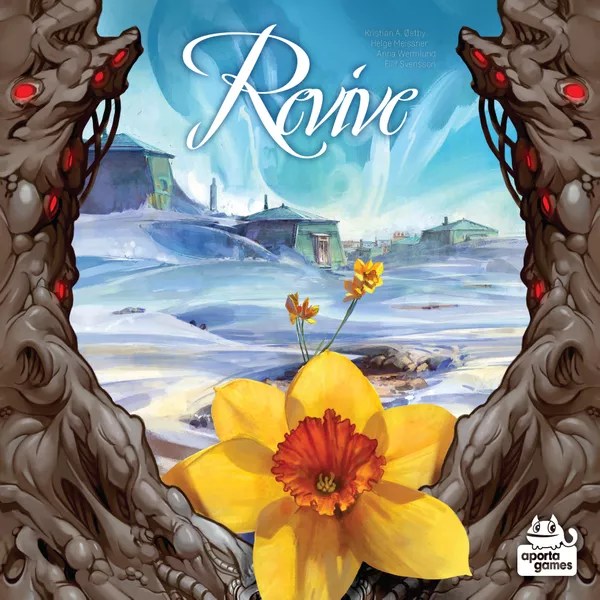
Image taken from https://boardgamegeek.com/image/6950224/revive
Designers: Helge Meissner, Kristian Amundsen Østby, Eilif Svensson, Anna Wermlund
Publisher: Aporta Games
Artists: Gjermund Bohne, Martin Mottet, Dan Roff, Jessy Töpfer
Revive is such a unique, fascinating, thinky board game that doesn’t take too long to play (at least solo) but does showcase some really interesting decision making and strategizing. While not mechanically integrated, the theme is present and relevant, specifically in the campaign story. It’s just overall a really solid mid-weight, smooth euro.
There is honestly quite a lot going on in this game, so I’m not going to cover too much in terms of how to play or the nitty gritty of the mechanics. Some will be mentioned in my thoughts, but if you’re interested in a game play overview, this is not the review you’re looking for.
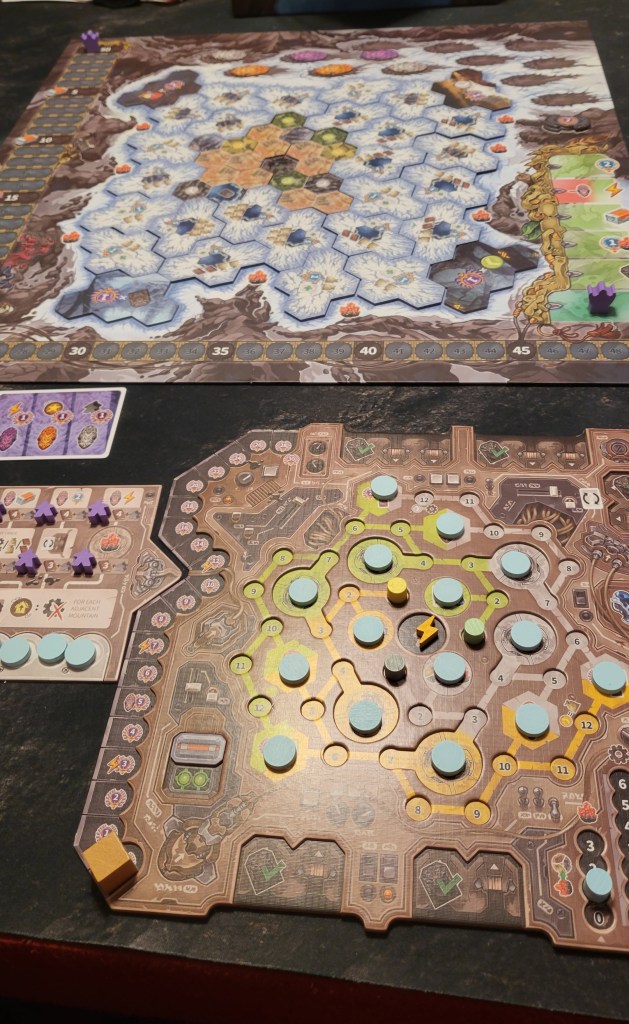
First off, let me just say that the setup for this game is rather lengthy. There are a lot of little bits and pieces including wooden components, tiles, cards, etc. that all require some TLC to get the game going. That said, the componentry is nice, and everything fits well back into the box which is always a positive. The artwork is also gorgeous, especially the image on the back of the board.
The rulebook for this game is fantastic, in my opinion. Not only are the explanations of the game done well, but the order of the rulebook integrates with the flow of the game expertly. That first game, you feel like you can sort of following along with the descriptions and play your first turn(s) simultaneously. The symbol reference pages are also phenomenal; there was not one symbol or tile or card that I came across that wasn’t described in detail.
While I only played it solo, I would be interested in testing it in a multiplayer setting. I feel like a four-player game would be quite lengthy, but the player interaction on the main board would obviously be more intriguing when not playing solo. There are also some tribes that have abilities more well suited to a multiplayer setting that I would like to experiment with.
Before I get into what I really enjoy and appreciate about this game, I do want to point out a few small, potential flaws. I always value the inclusion of player aids and reference cards, but these ones are a little weak. I assume they were trying to keep text on them minimal, which I do like, but I still felt like I needed to reference the rulebook at quite a few stages, especially during hibernation. By personal preference, I also am not a huge fan of the beat your own score system for the solo mode. I actually find the design of the solo mode to be lovely but playing to just try to beat any previous scores/reach a certain level in the score chart is a little irritating. From my limited board game design knowledge, it seems like creating and implementing scenarios and/or achievements for the solo game would be an easy addition. Also, I think partly due to this, the game got rather repetitive for me after eight (ish) plays. I’d likely feel different if there was variation in player count, but always just trying to maximize points wasn’t super motivating.
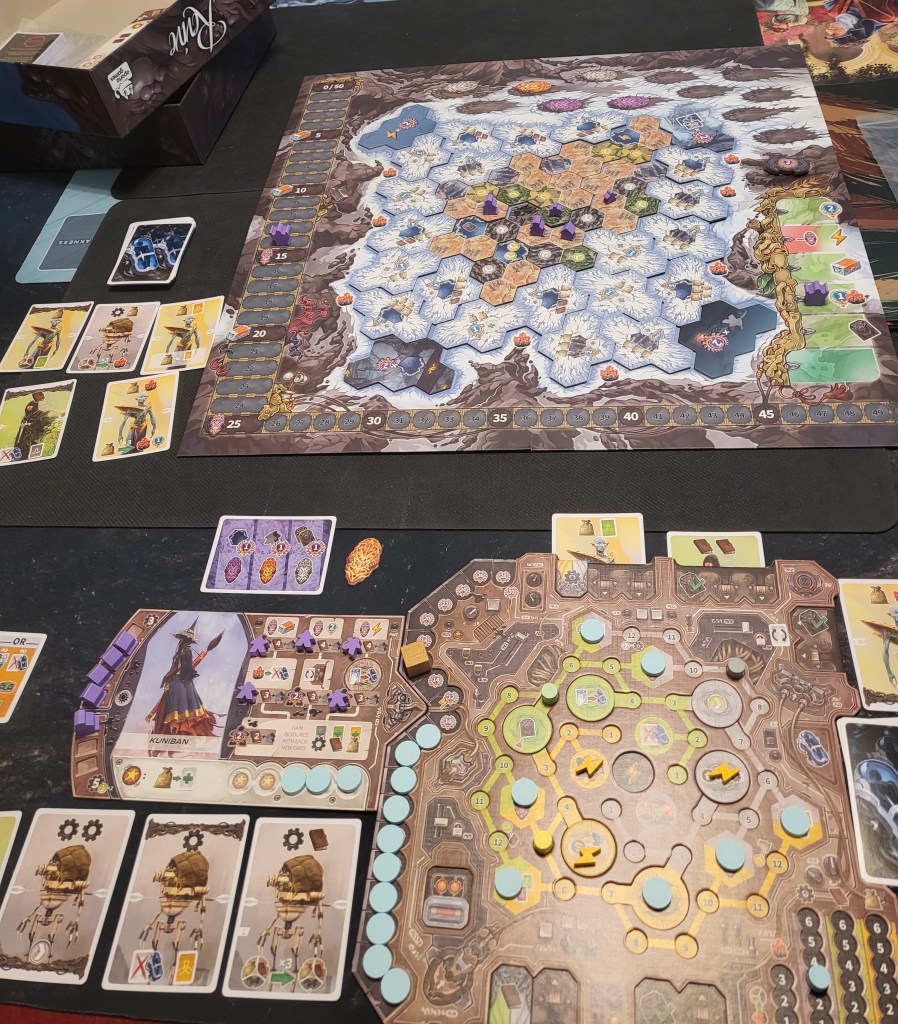
Now on to my favorite parts! As most people who have read at least one of our reviews knows, I adore a good campaign, especially when it can be played solo. The unlockable components and content during the campaign for Revive was great. It’s a five chapter campaign, and after the first game, additional elements, content, and rules get introduced that enhance the game play and strategic nature of the game. I also admire how tense and tight the solo game gets towards the end: with the action cube moving up the track when playing cards and hibernating, it’s tough to balance the action selection and resource management with trying to gain points. I always felt I needed one or two more turns to really optimize my game, but I enjoyed that.
One other addition that I greatly appreciate is that the unique tribes do truly play differently, have their own abilities, and their boards display special technologies (and maybe other powers that could get unlocked during the campaign…). Each tribe board is also double sided to increase that variation. The back side (the moon side) increases the variety of actions, bonuses, and technologies which are really impressive and overall practical in terms of replayability.
My absolute favorite design choice in this game is the interconnectedness between the tech tracks on the player boards and the actions and goals for the game. It’s challenging to describe without just explaining the whole game, but even though there are a lot of moving parts, action options, components, etc., everything has its place and ties in or relates to some other important aspect of the game (and maybe even the theme). It’s truly brilliant and it creates such a satisfying puzzle to try to decipher. It’s a solid combo-making game where one thing lets you do another thing which leads to two more things.
For me, as I’ve only played it solo, this game isn’t perfect, but it is a really fun and cleverly designed board game. There are a lot of unique elements, some thematic integration, and just really cool, puzzly game play with neat reliability on other aspects of the game. The ultimate creation? A piece of art that is cohesive, strategically deep, and has a wonderful table presence. What more could you ask for!? Unless, of course, we are talking about the win conditions related to the solo mode…
 The Adventures of Yogi Bear and Delaware
Leave a comment