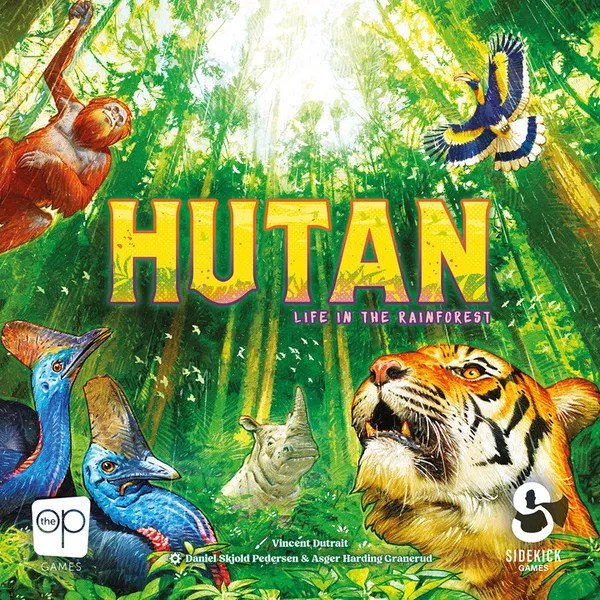
Image taken from https://boardgamegeek.com/image/8280787/hutan-life-in-the-rainforest
Designers: Asger Harding Granerud, Daniel Skjold Pedersen
Publishers: Sidekick Games, The Op Games
Artist: Vincent Dutrait
The moment I saw this game existed, I was intrigued. Then, after some research, I discovered that it has scenarios, achievements, challenges, etc. and was immediately sold. Not only do I adore nature themed games, but it just looked so colorful, bright, and fun!
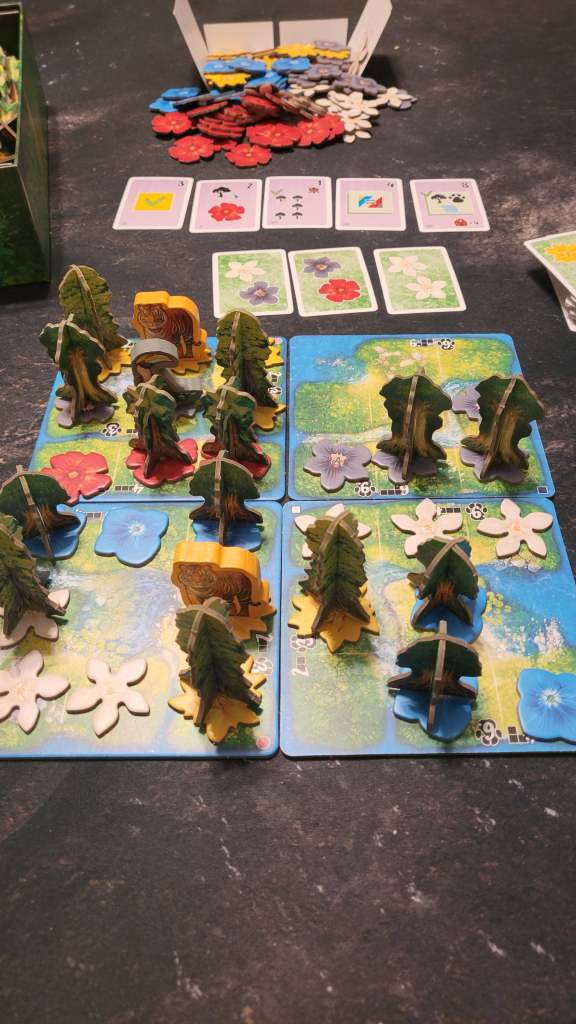
For your very first game, the setup time will be quite lengthy (30 40 minutes) because all trees must be constructed, flowers and player boards need to be punched out, and the insert has to be put together. Each subsequent game, though, has a very quick setup time. Player boards get arranged, a supply of flowers, trees, and animals is set within all player’s reach, and cards get shuffled and drawn as necessary per player count.
The mechanics in this game are quite simple but rather ingenious as well. In the solo game, there are eighteen rounds, and each round, the player draws three flower cards from the deck of 54 (how you know when the game is over). After the three cards have been revealed, the player selects one and takes those flowers from the supply. The other two cards get discarded.
There are a few rules for flower planting placement. Besides the very first card, each flower must be adjacently connected to an existing flower, and all flowers from the selected card must be placed orthogonally connected to each other. Regardless of the turn number, all flowers from the card must be used and placed. You can place flowers of the same color/type on top of each other, but flowers of different colors may not be stacked.
Players have two primary objectives when deciding which card to select and where to place the flowers: growing trees and completing areas. Trees grow when a player has two flowers of matching colors stacked on top of one another. Areas consist of 2-5 spaces in varying shapes separated by water on the player boards. An area is considered complete when all its spaces are filled with flowers of a single color. Trees are worth two points each at the game end, and completed areas will score you points (depending on the size) while incomplete areas and areas with multiple flower colors will count as negative points.
While placing flowers, growing trees, and completing areas, it’s possible to create a perfect habitat. To create a perfect habitat, players must have a complete area with trees on all flowers. Once a perfect habitat is achieved, an animal gets attracted to that area and replaces the last placed tree. Besides being worth points at the end of the game, animals also facilitate fertilization meaning that areas adjacent to the newly placed animals can receive a flower of any color (and can even cause a tree to grow).
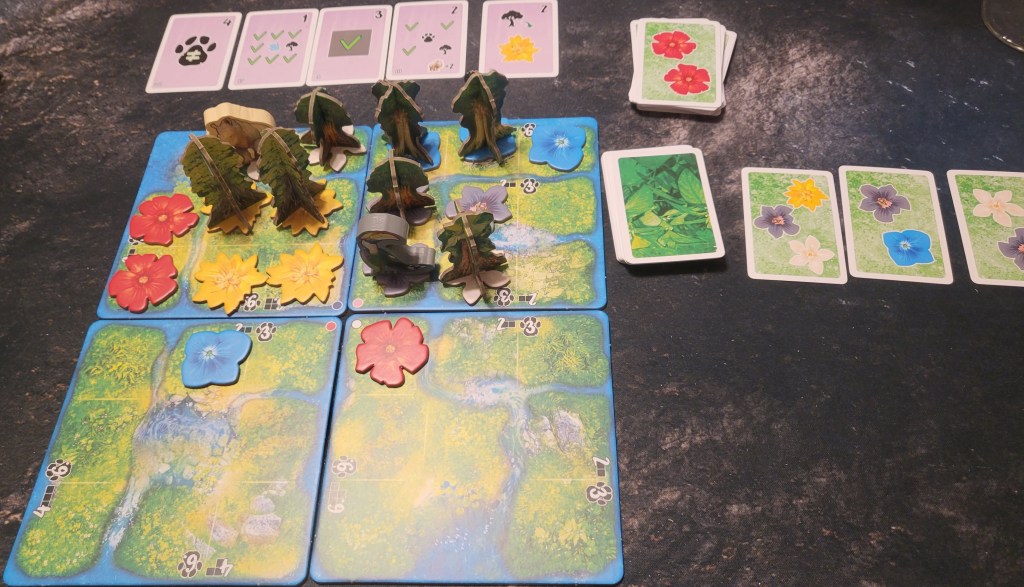
At the conclusion of the game, points are scored for trees, completed areas, animals, and then points are subtracted for any incomplete/mixed areas. There are also scoring objective cards (called ecosystem cards) that get laid out at the commencement of the game that get evaluated and scored at the end of the game. These vary greatly and can include goals such as completed areas of a certain color, trees on a specific color, animals and trees in reference to lakes, animals on the edge of the board, etc.
There are fourteen scenarios included in the rulebook (that can be enjoyed at any player count), as well as many other challenges and modifications the players can strive for and/or incorporate into their games at their discretion. Each scenario provides the player(s) with a specific setup for the player boards, five indicated ecosystem cards, and a minimum score value.
Now that I’ve gone over most of the game play and scenario details, here are my thoughts.
First of all, I have to say, for the price point of the game, the componentry is lovely and the constructible insert is phenomenal. It allows all parts of the game to be separated, have their own place (and they tell you where everything should go), and fit very nicely back in the box. It’s primo. The game is also decently thematic (not immersive but each action is thematically relevant) and the artwork is absolutely stunning. Yes, the cards are just flowers, but the visual design of the play elements (trees, animals, flowers, etc.) are very lovely and appealing. My only small complaint is that I wish the lakes on the player boards were a little more well defined.
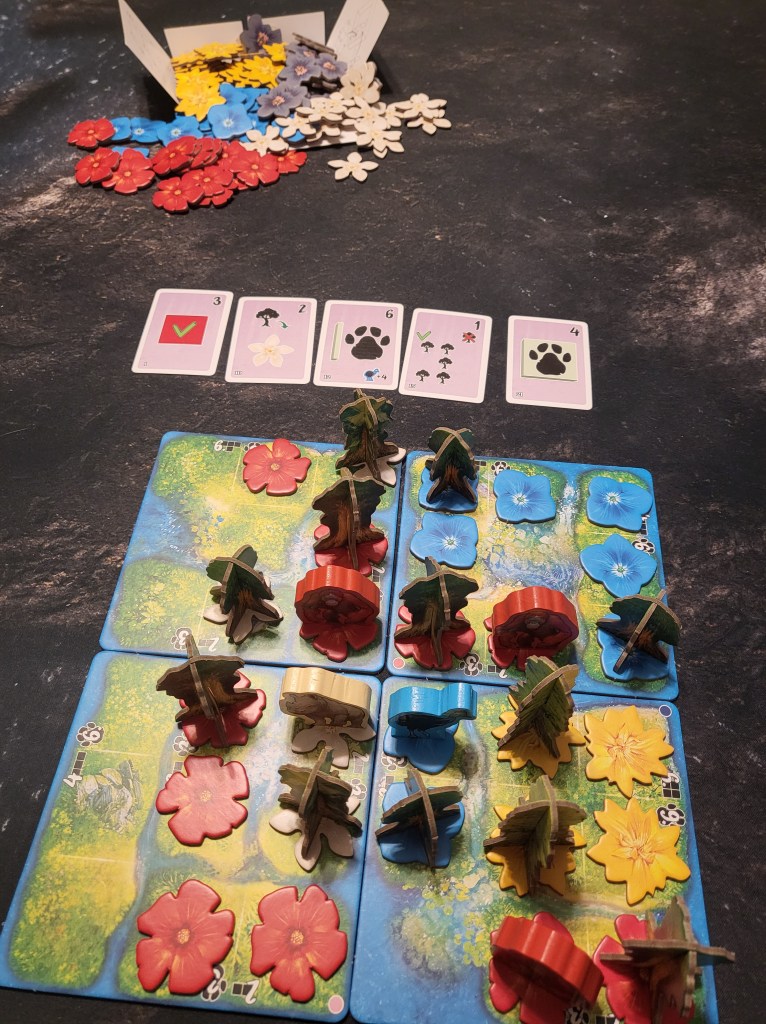
The gameplay itself is quite light. There are definitively some strategic elements in terms of card selection and flower placement, but that’s about the extent of it. It was very easy to learn, and I presume it would be easy to teach, so it seems to be a great game for gateway/gateway plus players (this is one I want to play with my mom!) or anyone that wants something strategic but not heavy. There are fun decisions without being complicated. There is some randomness in the game, however, as there is with almost any card-based mechanic. In the solo game, with three card choices, it’s usually not a huge hinderance, but there was one game where I knew from the first turn or two that I wasn’t going to do well just based on my flower card options. That said, overall, it’s really clever, and I thoroughly enjoyed my plays and experiences.
As with almost any game for me, the scenarios (and other goodies) are a major positive. The difficulty increases nicely over the course of the scenarios, with the last scenario being quite challenging (I haven’t beat it yet). The unique player board layouts are really neat, as is the opportunity to experiment with all the different ecosystem cards. Personally, those objective ecosystem cards create the highest replayability factor in this game. Each card combination feels special and helps guide your choices.
Without the scenarios, challenges, and modifications, I’m honestly not sure what the replayability on this would look like. There is a lot of good variety baked into the game including double sided player board squares that can create numerous different setups, the ecosystem cards, etc., but the game play loop is pretty similar from game to game.
For a lighter, beautiful, quick playing game (each solo game took me around 15 minutes) with lots of created content variations in the rulebook, this one is a winner. I don’t think it needs to be a staple in collections, but if you like a good progression of solo (or multiplayer) challenges, the theme, and/or need a nice, easy game with good flow that’s strategic and approachable, I’d highly recommend HUTAN: Life in the Rainforest.
 The Adventures of Yogi Bear and Delaware
Leave a comment