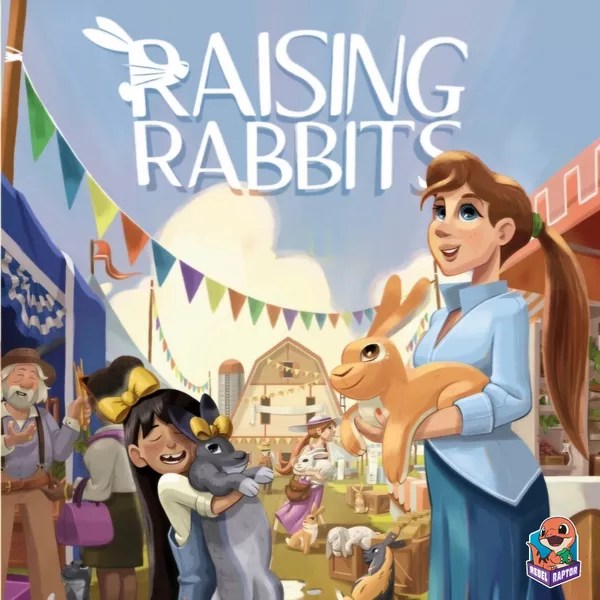
Image taken from https://boardgamegeek.com/image/8179272/raising-rabbits
Designer: Aaron Rebelo
Publisher: Rebel Raptor
Artist: Conner Gillette
Golly, this game is so charming and adorable! But, before we go any further, please note that a preview prototype copy was provided by Aaron and Rebel Raptor games for a genuine review, so everything pictured and discussed is subject to change between now and final production. Thank you, Aaron and company, for this opportunity!
Let me just start by saying I was immediately interested in this game because we have a pet rabbit (and I’ve had more previously) and I think bunnies are precious. So, the theming was an automatic plus for me, but I was concerned the game play would be too light and/or wouldn’t enhance the theme of the game. Thankfully, that was not the case; this game is really well designed with some interesting and tough decisions while still remaining very straightforward, easy to teach, approachable, and quick playing.

At the start of the game, each player receives a breeding board and a show board which will have varying numbers of repair cards based on player count (at 2 players, only three, at 3-5 players, four) and fourteen action cubes for the whole game. The central market also gets set up with cards that include items and rabbits for sale, as well as extra money, game tokens, etc. There are also Bunny Bulletin cards and goal cards that get shuffled and placed in the main middle area, as does the round tracker. Each player draws two goal cards, keeps one and discards the other.
Before any of the rounds commence, players take part in an auction to gain rabbit cards. The first player draws two bunny cards, selects one to keep, and then all players including that player bid on the remaining rabbit using their ten starting karats (money). This continues around the table in turn order until all players have completed drawing two, selecting one, auctioning one.
Once everyone has at least one bunny, the months begin. There are six months in the game and each player gets one turn per month. On a turn, a player can use between zero and three action cubes to perform actions via their player board. Actions include drawing more goal cards, breeding bunnies, showing a rabbit, going to the market to purchase items and/or sell/buy rabbits, collecting poop (hilariously realistic), and repairing pens. There are also some bunny cards that allow players to use a cube to perform the identified action. All listed actions require one action cube except for breeding which requires two. There are also a few free actions that can be taken at any point during a turn including playing a rabbit card, swapping cards on your board(s), and removing a rabbit card from a board and returning it back to hand. As one player finishes their turn, rabbits in the market are refilled but any purchased items do not get replenished until the end of the round. Then, play passes to the next player clockwise. The end of the round comes at the conclusion of the final player’s turn.
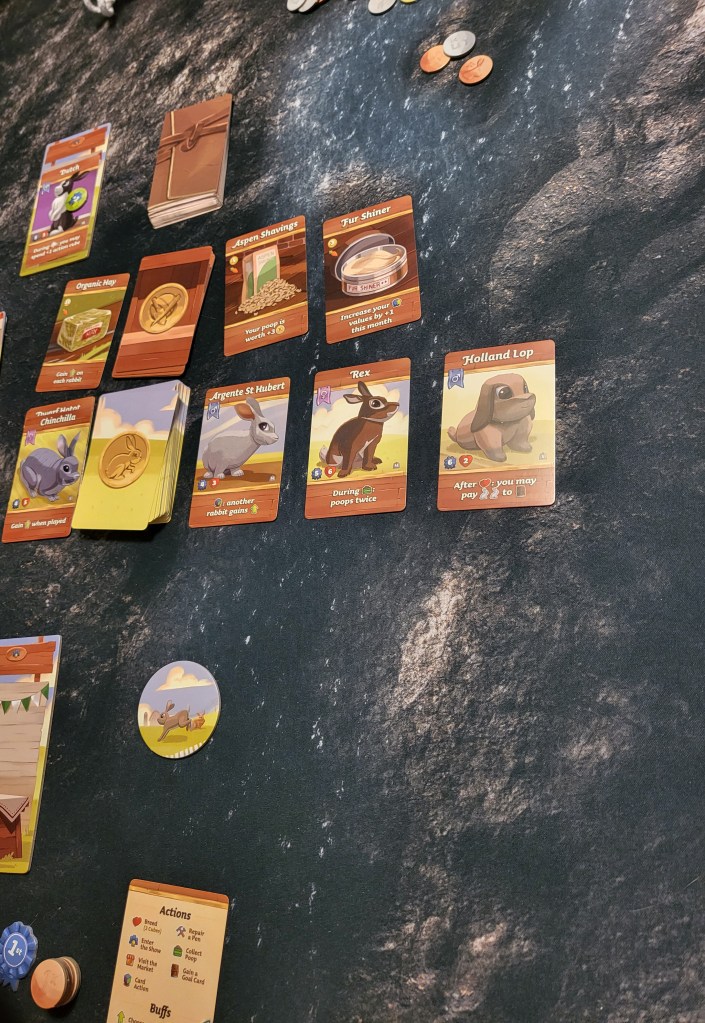
At the end of each round, all bunnies that were selected to go to show compete against one another for first, second, and third place ribbons.
Play continues over six rounds/months with each round ending with the Hop Token (first player token) moving to the next clockwise player and beginning with a Bunny Bulletin card, the market getting refreshed, etc. At the end of the game, players score points based on any bunnies from breeding, complete hidden goals/objectives, all first, second, and third place show ribbons, and one point is received per three karats remaining. The player with the most points wins!
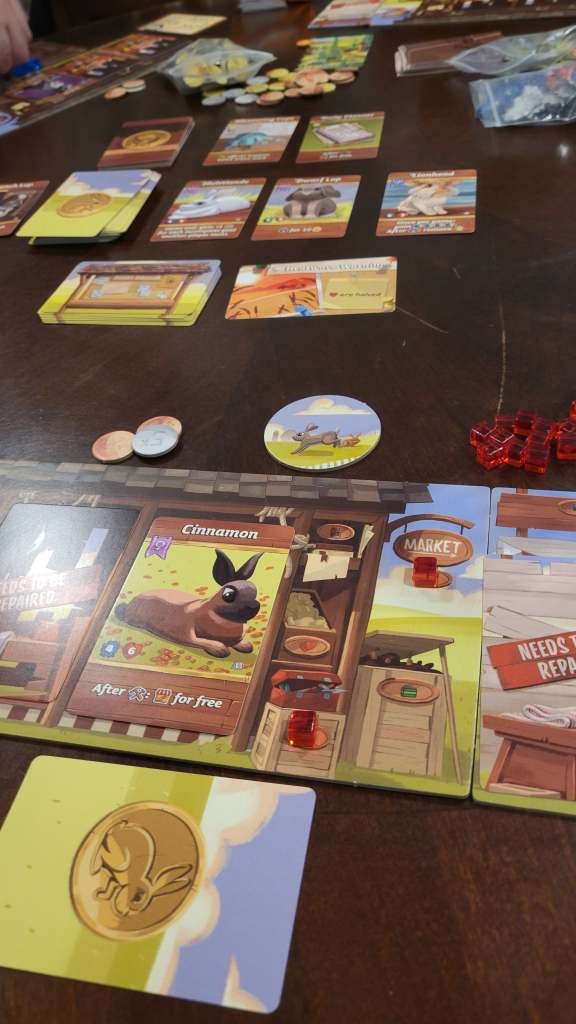
I was pleasantly surprised by this game. As I mentioned, it’s pretty simple in terms of actual gameplay, but there are a lot of fun decisions to make. Here are some major highlights in this game for us:
1) The action selection and action management aspects of this game are soooo interesting and tight! Fourteen action cubes for six months mean you can’t do everything you want, and you really have to budget and maximize your cubes and turns.
2) The unique bunny abilities (and their respective art) are really neat and add a fun layer to the combo creation and strategy elements of the game.
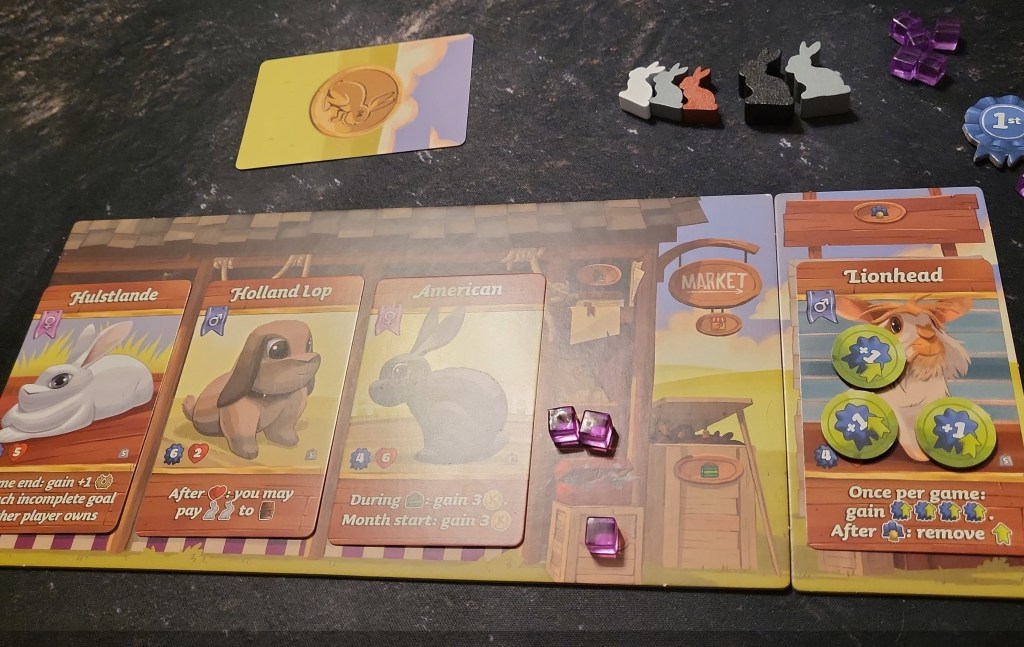
3) The componentry is nice! There is a deluxe version with some fancier items, but the standard wooden rabbits are chunky, the cards are solid, and the rest of the cardboard components are sturdy.
4) Strategically/game play wise, I enjoy that the bunny tokens are of limited supply. I feel like the finite quantity can truly influence the game and impact decisions throughout the game (speaking from experience).
5) The Bunny Bulletin cards are a wonderful addition. I enjoy that they affect all players equally and can be positive or negative. They seem to shape the round in a good way.
6) I appreciate that there are not twelve different ways to score points, and that (besides the money) everything has a round, whole point value. It’s very streamlined and sensical.
7) Everything is very thematic and endearing. The artwork is lovely, the actions are exceptionally relevant, and each choice and action option have an importance.
8) The player aids are phenomenal! One side outlines the actions well while the other presents the ways to score and their respective point values. It provides all necessary information without having a superfluous number of words on the card. 10/10
While we obviously enjoyed this game, there are a few “meh” aspects for us, meaning they could be taken as positives or negatives:
1) Overall, the game seems to be better with more players. It played exceptionally quickly at two (like 20 mins) and there is a bunny added to the show for increased competition (which is a great addition, especially since you know the show value of that rabbit before your turn), but the increased tension at the show and any card effects that affect other players are more impactful at the higher player counts. We only played at the two ends of the spectrum, but I imagine three and four player games would be enjoyable. Also, the longer time in between turns meant the market changed more and so it was more challenging to predict and plan on which rabbits and/or items to acquire. As we mainly play at two players, this is a bit of a downside for us.
2) The initial auction/bidding aspect for the rabbits was fun and interactive but I could take it or leave it. It’s different and makes the start of the game more strategic and intentional, but I’m not a huge fan of that mechanic in general, so it’s probably my least favorite part of the game (but it’s not bad by any means).
3) While the action selection/management and card combination creation are quite strategic, there is a substantial bit of luck in terms of the bunnies you draw and have available at the market. Their respective abilities and how well those work with your current rabbit(s) are also therefore rather random.
4) At five players, the game was probably 60-70 minutes in length (longer than the printed box time), but we also had three players learning the game, so take that into consideration. Truthfully, it still seemed to play quickly but there was definitely more downtime in between turns.
5) There is pretty minimal player interaction, especially on the actual player turns. Yes, the shows are competitive, but otherwise, unless a bunny ability specifically impacts another person, this game is mostly multiplayer solitaire. That said, it is important to pay attention to what other players are doing as you sometimes need to breed (for example) in order to prevent someone from getting 54 rabbits (not that this happened to me or anything…).
Overall, this is a thematic, quick, strategic gem of a game. It’s not something I would want to play all the time, but it’s a wonderful game for gamers and non-gamers alike, and it’s so fun and cute, it’s hard not to enjoy the experience!
Our bunny’s conclusion: it receives the Luna paw of approval.

 The Adventures of Yogi Bear and Delaware
Leave a comment