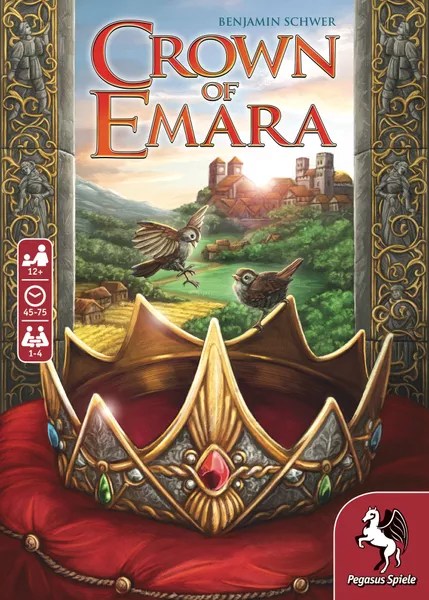
Image taken from https://boardgamegeek.com/image/7415514/crown-of-emara
Designer: Benjamin Schwer
Publisher: Pegasus Spiele
Artist: Dennis Lohausen
In Crown of Emara, players act as noblemen utilizing helpful councilors to try to win the favor of the king and receive the crown of Emara. Besides the movement selection aspect of the double rondel which characterizes this game (in my opinion), other relevant mechanics include action selection and resource management. With all these working in conjunction, Crown of Emara creates a fun, unique, and tight strategic game.
The main set up for Crown of Emara involves assembling two round boards, one representing the countryside and the other the town. Each player has one councilor on both boards which are utilized to dictate movement. The countryside board focuses on resources, while the town board is where most of the actions take place and points are scored.
Over a series of six rounds, each player draws three cards from their deck and plays one each turn (so there are three turns per round). After three rounds, the cards get shuffled and everything gets repeated, hence the six rounds. Over the course of the game, the goal is to get as many building points and citizen points (two different numbers) as possible because the lower of those two for each player represents their final score. This balance and duality is interesting and is at the core of a lot of the decision making in the game. It’s difficult to ensure both point tracks are as high as possible considering both require different resources and actions for advancement.
The mechanics of this game are fascinating. While technically being relatively straightforward, they’re surprisingly deep and thinky. Each player has a board with three card slots, each labeled with movement values of one, two, and three. Each turn, a player selects a card from their hand, plays it to a specific slot, and then performs the card action and movement action in any order they choose. There are also a few free actions that can be taken at any point during each turn to make it even more strategically spicy.
Not only is the double rondel awesome and rather crazy in and of itself, but then you add in choosing when to perform each action and in what order – it’s nuts! There are so many options and possibilities, it’s easy to have serious analysis paralysis in this game. There is a definite need to plan ahead; lots of strategic consideration and thought-provoking decision making need to occur to optimize turns and maximize citizen AND building points. There are a lot of ways to score points and numerous pathways to each scoring opportunity, so there’s a lot to consider and mentally juggle.
This game is also quite tight in terms of resources, number of actions, overall amount of time, etc., so you never feel like you have enough of anything to do what you need to, which I really like! It creates a fun tension and encourages players to plan more.
There are a few different variants provided near the end of the rule book for those that want to mix things up a bit. There’s also a solo mode that plays well. The game play remains relatively unchanged, but there’s still enough impact on the game to affect your success and influence your decision making. Interestingly, you know how many points the artificial opponent will score and how they will acquire those points, so you can spend your turn planning (or scheming) and trying to keep their points to a minimum while tangentially maximizing your own points. There are also two different ways to play solo: beat your own score or a mini campaign.
In general, since the solo game is similar to a two-player game, especially since the solo game is rather self-contained and predictable, I honestly don’t have a preference solo vs. multiplayer. I appreciate the addition of the solo mode, it plays nicely, and the multiple ways to play increase the replayability some, but I also enjoy seeing other player’s strategies and thoughts on the game.
That said, I could see this game getting samey if played too much or too often. Yes, there are many different strategies to try and numerous avenues to explore, but there are always the same actions, resources, and outcomes at each location.
A few other issues with this one for me: the set up is rather tedious and lengthy, so it can be a little challenging to get to the table. There isn’t much player interaction which I don’t necessarily mind, but I would have thought something would happen if players share a space on either rondel board and I’m surprised nothing occurs. Occasionally, the other player(s) can foil your plans, but that doesn’t happen too often. There are also a few aspects of the game that don’t seem very important or useful and I question their integration (for those that have played, what’s up with the bread?! It’s so hard to get yet doesn’t really do a whole lot in my opinion).
Overall, I find Crown of Emara a skillfully designed rondel game with a few minor issues. The artwork is thematic and lovely, and each piece for both the countryside and town boards are double sided just for aesthetic appeal and art preference (at least in the newer addition). While having some nice inherent variability and created variation, there is still the possibility for this game to get worn out, but the clever mechanics help keep it enjoyable.
 The Adventures of Yogi Bear and Delaware
Leave a comment