
Image taken from https://boardgamegeek.com/image/8468743/usolli-the-strategic-game-about-salah
Designer: Ahmad Salahuddin
Publisher: Cardboard Quokka Studio
Artist: Siraj Fakhri
Besides a world religions class in college and a short refresher a few years ago, I really don’t know much about the Islamic religion apart from their main core beliefs and practices. U’solli was marketed as a game that could be played by those that practice the religion as well as those that don’t, so I thought I’d give it a try. With already having produced copies when the Kickstarter launched, the games were shipped very quickly (I received my copy less than a month from the conclusion of the campaign). While it’s not the cream of the crop, I think it’s very well designed, fun, and I actually feel like I know more about Islam after my handful of plays, which I find really neat.
In U’solli, players attempt to pray all five Salah before the end of the day. To do so, Rak’a cards get collected from a general market of sorts (rows and columns of face up cards) and then sets of similar colors can be discarded to pray the prayer associated with that color. This means that every round players decide whether to move and gain a card from the market area or discard cards to pray.
Each Rak’a card has specific movement rules associated with it, whether that be move one spot in any direction, as far left or right as you want to, or even options that are wild and let you choose a location for your meeple. Once movement is complete, the player picks up the card at the spot they ended and performs any actions associated with gaining that card. Some cards don’t have these, but others can cause event cards to be drawn or the time tracker advanced.
There are five main prayers in Salah that happen over the course of the day: Fajr is before dawn, Dhuhr is at noon, ‘Asr is in the afternoon, Maghrib occurs at sunset, and ‘Isha at night. Each of these five prayers have an associated color, so to perform an individual prayer, you have to have a specific number of cards of the corresponding color. The other trick is that you can only pray when that prayer is on time or has already passed – you can’t choose one in the future. The time tracker is the way you identify which prayer is on time and which have passed. The cards for each of the five prayers create a chronological line at the start of the game, and the time tracker starts on the farthest left spot indicating early morning. Each time a card is collected with the time symbol and/or when a player prays, the time tracker advances. Each prayer card only has a specific number of time spaces before the token shifts to the next card. The game ends when the time token has moved past the last time spot on the final ‘Isha card.
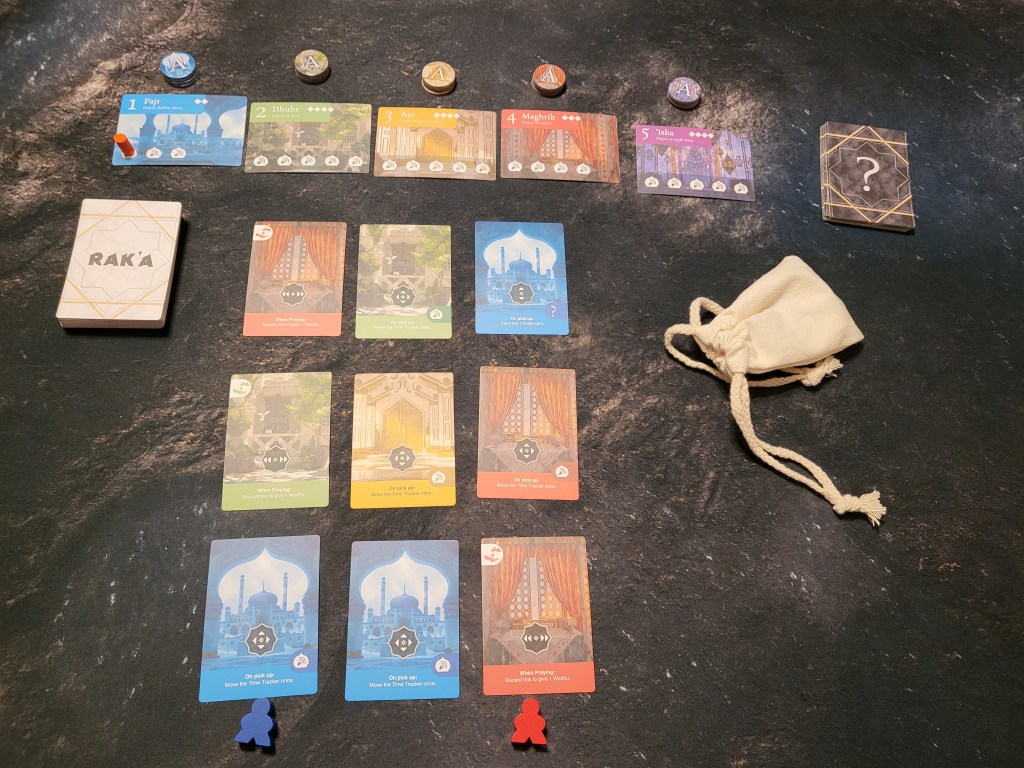
Note the meeples are not in the correct locations for a solo game here! This is just showing the set up for a standard game.
When selecting the cards to discard for prayer, there must be at least one card that has the Wudhu symbol on it, representing the act of washing before Salah for physical and spiritual cleansing. Also, if any discarded cards have a Musafir (traveler) or Khusyu’ (focus) icon, the player gains a prayer bead (more on these in a second).
Points are accumulated through completing prayers and gathering prayer beads. Each prayer has a stack of tokens from highest to lowest value. The first player to complete a prayer takes the top, most valuable token to be scored at the end of the game, then each subsequent player to complete that prayer takes the next token in the stack. In the basic version of the game, there are three different colors of prayer beads, each with their own specific value of points (drawn randomly from the bag when obtained).
Besides the basic mode of play, there is also an advanced variant and a solo mode. The advanced version adds in some common goal cards (another way to score points), a few of the standard rules get tweaked (ex. prayer beads all have equal value, you have to discard a card to share a space in the market with an opponent, etc.), and there are some interesting alterations to the stipulations for paying cards to complete a prayer. In the solo mode, the goal is to beat the Ustadh’s (teacher’s) score. Through some simple mechanics to facilitate, the Ustadh “plays” similarly to players: collecting cards and completing prayers to gain point tokens and prayer beads. I greatly appreciate the inclusion of both of these, as I often play solo, and I like that it can be taught to and played with any group, regardless of their level of experience with board games. As an avid gamer, the advanced mode adds quite a lot of strategic challenges which are necessary for personal replayability and longevity, and they provide a nice puzzle to solve. The basic game is great for a family game night or a nice, light gateway/filler game.
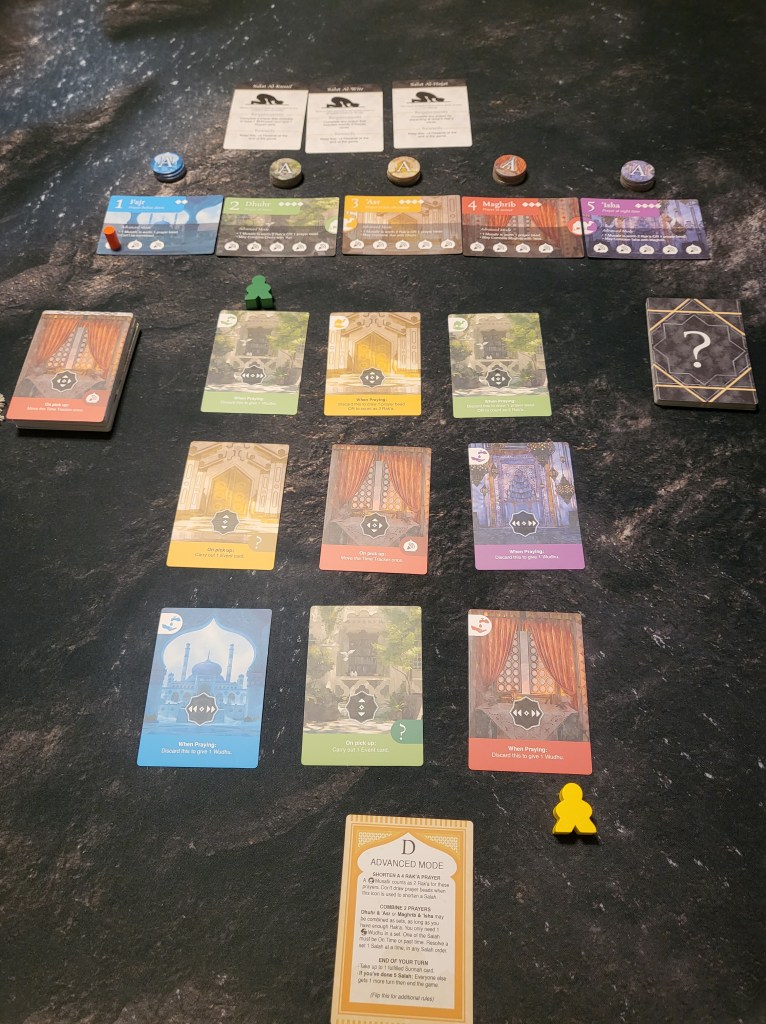
The meeples aren’t 100% correct here either, but this is the generic set up for an advanced game.
I feel I didn’t do a great job of explaining this game, but it’s a really unique, interesting, thematic, cultural learning experience that I overall recommend. The mechanics are interesting, but there is a substantial amount of luck concerning the card draw and the ability to move to collect certain cards. It’s not perfect, as I could always do with a little less of the luck factor, but it’s a really solid representation of what I think religious board games should be. It’s not trying to force anything down your throat or provide opinions; it simply explains and exemplifies a standard practice in one of the major religions of the world.
I’m really happy that I have this game. It’s not my favorite game ever, but I appreciate its skill in teaching the players while truly creating a fun and engaging experience. I certainly have nothing like it in my collection, it’s a pretty small box, and plays decently well solo, so I have faith (pun intended) that this one will be with us for a while. And it’s really colorful!
 The Adventures of Yogi Bear and Delaware
Leave a comment