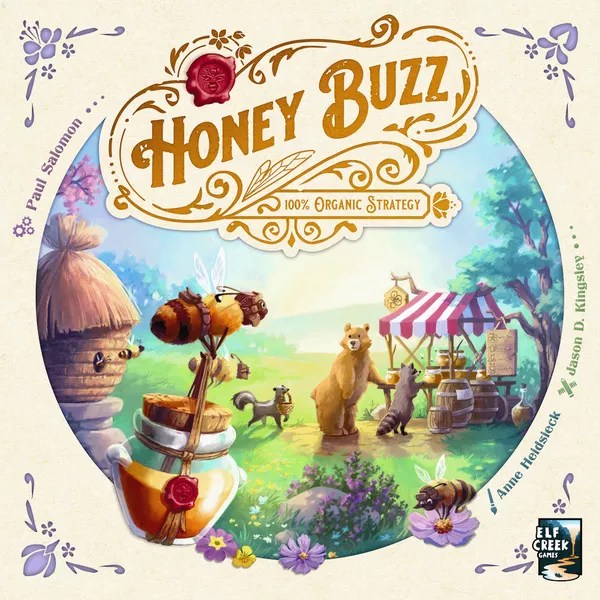
Image taken from https://boardgamegeek.com/image/5608344/honey-buzz
Designer: Paul Salomon
Publisher: Elf Creek Games
Artist: Anne Heidsieck
First of all, the fact that the meeples in the game are called beeples is amazing. 🐝
Honey Buzz is primarily a worker placement, action selection, and tile organizing game that is expectedly themed around a beehive. Over the course of the game, BEEPLES (yes, this is me using this word in excitement) get placed in various locations on the hive board, tiles get collected and added to expand your personal hive, and honey orders and queen’s orders need to be fulfilled.
I’m sure there are plenty of other places you can find an overview of the game, but I want to point out why I enjoy this game and what makes it different. It’ll include some mechanics-related information as well.
The first interesting twist with this game comes from the worker placement. There are six sections on the hive board each corresponding to a different hive tile type (we will come back to this). When you place a BEEPLE or BEEPLES, you collect the associated tile. The unique aspect comes in when other players (or your future self) also want a tile from a location at which a BEEPLE already exists. If one BEEPLE is there, the next player wanting to gain that tile will have to place two BEEPLES at that location, then three and so on. So, each location that gets used becomes more difficult to visit and therefore more valuable.
During the setup of each game, every player begins with the same starting hive tiles in the same configuration to keep it an even playing field. As tiles are collected from placing your BEEPLES, you add them (with rules of course) to your personal hive. When a cell (hexagon) in your hive gets closed in from tiles, the player gets to activate each action that is adjacent to that empty cell in any order they choose. For reference, these actions include gaining a baby BEEPLE (they have snuggly hats on the tiles!), increasing your money supply, foraging for nectar or pollen, producing honey, and going to the market to sell or complete orders. This mechanic is fascinating! There’s actually quite a lot of forethought and strategy required when selecting your tile and then choosing the best location for that tile in your personal hive.
When a player forages for nectar (pollen is basically a consolation prize if you can’t make it to your desired nectar), there’s another layer of strategy that needs to be taken into consideration (and this even relates to placing tiles). It all works together like a beehive. 😉 Each type of nectar (there are four) has a specific color pattern on the edge of their individual tiles. When collecting foraged nectar to place in your hive, the edges of the nectar must match the edges of the tiles forming the empty cell in which you’d like to place that nectar. That means you have to strategically lay your tiles to allow for certain types of nectar, but you also have to forage in such a way to maximize your empty cells and ensure you can utilize that nectar.
The board is double sided, and on the flip side, a memory/deduction aspect gets added to the mix. On the standard side, each nectar tile is face up, so you just have to move enough to collect the appropriate nectar. On the advanced side, those nectar tiles are face down, so if you can use that specific nectar, you gain that tile. If not, it gets placed back on the board face down. The extra tricky bit is that the viewing of these is secret, so unless a player takes the nectar tile, you have no idea which type it is.
While the game play mechanically doesn’t change much, besides the alterations in the advanced variant, I do appreciate that there is a solid variety of starting configuration cards as well as queen’s and regular order cards. It at least provides some uniqueness to each game and increases the replayability some. That said, I can also see this getting stale after a few simultaneous plays and/or after many plays in general.
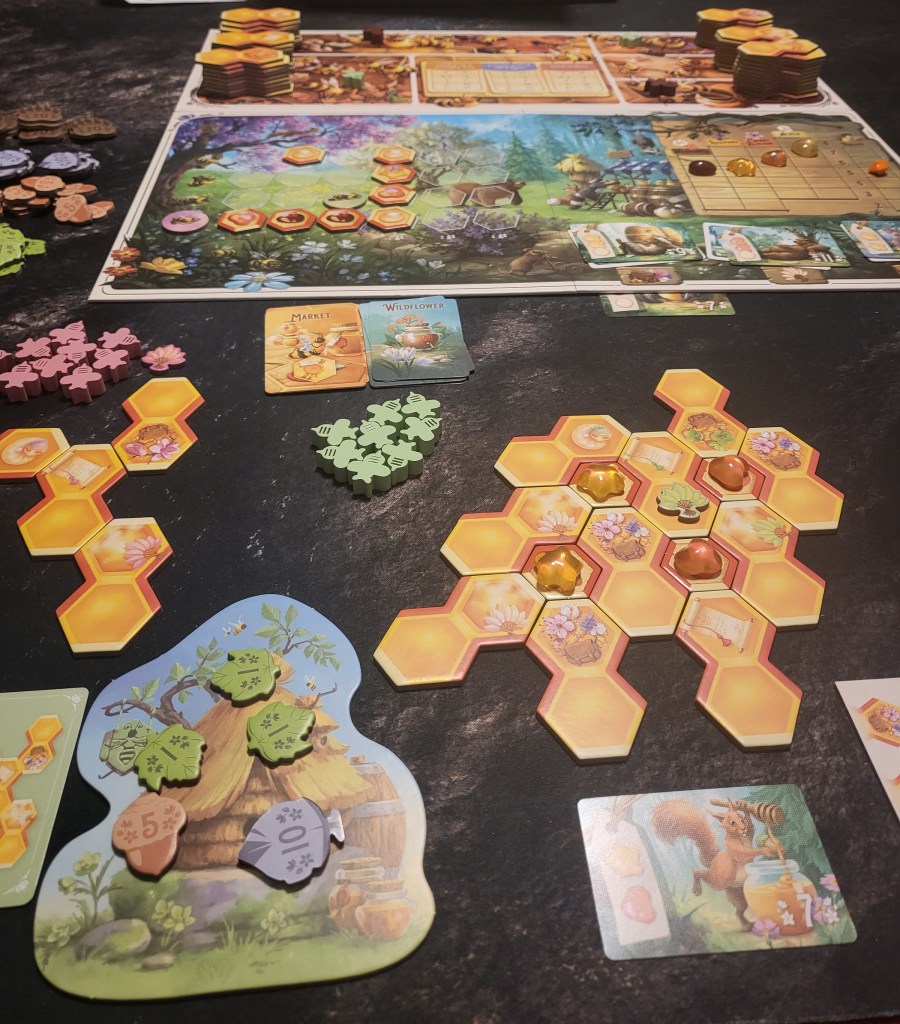
The componentry in this game is top notch, especially for the price point and for it not to be any sort of collector’s addition or anything. The cards have linen finish, all the BEEPLES are wood, and the cardboard components are sturdy. The best part is the texture of the honey pieces; they feel ooey gooey and sticky like honey but they’re really not either of those things. It’s so brilliantly confusing. 😂 I also adore the chosen pastel color palate for this game. It’s lovely and soothing and thematically appropriate.
In the solo game, there’s not really an AI to facilitate, it’s more of an added step each turn. The incorporation of large drone bees (literally, the drone BEEPLES are extra big) is the major change to the solo game, and what increases the tension. There is a deck of cards to dictate where the drone bees get placed as well as an action that the drone takes. While being an easy implementation, I didn’t want to play it solo more than a few times, especially since the cards make the game slightly more luck based, which I usually don’t prefer. There are separate queen’s orders for the solo game which adds some variety, and there are multiple difficulty levels you can choose from, but the game felt pretty samey after a few plays solitaire.
The solo experience is enjoyable, but overall, I prefer multiplayer. The player interaction is more fun, there’s a little more freedom in the game, and I found it overall a more strategic experience. In the solo game, if a drone bee is at a location on the hive board, regardless of the number of BEEPLES you can place, you can’t collect tiles from that location which felt very restricting. The multiplayer game removes that (I learned it solo, so I felt like the world was my oyster playing multiplayer) and adds more decisions on where to gain tiles from, how to maximize your BEEPLES and hive, etc. which made it more pleasurable and puzzling (always a plus from me).
Well, there you have it! I like Honey Buzz a lot, just not as much for solo play. Thankfully, it plays in a decent amount of time (60 ish minutes solo, 75 ish two player) and is pretty easy to teach because each of the actions make perfect thematic sense. I love a game with thematically integrated mechanics, and this one does it well.
If you’re still reading and you’re not tired of me using the word BEEPLES every chance I got, you’re a saint.
 The Adventures of Yogi Bear and Delaware
Leave a comment