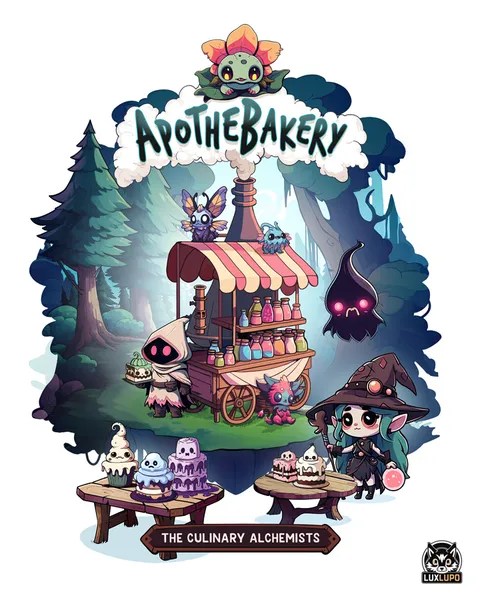
Image taken from https://boardgamegeek.com/image/8650590/apothebakery-the-culinary-alchemists
Designer: Paolo Jones
Publisher: Lux Lupo
Artists: Jonas Fischer, Paolo Jones
If you don’t want to read this whole review, here’s what you need to know about Apothebakery: it’s adorable with fabulous artwork, it is fun, silly, light-hearted and is more luck-dependent than strategic. It does still create some interesting decisions, though, using multiple mechanics such as bidding, resource management, and push your luck. From our experiences, playing with others (for us at two players) is superior to the solo game, but the solo mode is well done and a welcome addition.
Now onto more specifics. Over the course of six rounds, players will use character cards (called Forries) in their slightly asymmetrical deck to bid on turn order as well as provide the total amount of energy that can be used to acquire resources from the wilderness. Once the resources are gathered, players can use their alchemy station (player board) to turn those resources into elixirs which can then be used to heal adventurers. Most of the reputation points in the game come from healing adventurers, but players also have hidden objectives that score at game’s end, and there are end-game bonuses that provide a few additional scoring opportunities.

I’ve never done this in a review, but I’m going to go through some of the details of the mechanics because I think they explain the gameplay and overall flow of the game nicely.
Bidding: Not only is there bidding but it’s blind bidding. Each player has a deck of Forrie (creature) cards that have varying degrees of energy. At the start of each round, players draw three cards from their Forrie deck and decide which cards they want to use for that round’s bid. Once everyone has selected their cards, all reveal simultaneously, and then the player with the lowest total energy goes first then everyone else follows in ascending order. The first player then gets the first pick on which resources they want to gather from the wilderness. Each card in the wilderness has an associated energy cost as well as a specific resource it represents.
Push your luck: Once everyone has collected their resources, players use their alchemy stations to transform their resources into elixirs. Each resource card has a specific potency ranging from one to three, which corresponds to the number of elixirs that can be drawn from the respective bag if that resource card gets discarded. Each bag has pure elixirs (most common), impure elixirs, and failed elixirs (least common). The elixirs are drawn blindly from the bag, so it’s possible not to draw any pure elixirs depending on what other people already have and how many you are drawing. Besides the decision on which resource(s) to use, each player board also comes with four special abilities. Using these abilities costs mana (which you have a finite amount of for the whole game), so they must be used sparingly, but they can help you make wild rainbow elixirs, purge unwanted elixirs, add potency to a resource (so you can draw one extra out of the bag), and transmute one resource into another.
Resource management: Once all players have their elixirs, in turn order, they can use/spend those in specific combinations to heal adventurers. Each adventurer has a diagnosis which determines their health value (how many rounds they survive) and a cure which identifies the type(s) and number elixirs required for healing. All player boards can only hold a certain number of elixirs (six), so players have to manage the elixirs in their inventory to ensure they have space for what they need.
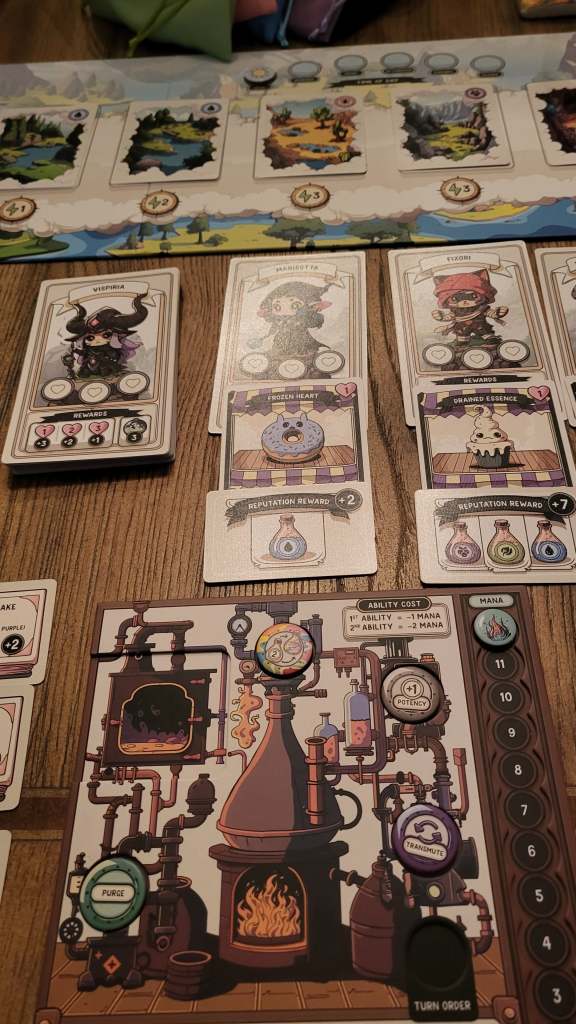
Action timing: Each round has a pretty specific order of events and actions, but as players heal adventurers, they gain spells that can be utilized at different points in the game. Each player board can only hold one spell card, so players have to decide when to use the one they have in relation to the timing in the game but also if the spell they currently have should be played before healing an adventurer and acquiring more.
Hidden goals: After all six rounds, players score additional points based on three hidden objective cards that were drawn at the start of the game. Success can be based on luck (ex. if you need three blue cakes and only one shows up in the game), but others require strategic considerations that make each game slightly different and more mentally engaging.
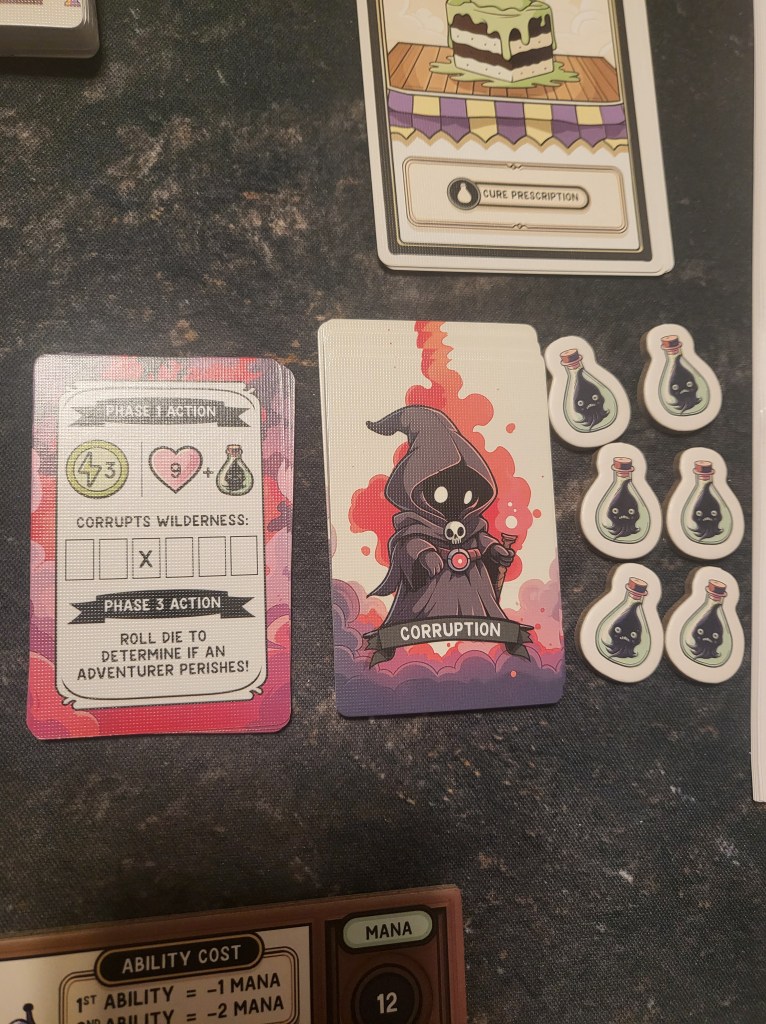
The solo mode involves a corrupt AI opponent that tries to gain negative (corrupt) reputation points. During the bidding phase, a card is revealed from the corruption deck that indicates their energy amount for that round. During the healing phase, a die determines which and if any adventurer succumbs to corruption. The solo mode is fun and creates a decent experience that’s comparable to multiplayer while not being difficult to facilitate, but part of the joy in this game is experiencing the goofy diagnoses, cake art, and luck-dependent outcomes, so I didn’t find it quite as fun. I also found the token draws more enjoyable with others so you can celebrate, complain, or revel at the results. Additionally, the luck factor affected me more and/or made me more irritated in the solo game vs. multiplayer as the AI actions are solely based on cards and a die.
Truthfully, there is quite a lot of randomness in this game. While that is great in terms of the replayability value and variability from game to game, it doesn’t help with the significant luck factor. Not only are all card draws (resource cards, diagnoses, cures, spells, objectives) going to be random, but the potency of each resource is completely unpredictable and not based on its cost, obviously the bag draws are sheer luck, and any time an impure elixir is used, a die is rolled which could add or subtract victory points or cause immediate death, all of which could be significantly impactful on the game.
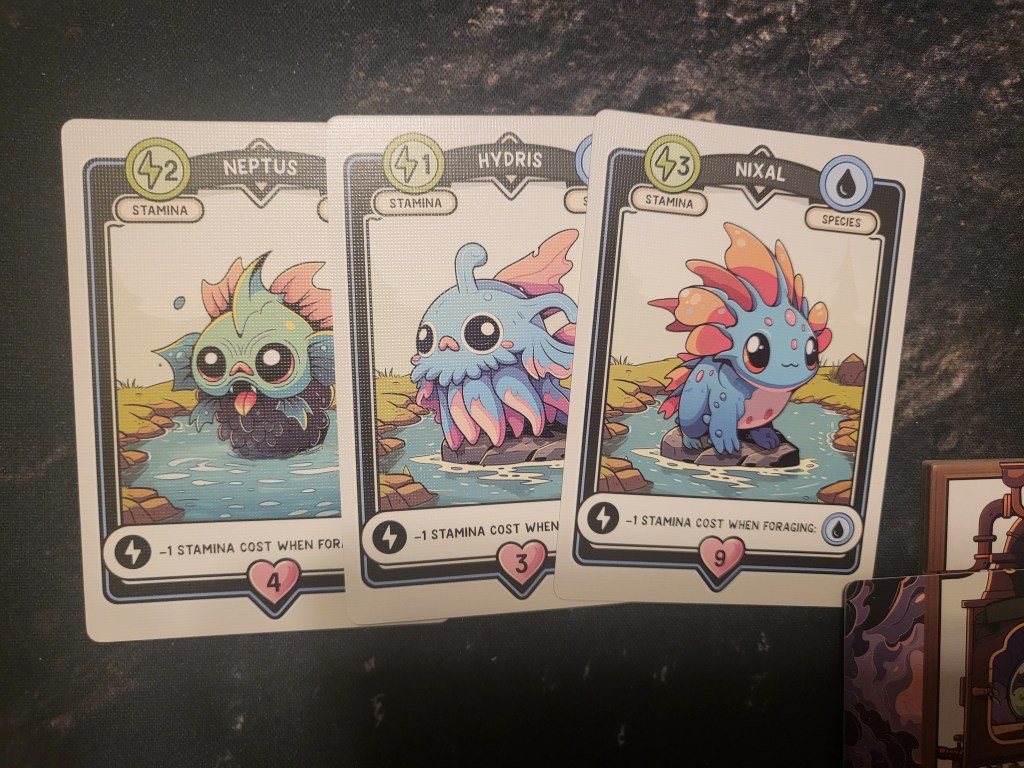
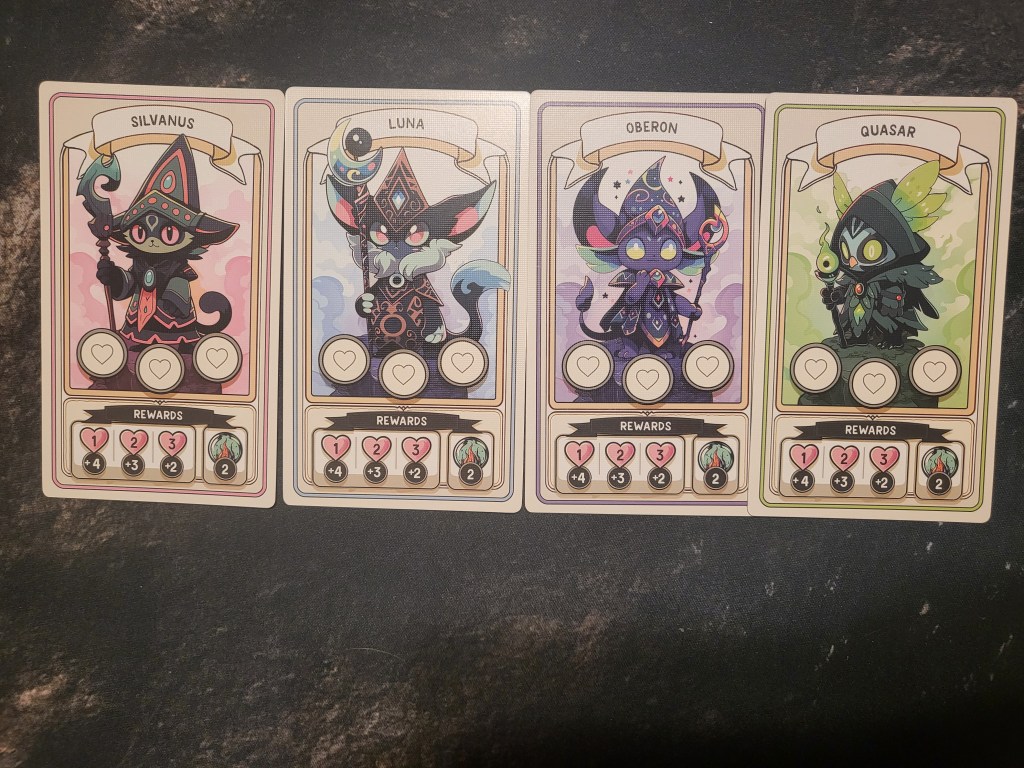
There are a few other aspects of this game that I haven’t touched on that I think are worth mentioning. First, each Forrie deck is associated with a specific resource, so the cards for that resource in the wilderness cost one less for that player which is fun. Each deck also has a special iridescent Forrie that can only be added to the deck if it’s not possible for that player to gain any resources from the wilderness. In our five plays, that has yet to happen. I think it’s a great addition, I just wish it was more relevant in the games (at least at lower player counts). Also, the alchemy phase (where elixirs are made) can happen simultaneously to reduce play time but we found that was tricky because often more than one player needs to pull from the same bag, and the established player turn order then matters (we ended up doing some partial simultaneous pulling). Lastly, if an adventurer dies (is not saved in time or an impure elixir gets used and the skull icon gets rolled), they get flipped to their ghost side which has a side effect that impacts the player(s). If they die by a dice roll, only that player is affected, but if they die because the players couldn’t save them in time, all players face the ghost consequences. This creates a really interesting and unique cooperative aspect to this game. Yes, the game is explicitly competitive, but you collectively don’t want the adventurers to die, so it can be entertaining to try to plan with the other players and determine who is going to try to heal which adventurer. Of course, players could screw each other over, but because of that collective imminent death, there’s incentive to work with others and prioritize healing certain adventurers based on their health status.
As the rule book states, this game is about having fun, and this game does that well. It’s not deeply strategic or satisfyingly puzzly, but there is enough to feel like your choices matter (for the most part), and it’s just an overall enjoyable, playful game. The artwork is also adorable and stunning. Half the fun of experimenting with the different Forrie decks is to see the unique artwork for each creature, and part of the enjoyment of the diagnosis cards is looking at the illustrations of the silly cakes. Apothebakery delivers on what it claims to be and doesn’t pretend to be anything it’s not, and I love that.
P.S. The Kickstarter came with this neat Arcane Adventurers micro expansion that adds different adventurers that provide mana instead of spell cards (a nice twist), and they’re visually stunning!
 The Adventures of Yogi Bear and Delaware
Leave a comment