
Image taken from https://boardgamegeek.com/image/8061612/neko-syndicate
Designer: Dani Garcia
Publishers: Combo Games and 25th Century Games
Artist: Jennifer Giner (Graphic Designer : Pablo Sanz)
While this is only the second Dani Garcia I’ve played (with the other being Windmill Valley), I absolutely adore his game designs. Neko Syndicate is a unique action selection game where you construct a pyramid of cards and choose paths along the pyramid to perform actions. The ultimate goal is to earn the appreciation of the Kumichō through the acquisition of prestige points by completing missions and delivering sushi. With a fun theme, interesting design,
intriguing and distinctive mechanics, and a relatively small box with high replayability, this one is definitely a keeper!
To set up the game, besides preparing the path (this tracks the number of rounds), you also draw three missions to be used for that game. There are 24 different mission cards included in the game, so there is a lot of variability in just this aspect. These goals are one of the two main ways to score points, and the faster you achieve them, the more points you receive. Besides your starting lieutenant card (these are all the same, and are always the top card of your pyramid), you also draw four minion cards, choose one to place in the second row of your pyramid, one to keep in your “minion waiting area”, and then discard the other two. There is also a majorly fiddly bit to set up: each player places eight cubes of each sushi type (so 32 total) in their warehouse. During the game, the cubes don’t bother me, but packing the warehouse(s) is a pain in the neck.
Over the course of fifteen rounds, players decide which path on their pyramid they would like to take, then move individually from card to card (or action space to action space on each card) and perform each corresponding action (you don’t have to do all of them if you don’t want to). The lieutenant card has two options for starting your turn: you either draw three cards from the minion deck and then discard any combination of two you have (can include those in waiting) or you add a card to your pyramid. After that initial card, the main action options on the minions include preparing/producing sushi (the fishmonger), transporting cubes between adjacent neighborhoods (delivery lady), moving cubes between neighborhoods via subways (subway operator), prepare nigiri (cook), or exchange sushi cubes (storekeeper). For the record, some sushi spots on cards don’t have to be cooked, but all the nigiri spots do.
After each player has finished all actions they wish to perform on their pyramid, the three goals are evaluated. Any player that has achieved one or more missions places their scoring marker in the corresponding location. Besides the missions, players can score points via sushi deliveries and by completing full sushi orders on cards. The tricky part is that there are also ways to lose points at the end of the game including not having a full pyramid of cards, having leftover sushi, and cards with no delivered cubes. Another interesting scoring aspect is that each level of the pyramid has a multiplier, so you take the sum of positive and negative points for each level and multiply that number by the specified level multiplier number. It’s a little math heavy, but I really appreciate its uniqueness and the way it encourages balance throughout the game.
The one time I played the game with the fiancée, his response was, “that’s hard”, and he’s not wrong. Not only are you continually trying to optimize your action selections, but you also have to consider where to put new cards in your pyramid, when to keep and discard minions, and how the actions on the card will impact the flow of your engine. Since you are travelling along a path, the actions completed must be in order; you will always have the choice of the two actions on the lieutenant card first, but after that, you have to decide which consecutive action in the pyramid would be the most useful. Another curveball is that when you perform the actions, the card’s location in the pyramid determines your ultimate reward. For example, if you choose to complete a fishmonger action in row two of your pyramid, you gain two sushi cubes of the corresponding color. However, if that same card was in row four and you selected that action, you would gain four cubes. It’s brilliant! Needless to say, there is a LOT to think about and each decision is important, and I love it!
But wait, there’s more! One thing I forgot to mention: each minion card has two neighborhoods on it, so when performing the delivery lady action, you’re not moving the cubes from card to card but neighborhood to neighborhood making it even more tight and challenging.
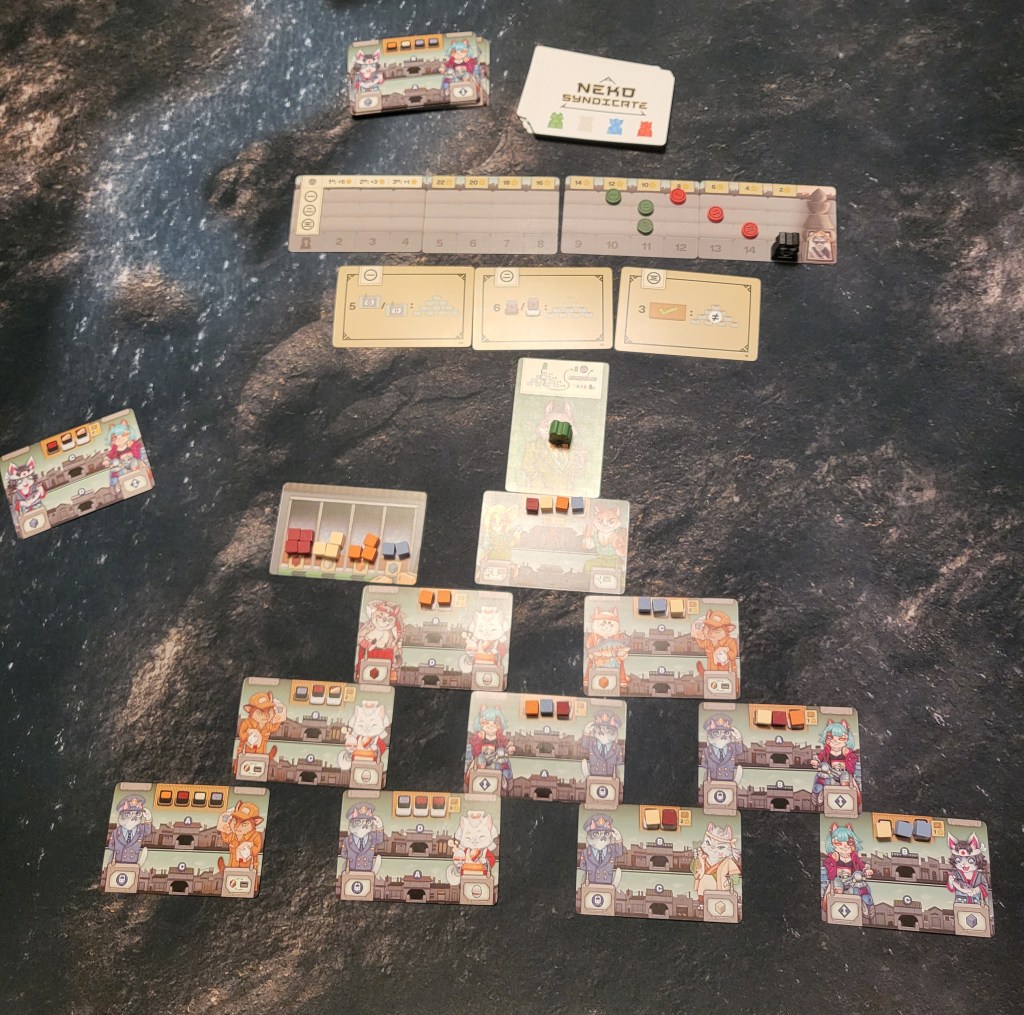
Sorry the glare on this is terrible. Somehow, it’s the only picture I have of this game!
The solo game plays almost identically to the multiplayer game, as the solo player just plays fifteen rounds as usual working to maximize their prestige points. At the end of the game, the AI opponent “CatANNA” gets her own pyramid from your discarded minion cards and a certain number of sushi cubes to fill those depending on your selected difficulty level. I appreciate that there isn’t a true AI you have to facilitate in-game so you can focus entirely on your own puzzle, but setting up a whole pyramid and distributing the cubes for CatANNA at the end of the game is rather obnoxious. It’s fiddly, time consuming, and all that it provides is a score to compare against. That said, I do greatly appreciate the numerous challenge levels for the solo game with variables in CatANNA’s mission scoring and number of sushi cubes she uses.
Besides the fabulous mechanics and game design, Neko Syndicate also has the following positives: awesome, creative artwork, nice componentry, an appropriate box size, a great game play length (as there are a fixed number of rounds and turns in a multiplayer came can happen simultaneously), a fun theme that’s not explicitly integrated into the mechanics but is done well in general (the artwork and round structure helps), and a great rule book that is easy to follow, has solid explanations and useful pictures.
As briefly aforementioned, there’s also high variability in this game with the different missions, randomness of the minions (and number of minion cards), solo challenge levels, etc. which is phenomenal, especially for a smaller box game. Overall, Neko Syndicate is a super solid and unique brain burning game that’s not overwhelming or overly complicated and is fantastically designed as a really clever puzzle.
 The Adventures of Yogi Bear and Delaware
Leave a comment