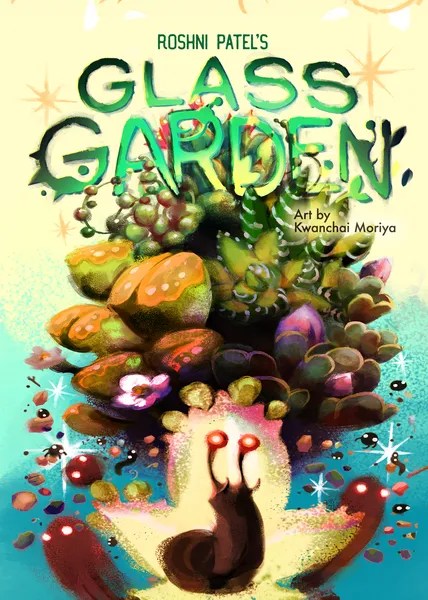
Image taken from https://boardgamegeek.com/image/8482221/glass-garden
Designer: Roshni Patel
Publisher: Button Shy
Artist: Kwanchai Moriya
Ah yes, another wonderful, small, solo Button Shy game. As with all their games I’ve played that fall in this category, I love the minimal storage space, quick game play, and surprisingly deep strategy, and this one is no different. Over the course of the game, players work to combine resources to grow succulents while mitigating damage done from critters. At the end, points are scored based on succulents and their location in the garden.
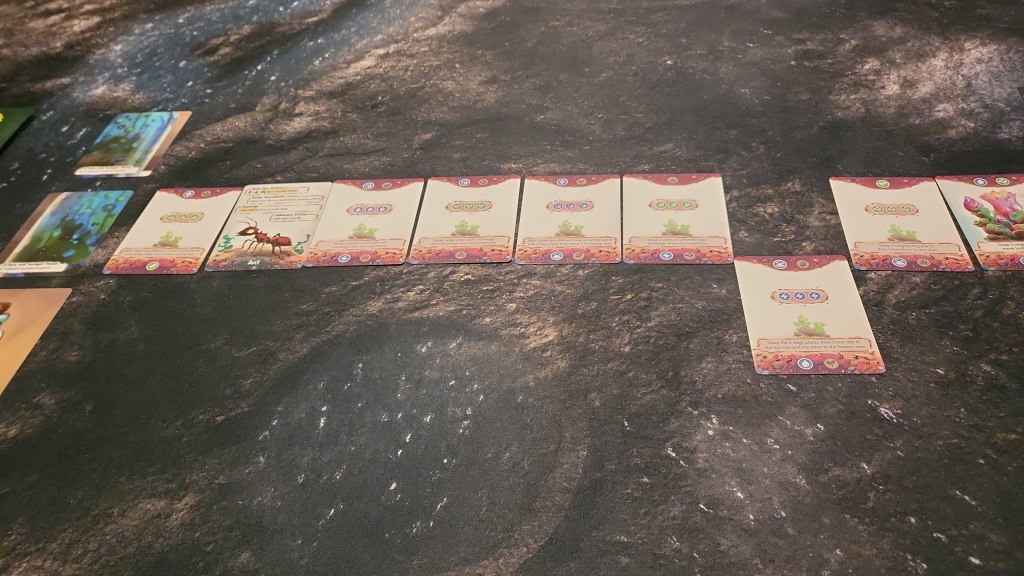
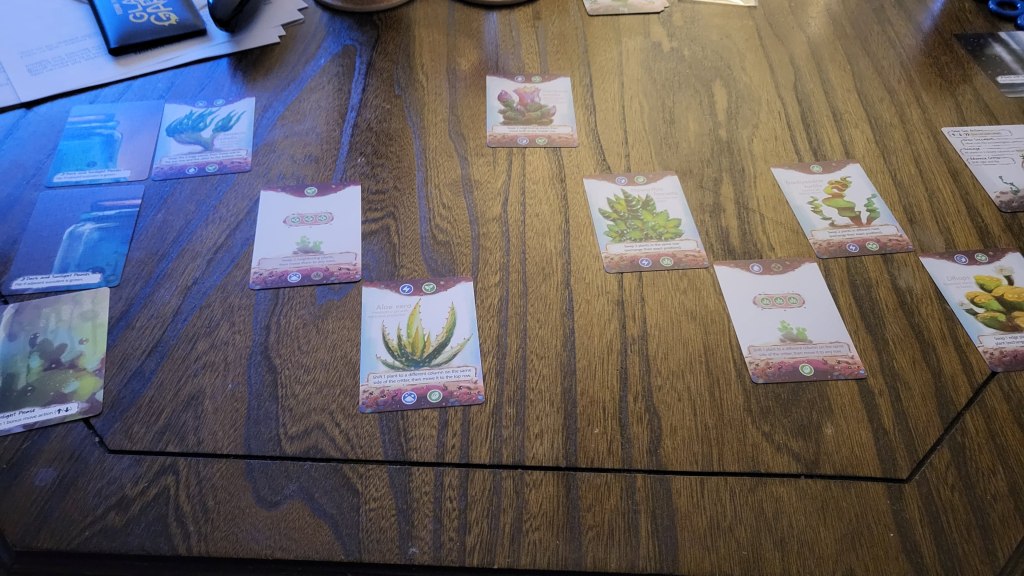
Set up is simple. There are six glass cards that get shuffled and placed on both ends of the play space (three on each side), one critter card gets placed on the far left of the middle row, and then the eight plant cards get shuffled and randomly placed in a line to the right of the critter. Each round, players can take up to two actions which include moving a plant card any number of spaces in the direction indicated by the critter or shifting a plant up or down a row. Since there are three glass cards on each end, there are three total rows plants can live in.
Once the player has completed up to two actions, any succulent(s) that have the necessary active resources can grow. One of my favorite aspects of this game is how the resources are designed. Each plant card has available resources on the top and bottom, both of which are called the fertile zones. To grow a succulent, the specified number and type of resources must be present in the same fertile zone from plants in three consecutive columns and not separated by the critter.
After any/all succulents are grown, the critter damages the garden by (usually) moving cards down a row. Each critter (there are four included in the base game) has a unique damage ability, and each critter also has two sides which can impact which side of the garden gets damaged. Once the damage has been dealt, to signify the end of the round, the critter advances one column to the right and gets flipped over. Play continues until the critter cannot shift to the right any further, then the sunlight phase occurs.
During the game, if any succulents that grow are adjacent to a glass card, that glass card gets flipped from its dark side to its light side. During the sunlight phase, the player can use any bonuses on the glass cards they flipped to the light side (usually providing additional move actions), then all succulents get scored. Players attain one point for each succulent in the bottom and middle rows of their garden, and two points for each succulent in the top row.
As I mentioned, Button Shy knocked it out of the park again on this one. The artwork is absolutely gorgeous, and the game play backs it up. It’s a really clever puzzle overall, and the design is unique and exciting. I enjoy that each critter damages the garden differently, and flipping the critter each round means they affect alternating sides of the garden (usually). The fact that all required resources have to be in the same fertile zone AND on the same side of the
critter AND in three consecutive columns is brilliant. I didn’t mention this during my overview, but succulents provide more resources than the standard card (what the game calls “soil side up”), so the more you grow, the more resources become available. The glass card element creates an interesting additional layer of strategy as well. All these incredible design choices come together to form a delightful and challenging game.
During the Kickstarter, I also added on the centerpiece expansion which adds four new critters and includes a new mechanic with four unique centerpiece cards. The critters just provide more game variety (and a steeper challenge), while the centerpiece cards add an extra goal for the player to achieve. Each centerpiece card has a specific pattern on it in relation to the plant formation in the garden relative to the centerpiece. Once the pattern is matched, the centerpiece gets flipped and the player gets a useful bonus to utilize immediately. With the expansion, a player cannot win if the centerpiece is not flipped.
The base game itself has some inherent randomness, and there are four critters to experiment with, so that version itself has quite a lot of variability to keep the game from getting stale. The expansion increases the variety exponentially. Even if there were only extra critters in the expansion, it would provide a lot of extra replayability, but the added centerpieces also aid in a feeling of continued freshness for each game.
After quite a few games, I have to say, this game is tough! I was feeling good in my first game with the fly (suggested for your first game) as it doesn’t damage the garden, but the more I experimented with the other critters, the harder it became to score well. Then, I added in the expansion which dials the difficulty up even more, and I got crushed. The critters in the expansion are mean! Playing has been a lot of fun, though, and I look forward to working to improve my scores. I realized I’m not very good at growing succulents at the edges to flip the glass cards, which I’m sure would be useful, but with the critter in the middle for most of the game, that’s challenging to accomplish (or I am missing something massive, which is possible).
As with most of these solo pocket games, this one is definitely a keeper. I still have a lot of game to explore and a significant amount of improving to do, and it’s just a really fun puzzly experience. If I had to compare it to A Nice Cuppa (just because that was the last one of these style games that was released and I reviewed), I’m more likely to play A Nice Cuppa solely for the fact that Glass Garden is almost a little too hard, and A Nice Cuppa has a lovely puzzle without being directly mean to the player. I understand that’s the point of the critters, and I greatly appreciate Glass Garden for what it is, I just have to make sure I’m not feeling sensitive when I play it. 😂 Who knew a beautiful package could be so prickly! I guess succulents can be like that sometimes, too. 🤷♀️
 The Adventures of Yogi Bear and Delaware
Leave a comment