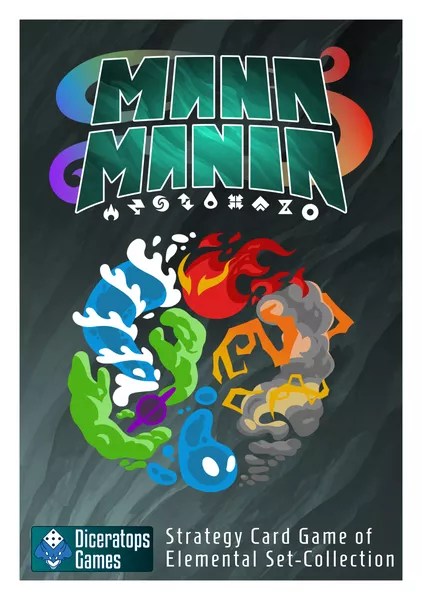
Image taken from https://boardgamegeek.com/image/8352118/mana-mania
Designer: Anonymous but on the Diceratops team
Publisher: Diceratops Games
Artist: TortleDove (@DoveTortle on X)
Before I get into the nitty gritty of the review, please note that a preview/prototype copy of the game was provided via Diceratops for an honest review. All mentioned and pictured gameplay, components, and artwork are subject to change.
Also, this is our first ever preview copy received and therefore prototype copy review, so many thanks Diceratops!!
Mana Mania is a unique set collection game for 2-4 players. Over the course of the game, the players work to build up a set of specific element cards in their tableau to score points at the conclusion of the game. The twist: only one of the elements will score for each player, but the element that scores is entirely up to the player and their game decisions.
To set up, the Leyline board, which contains a line of nine elements, is placed in the middle of the table, player order is determined (more on this later), and each player selects the spirit they would like to play as. There are four player cards, each with a unique spirit on both sides, providing a total of eight spirits to choose from. There are no asymmetrical game powers, the spirits are just for fun. As there isn’t much art in the game besides the element symbols, the characters are very well done aesthetically and are a pleasurable addition.
Once each player has their spirit player card and respective token, one card from the 81-card elemental mana deck is dealt to each player. The deck contains nine cards of each of the nine elements. Whichever element each player is dealt becomes their starting location on the Leyline board, and their spirit player token gets placed at the corresponding element symbol. Then, each player is given eight additional cards for a total of nine cards to be placed in a face-up tableau visible to all players. After all players have their cards, four additional cards are drawn from the deck and set face-up in a central location. This is referred to as the Mana Pool.
Starting with the lead player (rotates every round), each player takes a turn in clockwise order over a course of rounds (number of total rounds is dependent on player count). A turn consists of using up to three actions: the Mana action, the Elemental action, and the Shift action. Each of these can only be performed once each turn, but the player can choose to skip any actions if desired, and they can be executed in any order.
The Mana action allows players to trade one card from their tableau with one card in the Mana Pool. The Elemental action permits players to discard one card from their tableau to perform the indicated ability on the card. Each card of the same element type has the same ability. The clever part here is that the card you discard must be within range of your player token on the Leyline, meaning the element on the card has to be the same or adjacent to the element at which your player token is located on said Leyline. Using the Shift action, players are able to discard one card from their tableau to move one space on the Leyline.
As you can see, each of these actions can be interconnected, so the order of actions is actually quite important and can vary from turn to turn. This provides some interesting strategic decision making and tactical action selection.
In between rounds, the Mana Pool is completely refreshed, and each player draws back up to nine total cards in their tableau. It’s also important to note that some rounds (again dependent on player count) are boosted rounds meaning players can choose to use boosted actions instead of the standard actions. I won’t go into the details of these, but as expected, these action options are
stronger but it’s not possible to take all three boosted actions in a single turn, so this adds an exciting layer of strategy and consideration. Play continues until the conclusion of the final round. Points are calculated based on the sum of the card scoring values, but remember, only the cards corresponding to the single element your player token ends on get included and all other cards are essentially useless.

After playthroughs at all possible player counts, here are some likes, dislikes, and neutral thoughts on Mana Mania.
Likes:
1) The first player is determined by the last player to pet a cat which I think is imaginative and entertaining. Unfortunately, the rules state cats cannot be players. 😕
2) The player aid/reminder cards are well made and useful.
3) The boosted actions are an exciting twist. They provide variability during the game and also influence strategy.
4) The player action tokens are a great design. Players can flip them over once an action is complete to manage and organize their turns keeping things smooth and easy to track.
5) As mentioned, each character card (and token) is double sided with fabulous artwork that portrays quirky and fun-loving personalities.
6) There’s a good variety of actions without being an overwhelming selection, and each action has a definitive purpose in the game. Enough happens to feel like you’re progressing in the game, but each turn is still pretty quick and streamlined.
7) Similarly, the elemental abilities have nice variation and are all special and impactful at different points in the game creating an enjoyable decision space. The correlation with the player’s Leyline location is also a smart and distinctive design choice.
8) The Leyline board is very unique and thematic. The different starting player positions and the importance of a player’s location on the Leyline at game end are fascinating.
9) It’s easy to teach as the rules are quite straightforward, and it doesn’t take long to set up or clean up. I think part of the ease of teach stems from the good symbology, a solid rulebook, and overall simplicity.
Mixed:
1) We have such mixed feelings on the open information player tableaus. It makes it significantly simpler to try to guess which element a player is focusing on, making it easier to sabotage and increase the player interaction. That said, it also provides the opportunity for card counting (could be positive or negative in and of itself). It’s interesting to think about what the game would be like with a closed hand, but there is one card action that would essentially be useless with that design, so open information ultimately makes sense.
2) This game seems to play better at higher player counts. As we mostly play at two, this is a bit of a negative for us, but a peak at four players could be good for other groups. In a four-player game, there’s more going on and it’s more chaotic in a fun way (still not very wild, but slightly more exciting than at two). There’s also one card ability that is pretty underwhelming at two players, and the zig zag play with two players is interesting but odd.
Dislikes:
1) As with most card-based games, success is very luck dependent. Yes, there is some strategy, but there’s little players can do in-game to mitigate the luck factor.
2) Overall, the game is a little slow. Besides the one action card just mentioned, there is minimal player interaction, so other players’ turns aren’t typically particularly exciting. It’s also possible for one player to get quite far ahead and there’s not much in terms of a catch-up mechanic.
3) While there is inherent variability with the randomness of the cards, the replayability on this is questionable. Yes, each game will likely be different in terms of card construction and order, starting location, etc., but the gameplay loop itself seems to be very similar from game to game, which could get repetitive after a few plays.
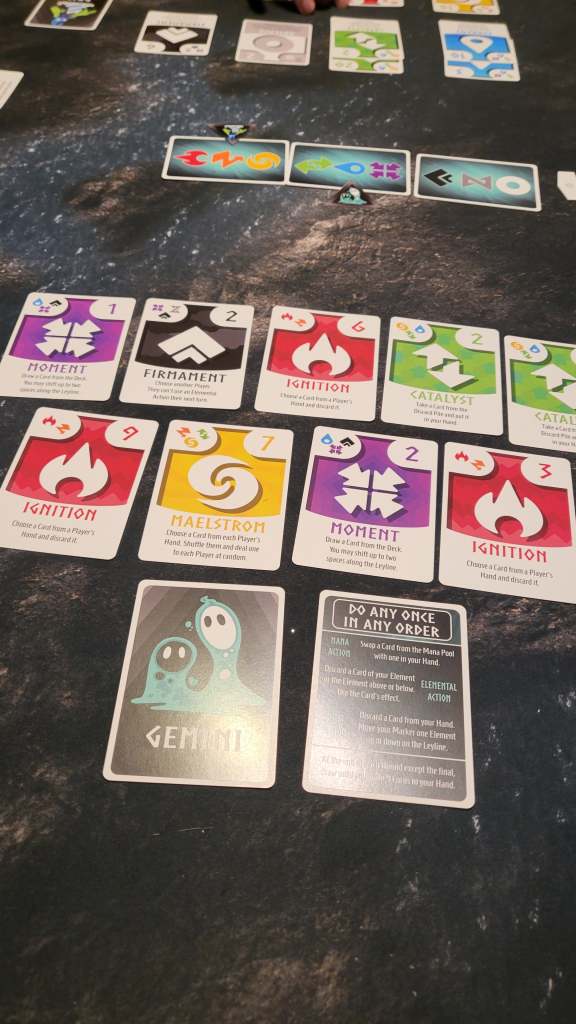
As you can see, I like playing as Gemini. 😂
On an important note, we identified a few understandability/clarity issues as well as a few design changes that could be made to improve this game (in our opinion of course). We have sent these to the publisher in hopes they can influence the final version of the game, but I don’t think it’s fair to include those in our likes and/or dislikes since they’re more specific to the game as it is currently. Graciously, Diceratops was very open to our feedback, so hopefully the game improves from here!
In general, Mana Mania is not a bad game at all! We enjoyed it, especially at higher player counts, but we don’t love it. It presents a unique twist on set collection, but overall, there’s nothing drawing us back to play it again and again, and it seems just one step short of really clicking. However, if you like set collection and/or the theme really speaks to you, this is definitely one to check out!
 The Adventures of Yogi Bear and Delaware
Leave a comment