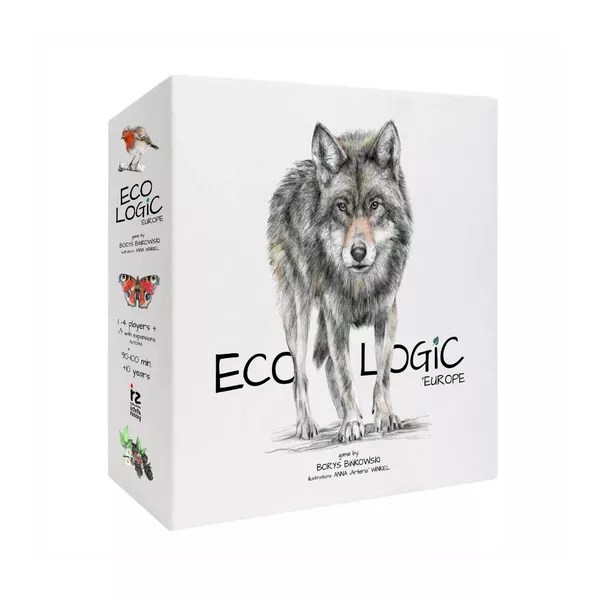
Image taken from https://boardgamegeek.com/image/8427593/ecologic-europe
Designer and Publisher: The one and only Borys Binkowski
Illustrations: Anna Winkiel
First of all, I’m not being sarcastic with my line above; it’s truly incredible that he designed and self-published this game. Besides my interest in the game theme and mechanics, a major driving factor for me backing this game was that Borys wasn’t interested in getting a bunch of reputable (or non-reputable for that matter) board game reviewers to play it and share their thoughts. The only information and videos on the page were from Borys himself. He just wanted to make a game from his passion and creativity, and I love that. I also adore that he manufactured and published the game entirely in his home country of Poland. While shipping costs did end up being higher than initially anticipated, I’ll take local production with a few extra dollars in shipping any day!
This game consists of three main components: habitat boards, resource tokens, and species cards. The cards and boards are well made, and the boards are double-sided to increase variety. The resource tokens are solid wood and appropriately sized. The artwork on the boards is lovely, but the illustrations on the species cards are absolutely gorgeous. Not only does it add to theming and immersion, but it’s also lovely to look at and really makes the game an experience vs. just another nature game. I also have deep admiration for the selected species, as they are all different and are endemic to Europe (scientific!).
The basic mechanics of this game are relatively simple. Over the course of four seasons, you try to grow your habitats into diverse and thriving ecosystems. Each round, you can either play a card into one of your habitats or discard a card to get a joker biomass token. Plants and trees, when played, produce biomass with the amount depending on the season and species. Other organisms require specific amounts of biomass from certain types of organisms. For example, a red squirrel can use trees, insects, fungi, etc. while the red fox requires small birds, amphibians and reptiles, small mammals, and invertebrates. In order to play a card, the amount of required biomass from the indicated types must be available in that habitat (logically, it’s a “feeding” type system). Each card has specifications on which habitat it can be placed in, so you have to decipher when to play which animal and where to maximize the diversity and productivity of your entire ecosystem.
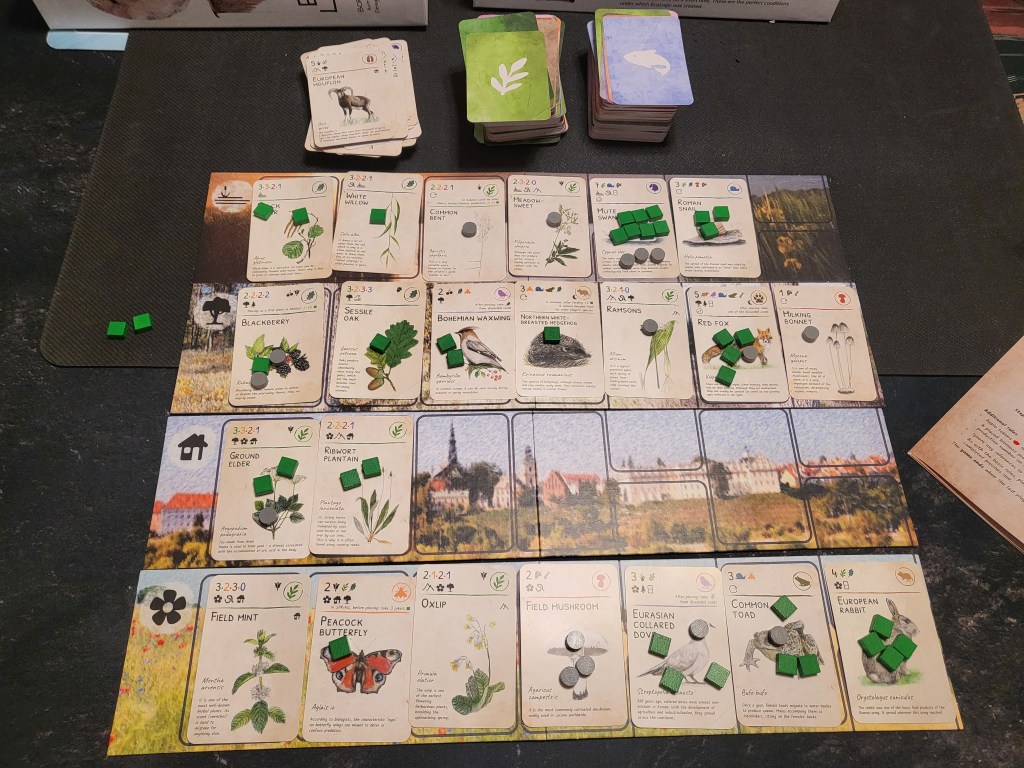
At the conclusion of a season, some biomass decays into remains, some remains on the organism, and any producing species will increase their amount of usable biomass according to the season. At the end of the game, points are scored via specific animals in your tableau with a printed points value, as well as for the overall diversity in each habitat. If there are five unique types of species in a habitat, you gain one point, six different equals two points, and seven is three points. Those are the only two scoring conditions, so the final scores are usually pretty low.
Overall, this game is unique, quite thematic, and just plain fun. It’s a great puzzle with interesting and well-integrated thematic mechanics. Not only do you have to ensure that you have enough biomass in the required habitat for the card you wish to play, but you also must guarantee that organism can be fed each future season as well, which is super fascinating. Creating an ecosystem that can support each additional organism as well as being as diverse as possible is an enjoyable and welcome challenge.
A few other interesting mechanisms include some pass drafting with your cards, which causes some internal tension as you sometimes have to sacrifice (not literally) certain species so you can work on building up your ecosystem, and you also always gain new cards to potentially integrate into your strategy and tableau. There are also certain animals that can be played in two habitats (half and half) which can make feeding them easier, but they also typically (not always) require more biomass. Some cards also have specific effects that can trigger when played or throughout the game. As it makes sense in nature, you also cannot play plants or insects in winter (the last season). There were multiple games this slipped my mind, so I never got an insect into some habitats that needed one for diversity and food. Oi.
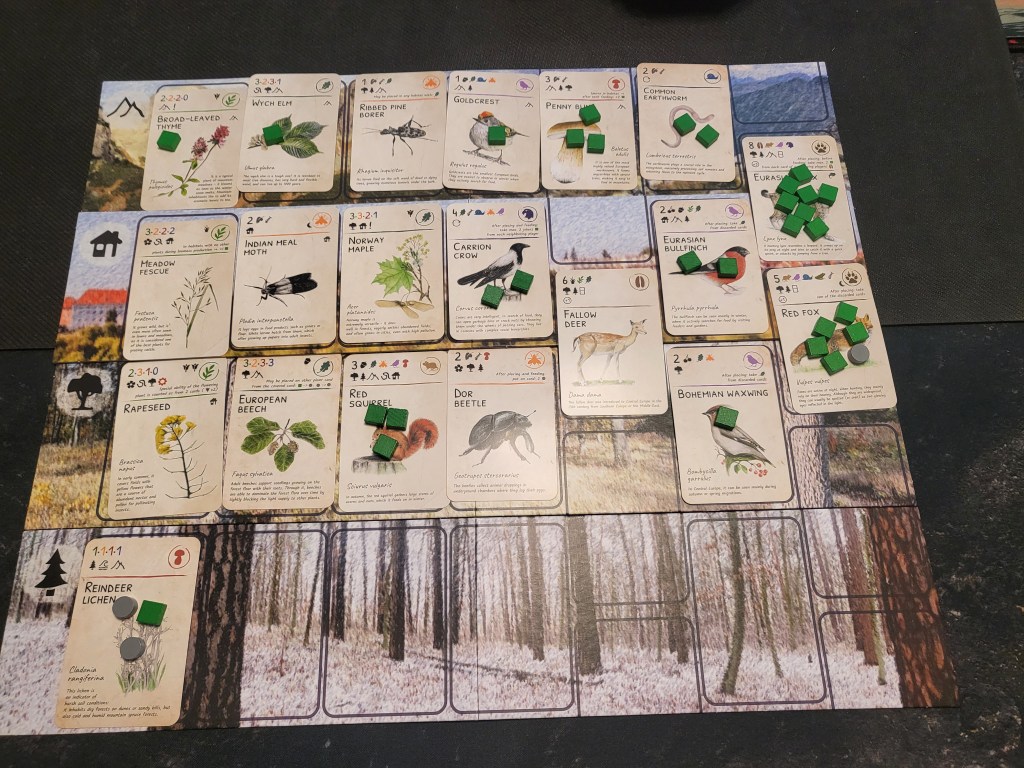
Besides the wonderful aesthetic, expressive theme, and clever mechanics, there is also a high replayability value for me. There are a LOT of cards (over 300 I think?) and the randomness of the habitats means no two games will be the same. There are also expansions available (I have all of them…) that increase variability in games and additionally increase the player count range. With all expansions, this game can play 1-7 players which is rather unheard of for a mid-weight euro-style board game. Thankfully, the turns are mostly simultaneous, so I don’t expect the game to increase in length too much with the added players (though I can’t confirm this, yet). In general, I find the game plays in a decent time frame, as it is definitely in the sweet spot for me for its type (solo took me 45-60 minutes once I had a grasp on the rules).
There are some other minor twists and details in the game that go unmentioned here, but know they add to the excitement of the game puzzle. For example, each card back distinguishes what type of card it is (ex. plant, tree, fungi, etc.), so when drawing cards, the players can actually look through the deck (only looking at the backs) to find a specific type of card rather than just pulling from the top. I genuinely don’t know if I’ve ever played a game with that option, but I love it, and it makes a lot of sense for the game. Yes, there is always luck with card-based games, but this significantly helps minimize it.
While I obviously adore this game, there are a few issues with it. There are some typos and weird diction on the cards and in the rule book*, which is always a problem, but it’s a little easier for me to get past knowing the game was self-published by someone who isn’t a native English speaker. In terms of understandability, though, the rule book is well designed and flows through the turns and rounds smoothly and logically, while also providing adequate explanations for each symbol. Some of the cards also need better explanations or wording, but thankfully Borys helped with this post shipment through a card list. Also, as a solo player, the weather and human expansions aren’t particularly useful or fun to play with, but I appreciate their inclusion regardless. The box is also slightly too unnecessarily big, which is really just personal preference.
It took me a few games to fully play correctly, but since the mechanics are so well integrated into the theme, it all makes ecosystemic sense, so it’s easy to understand and fall into the rhythm of the game.
I tried both the standard solo mode and the automa option (huge thanks for the inclusion of two different solo modes), and I significantly prefer the standard solo mode (this is literally what I noted “standard solo mode >>>>>>>>>> automa”). For me, I like that I don’t have to maintain or facilitate any sort of opponent in the standard version, and the puzzle was much more interesting and tense without the automa. I used to play a lot of tennis, and while I liked doubles, I preferred playing singles because I knew the outcome of the match was completely on me. Similarly, I enjoy that I’m the only driving factor for my success or failure; there was nothing that ruined any plans or made me alter my strategy. I am in control of every decision, and I just adore how that opens up the puzzle and deepens the strategy. Because of who I am as a person, I can’t end this review without saying that in the future, I’d love the addition of some solo challenges of some sort because they’re my thing, but that’s definitely not a need.
Honestly, this game may be difficult to find because of the self publishing, no retail release, etc., but I sincerely recommend trying it out if you can. Especially if you enjoy nature, ecosystems, biology, etc., I think you’ll really jive with this game. You’ll have to look past a few minor issues, but I think the puzzly, natural satisfaction of the design, theme, and their integration is well worth it.
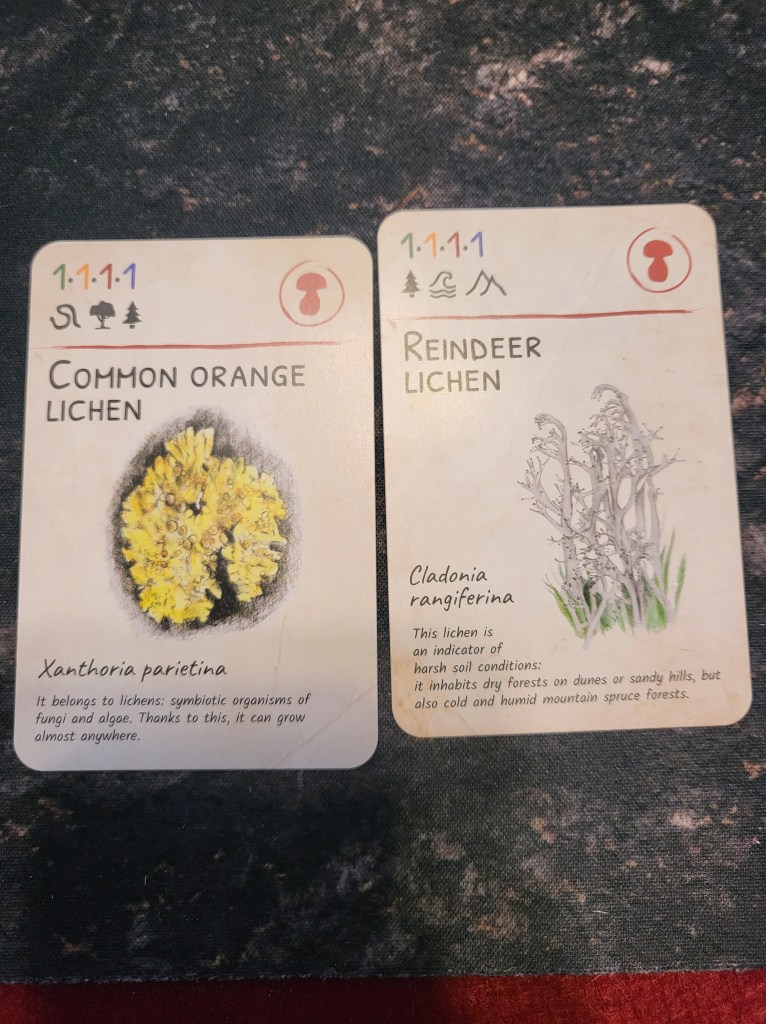
Side note/P.S: I am a lichen nerd, so I sincerely appreciate their inclusion in this game! Most nature games focus on plants, animals, and fungi, but this one actually has lichens! There are even more than those pictured. 🥰
*I will say, today (03/12/25), Borys released an updated rule book to fix some of the wording and also adjusted the rules a little for a two player game. There were evidently some reported issues with the low player count, so those were addressed, which is incredibly thoughtful.
 The Adventures of Yogi Bear and Delaware
Leave a comment