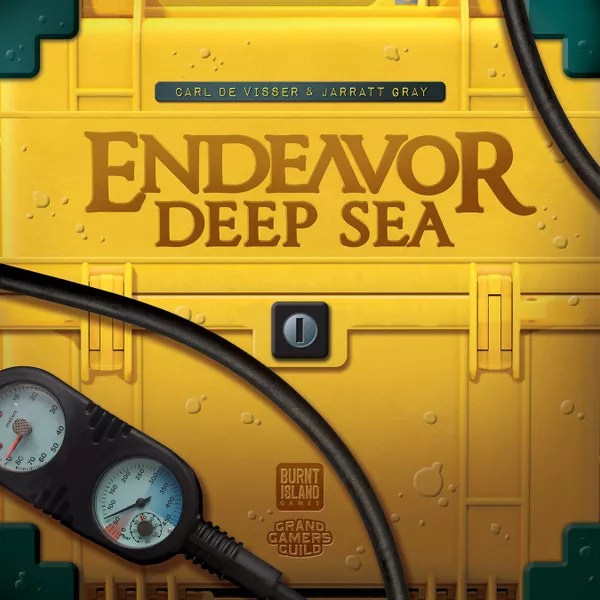
Image taken from https://boardgamegeek.com/image/6996584/endeavor-deep-sea
Designers: Carl de Visser and Jarratt Gray
Publishers: Burnt Island Games and Grand Gamers Guild
Artist: Fahed Alrajil
Besides the fact that it takes up a lot of table space (which I guess makes sense since you’re in the ocean, right?), this game is a real winner. It has beautiful artwork, deliciously intriguing gameplay, multiple game modes, wonderful components, and a really nice game length. What more can you ask for?!
Before I get into the mechanics of this game, I want to talk about the theming, art, and production. First off, the theming is very well done and everything in the game mechanically and artistically ties in well with the undersea exploration vibe. The artwork is gorgeous, especially the ocean zone tiles. The production quality (of the deluxe version at least) is phenomenal. The screen-printed wooden pieces are lovely, and the game comes with nice covering tools and organization solutions including useful inserts with an explanation of where everything goes to ensure it all fits back in the box. I sincerely applaud them for their commitment to conservation and minimal environmental impact; all pieces and parts, including a paper wrapping of the game, are plastic free and sustainable. Kudos publishers: more games need to be made this way!
The actual game play is simply enhanced by the wonderfulness I discussed in the last paragraph. Not only is it strategic and enjoyable, but it’s very intuitive, thematic, and plays in the perfect amount of time for the game design.
At the core, Endeavor: Deep Sea is a mission-based game that focuses mainly on action selection. Each game, the players select a mission (8 included in base game, 10 in the Kickstarter version) which is the driving force for the goals the players work to achieve and scoring at the end of the game. The mission also dictates the set up for each game and can provide some additional rules or objectives for that particular game. While I love this game anyways, the missions really drew me in; I love a game that has various levels or scenarios to try, and the ones created are variable while still fitting in well to the overall theme and story. Each mission is unique enough to not feel samey even after the tenth mission.
My favorite mechanical aspect of this game is the interconnectedness of the tracks on the player board to player turns. At the start of each turn, every player acquires a specialist, gains action discs, and removes discs from actions on which any are currently placed. The interesting part is that the further you move on each track, the better benefit you receive (ex. you gain more action discs), and each track is associated with one of those beginning of turn actions. So, it can be tempting to try to get your orange track rolling to get stronger specialists, but if you don’t move green, you won’t have enough discs to place on those specialists to perform the action, and/or if your yellow is lacking, you won’t be able to remove enough discs to open up spots for your actions this turn. This whole puzzle becomes a giant balancing act very quickly, and it’s so incredibly brilliant and satisfying.
There’s a fourth track on the player boards that relates to the vessels and travelling across the board. As you advance on this track, you can move further and deeper with each travel action and you also gain more vessels as you progress.
Without going into too much detail, the actions of the game include travelling (moving to a different ocean zone tile), conserving, journaling, diving, and the sonar action (how you gain more ocean zone tiles). Each action provides different benefits, requires specific discs and resources, and can be beneficial at certain times in the game and for specific missions. Through some actions, you are able to gain impact which is what gets placed on the mission board and will give the player benefits as well as potentially score at the end of the game.
The fancy version of this game allows for player counts from 1-5, which I love. Our usual gaming group is five people, so I look forward to playing with them soon, and I also greatly appreciate the solo implementation. Besides the solo mode and standard competitive multiplayer version, there is also a multiplayer cooperative variant we have yet to try. I really admire a well- designed game that provides multiple play options. From the two ways we’ve played, both the competitive game and solo mode (which is similar to cooperative) are very well done.
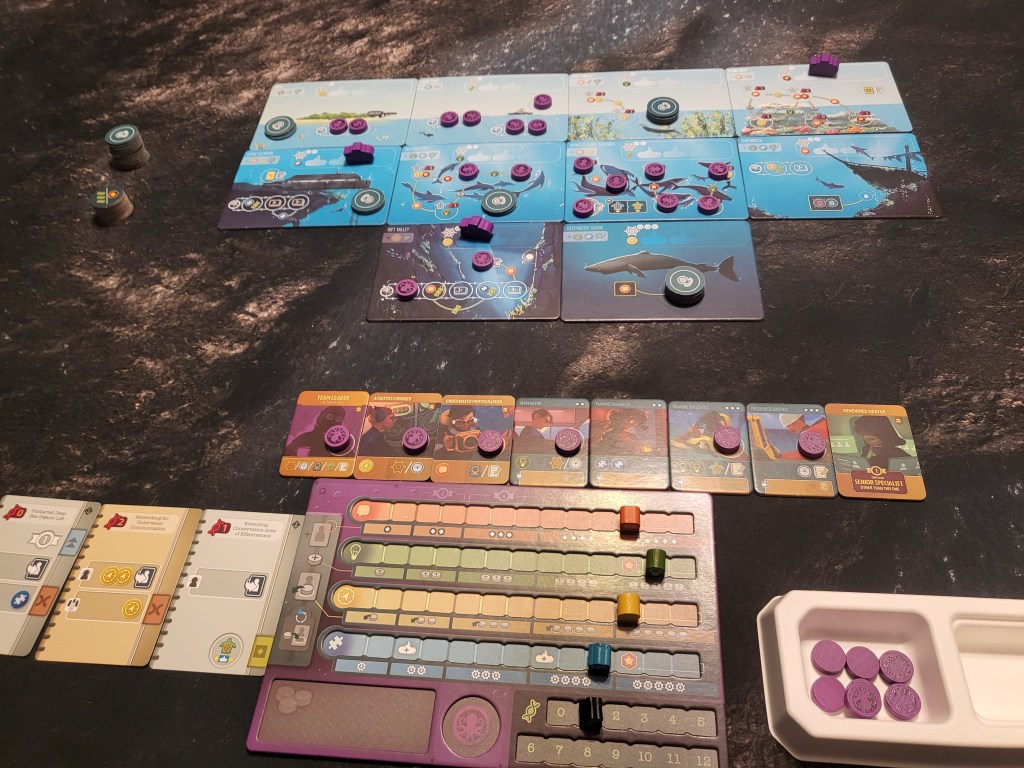
For the solo mode, the game play stays mostly consistent except goal cards and setback cards get added. At the start of each game, three goal cards and four setback cards create a small deck which represents the number of rounds (one card gets flipped at the beginning of each round). The goals are additional specific monuments the player can work to achieve, and the setbacks are as they sound. Otherwise, the game is the same, the player has seven total rounds, and the main objective for each mission is to achieve 4-7 goals (depending on the selected difficulty level) to succeed. Those four goals can come from a combination of the revealed goal cards, the printed goals on the mission, and the overall success in terms of points for the mission as a whole.
Honestly, I found the missions pretty challenging solo, but I was able to accomplish a few on the first try, others I have yet to master despite multiple attempts. Because the missions are already challenging, in the later games, I actually ignored the setback cards and just used them for round tracking. This is obviously not how the game is designed, but I needed something to make me feel like the goals were more achievable. The setbacks made success nearly impossible, and I wanted to feel like my strategy and consequent actions in the game weren’t frivolous. I do appreciate the goal cards, however, as it is often very difficult to get the required number of points for the mission and accomplish all mission specific goals.
I’ve also been able to experiment a little with the three mini expansions included in the Kickstarter version: Underwave Academy, Orca Reintroduction, and Robotic Wanderer. Underwave Academy adds an ocean zone tile and training badges that can be assigned to specialists and provide additional action options. Orca Reintroduction also includes an ocean zone tile, along with five wooden orcas that get placed on that tile. When you travel there, you gain an orca which can be used later to make the conserve action “cheaper”, and there’s a special benefit for performing the sonar action on the orca tile. Robotic Wanderer throws in some cubes and a robot meeple, as well as an additional ocean tile. This is probably the most complex of the three expansions, but it essentially allows players to perform actions (that can get upgraded) through the wanderer (AKA at the wanderer’s location instead of your current location).
Overall, this game is quite the catch (pun intended). With a variable player count, appropriate game length, quality componentry, solid strategic depth, no over complications or unnecessary rules, impressive game design, wonderful theming, interesting expansions, and a true environmental focus, Endeavor: Deep Sea would be a great addition to any board game collection, and we highly recommend it!
 The Adventures of Yogi Bear and Delaware
Leave a comment