Image taken from https://boardgamegeek.com/image/8591006/moving-wild
Designer: Chris Priscott
Publisher: Oink Games
Artists: Rie Komatsuzaki and Rie Takahashi
In Moving Wild, players build a personal tableau of animal, area, and improvement cards to design and construct the best possible national park. At the start of each round, a certain number of cards are set aside from the deck. Then, in the solo game, the player draws two cards, selects one to keep to add to their park, and gives the other to the “Collector”. The game ends after three rounds and the person with the most points wins.
The area cards in the game provide the physical space for the animals to reside, and each has a specific size and habitat(s). The improvement cards can help expand areas, add certain habitat types, impact the animals, etc. The animal cards are, well, animals, and are the only source of points at the conclusion of each round.
The reason improvements are helpful is that each animal card has a specific amount of space it takes up (need enough space in the areas to hold them), they are identified as friendly or hungry, and some have a special ability or scoring condition. When placing your animals in your park, only friendly animals can be located in the same area. Any hungry animals can only stay with animals of the same name. Each animal also has specific habitat requirements that must be met.
Besides the animal and area constraints, you get to decide where everything goes and the best way to organize it all, which is the fun part! There are a lot of interesting decisions when it comes to which cards to keep to maximize points.
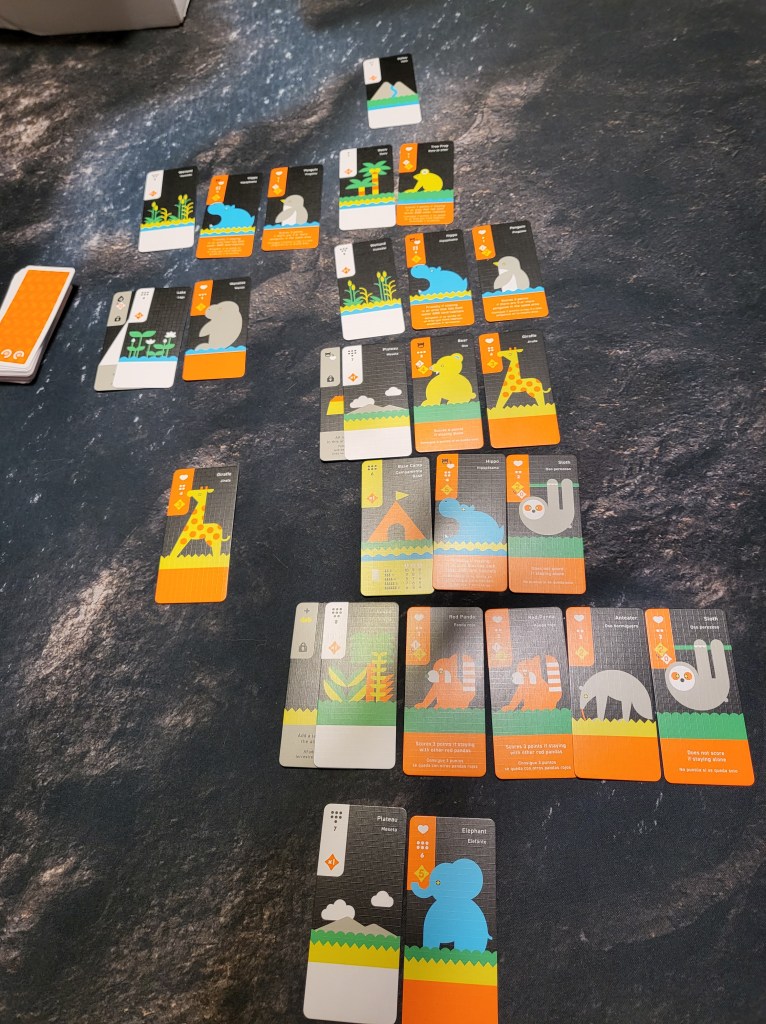
At the end of each round, points are scored based on the printed value on the animals and the printed multiplier of the habitat in which it lives. Players also receive two negative points for any habitat(s) that is not full and another two negative points for any displaced animals (-2 points each). In the solo mode, the collector scores the values on their animal cards.
Gosh, this game is clever! I’ve enjoyed it significantly more than I thought I would. Besides the fact it takes up quite a bit of table space, there’s a lot to love. It’s a tiny box with decent componentry, the theme is amazing, the artwork is adorable, and the game play is surprisingly deep. Even though it plays quickly, there is a lot of fun, enjoyable puzzliness to experience.
The solo variant has multiple difficulty levels which I appreciate. The easiest level is a standard game, and then the three additional levels require specific combinations of animals to be removed from the deck and placed in the collector’s park at the start of the game. This design choice is super fascinating to me since the player then knows those animals aren’t in the deck. I also commend the solo mode design because there’s an intriguing decision space when deciding which card to keep and which to pass to the collector since you know how they score points.
Let me just say, I’ve played quite a few games of this, and I have only won once, and that was after playing all four difficulty levels multiple times then circling back to the original easiest level. 😂 For me, this game was very challenging but in a fun and thought-provoking kind of way, not harsh or vindictive. If you lose, it’s from your own doing and your own decisions. Nobody takes cards from you, nothing blocks you, it’s literally just you deciding each turn which card to keep and which to give away.
I also just really adore the animals in this game. Giraffes are my favorite, so that’s an automatic win, but there are also adorable manatees and penguinos and all sorts of fun creatures. 😍 Their size and habitat requirements are also very logical and thematic which enhances the overall experience. The art work is also very quirky and unique creating a nice visual appeal and table presence.
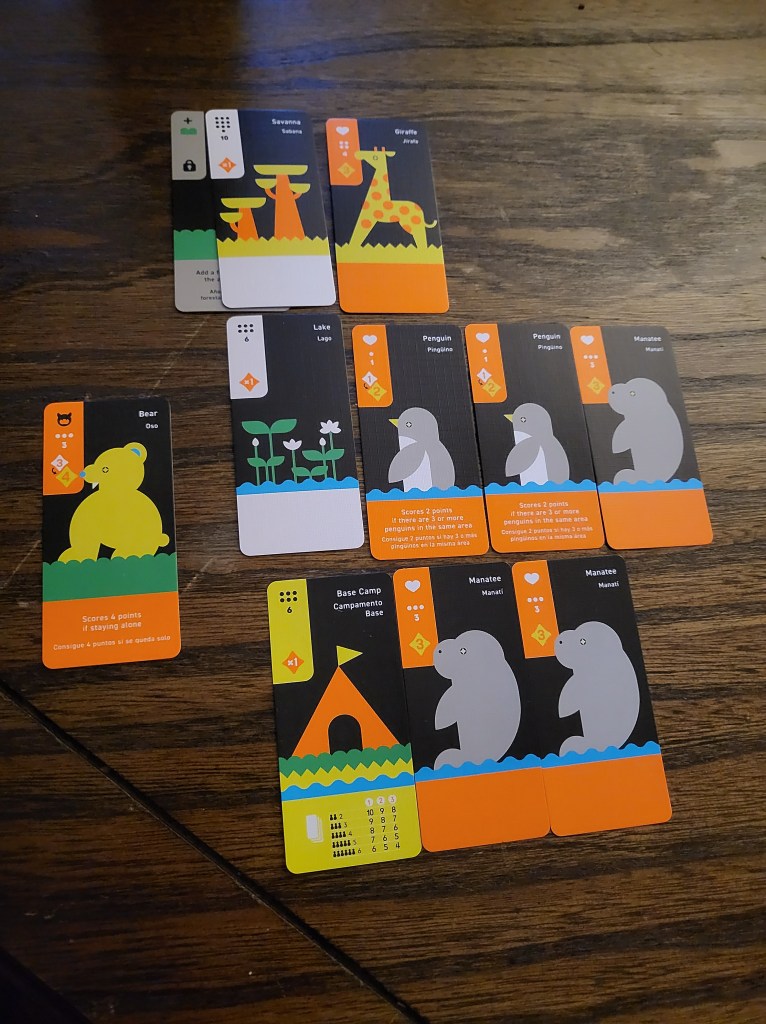
For the size and price of this game, I highly recommend it. Not only does it play excellently solo, but it also plays all the way up to six players to accommodate many gaming group sizes. I look forward to more solo plays, introducing it to other people, and experimenting more in the multiplayer setting.
 The Adventures of Yogi Bear and Delaware
Leave a comment