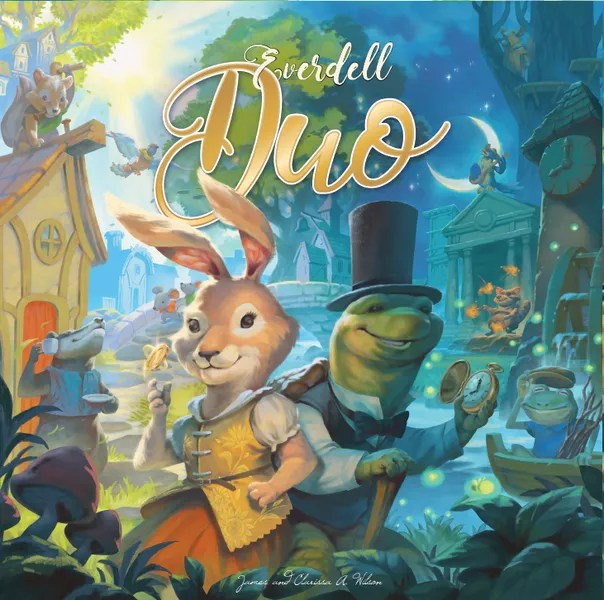
Image taken from https://boardgamegeek.com/image/8317636/everdell-duo
Designers: James A. Wilson and Clarissa A. Wilson
Publisher: Starling Games
Artists: Enggar Adirasa, Andrew Bosley
You might want to grab a snack and a beverage; this one’s my longest review to date. 😮🥳
Since Starling Games was amazing and I received my Kickstarter copy MONTHS early, now I get to do an in-depth review! If you don’t want to read my ramblings, know that I had so much fun with this game, and you can tell countless hours were spent developing the different ways of play and difficulty levels. It’s astounding, and everyone involved in the production of this game did a wonderful job.
Let me just start with some basic, non-gameplay-related likes for this game. First, the box is a really good size (schmedium and pretty thin), but everything easily fits inside without much unutilized space. The componentry is also very nice. The meeples are solid wood, the textures of the resources are unique (especially the berries), and the cards and board (and cardboard components) come well crafted. I’ve had no problems with anything after my many games. I also appreciate that the board is double-sided to accommodate all modes of play.
The artwork on the cards is exceptionally lovely. The color palette is pleasing to the eye, and each character and building has its own thematic personality. Every single card in the deck is unique, so you can visually see a lot of time went into the art production. The board also fits in well with the theme and is very functional (not too big, not too small).
For me, the playtime was just right. The skunks (keep reading for this to make sense) make some games shorter than others, but I was able to easily play a game in 30-40 minutes, and I usually play pretty slowly. The turns are snappy, so the game doesn’t drag on, and there is a clear end to the game after four seasons which also helps. If anything, especially with the skunks, I wish there was more time and more turns, but that’s what makes this game so fun and challenging!
Like I said, I haven’t played any other Everdell games, so I’m going to explain the game play of this one without providing any comparisons. The set up for each version of the game varies slightly, but the main aspects are placing event tiles (goals to work towards), river tiles (used as worker placement locations), and setting up the meadow full of cards. The sun and moon markers also get placed in the meadow, which are your timers for each season.
In the cooperative/solo modes (both campaign and challenge), skunks also get placed in various locations around the board. Their locations are dependent upon the scenario, the chosen difficulty level, and the roll of a die. They’re basically there to block certain worker placement spots and force the game to move quicker (the players take less turns the more skunks are in the meadow).
The main mechanics are worker placement and card/hand management (there are a few others I’ll mention soon). During each season, the hare and tortoise rotate taking turns. On a turn, a player can play a card to their city, perform a worker placement action, or draw a card from the meadow or deck. If a card is played, the moon moves; if a worker is placed, the sun moves; if a card is drawn, the player chooses whether to advance the moon or the sun. Once the sun and moon reach the end of the meadow track, the season ends.
Because of the sun and moon, there’s also an interesting action selection mechanism. For example, if the sun makes it to the end of the meadow, neither player can complete a worker placement action since the sun can’t advance any farther. This means you really have to consider which to move when selecting a card, as well as when to take which action to ensure you are able to accomplish what you need to. It’s honestly very clever and very well implemented.
While the mechanics are pretty streamlined and easy to grasp once you’ve played a round or two, the strategic depth is still omnipresent. As aforementioned, there is a lot of tension that arises from the time aspect of the game, both moving the sun and moon, and also just having enough turns to build up a little engine in your city. Often, at the end of a season, you wish you had one or two more turns, but alas, the game is designed to be tight, so that’s part of the experience.
The design of this game also encourages a large amount of forward thinking, and all four seasons basically become small maximization puzzles in a large optimization game. There are considerations for the timing aspects in terms of planning ahead, but with the combinations of cards, resources, and specific goals (either from the game or from yourself), there are even more possibilities to ponder and evaluate.
Before I go into the nitty gritty of the campaign mode, I want to share my thoughts on the challenge mode. I enjoyed the campaign mode significantly more, but I appreciate the inclusion of the challenge mode. It makes it easier to just play one or two games here and there, and the proposed challenges are quite difficult to achieve, so there are plenty of strategic avenues to discover and reasons to play multiple games. There are also three different difficulty levels for the challenge mode, so it’s easy to tailor the experience to what you want it to be. In the challenge mode, there’s an AI opponent (Miss Lily Thorn) who takes cards from the meadow at the conclusion of each season and gathers points from cards and events (also gained after each season). The interesting thing, though, is that you know which cards and which event(s) she will take because it’s always based on the locations of the skunks for that season. There is an added layer of strategy with this because you want to ensure that she scores as few points as possible on her cards and takes as few events as possible. It’s a nice addition, and I look forward to playing more, but the campaign is really where this game knocked my socks off.
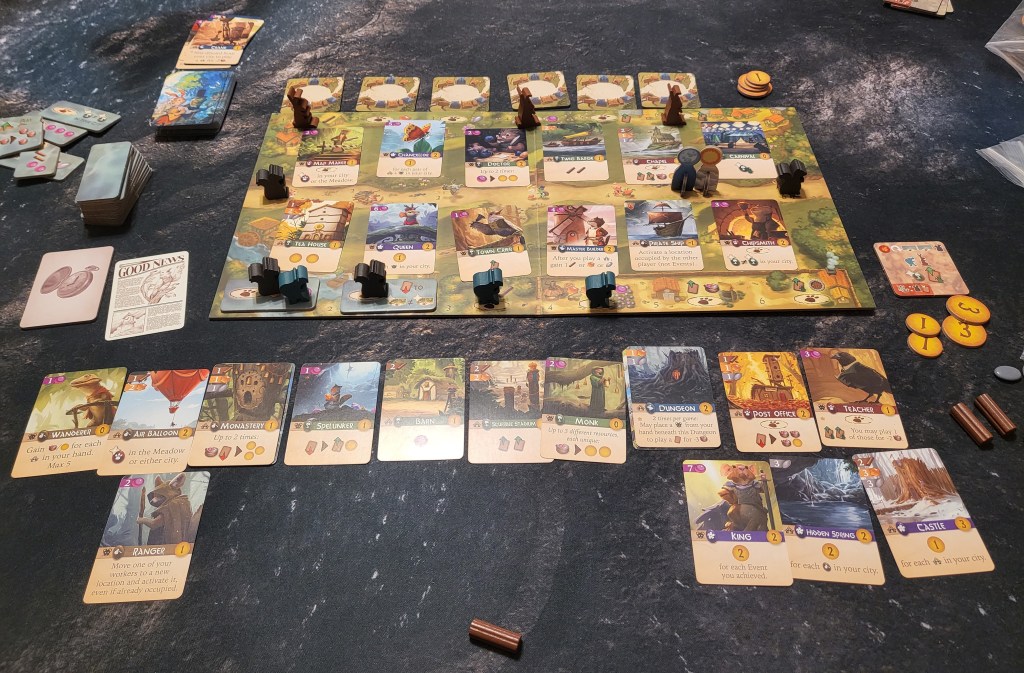
So, the campaign. It’s fifteen chapters, and while that seems long, I thoroughly enjoyed playing all chapters, and I’m a little sad it’s over. It was such a charming and special experience playing through the story.
The story itself is based on the hare and tortoise collaboratively being mayors of the town. As you progress through the story, you meet different characters, have unique goals and achievements, and get to immerse yourself in the setting. The story is creative, very well written, and gets a huge commendation from me (not that that means much). While I typically love campaign games, there are some that I’ve played that don’t have a very good story arc and/or the chapters and transitions seem choppy. Here, that is not the case. Everything flows smoothly, makes logical and thematic sense, and creates a fun world to explore.
As I mentioned, as the story develops, the chapters encourage you to try different strategies and explore unique aspects of the game. Sometimes you even have to accomplish tasks before the end of a specific season, which makes the time-related tension even more spicy. The thematic incorporation of the tortoise vs. the hare is also brilliantly brought to life in the campaign, both as part of the story and through the mechanical aspects of the game play. You also get to learn about and know the cards and characters more and more as you progress.
After playing, I’m truly astonished with what they managed to accomplish. I deeply appreciate that they designed the campaign to be highly replayable. Yes, you know the story, but with each chapter creating new challenges and goals, it would be easy for me to enjoy multiple play throughs. They also include two difficulty levels for the campaign, so you can always play again and make it more challenging for yourself if you initially succeed.
The game has inherent variability as well, mainly through the sheer number of cards, but also through numerous event and river tile options. While I’ve only tried the two solo ways to play this game, there are technically four different options, which also increases replayability significantly. There is the solo campaign and solo challenge modes, but you can also play the campaign cooperatively with another player, or you can play competitively against another player.
Playing solo, I controlled both the tortoise and the hare, but I could see the coop version with another player being interesting based on the actions that happen at the start of each season. Both the hare and the tortoise gain specific cards/resources/actions, so playing by myself, it was easy to delegate which character received which benefit, but I could see that being an interesting puzzle with another player. Similarly, those occurrences would be very different in a competitive game, so I look forward to trying that sometime as well.
One potential negative to note is that there is quite a bit of randomness in the game. The cards will always be random in terms of which cards you see in a game, and which are in the meadow, deck, etc., but that’s expected. In the solo/co-op games, there is also a significant amount of luck when it comes to rolling for the skunk placement. It can be frustrating, but I can’t think of a
much better way to keep it random across the multiple locations.
In terms of cost analysis, this game is an incredible value. Even with shipping, I paid less than $30 for this game, and even if I never play again (which obviously won’t happen), I’ve more than gotten my money’s worth. The componentry is also really nice for a game at this price point.
Well, now that you’ve read my novel, I hope you get a sense of how fantastic this game is and were able to evaluate if it’s right for you. I highly recommend it; it’s overall really splendid and I can’t wait to play some more. It was the game I played almost every day after work for a while, so I’m going to miss it. I guess I’ll have to play again soon!
 The Adventures of Yogi Bear and Delaware
Leave a comment