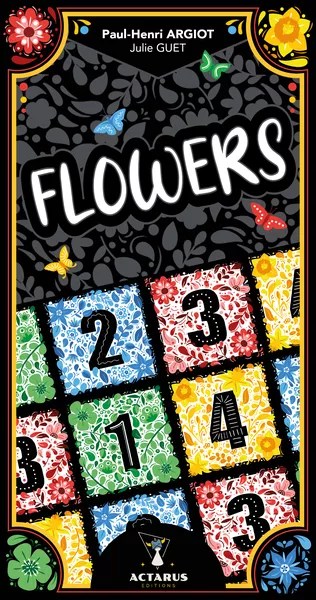
Image taken from https://boardgamegeek.com/image/7810232/flowers
Designer: Paul-Henri Argiot
Publishers: Actarus Editions, HUCH!
Artist: Julie Gruet
FLOWERS is a quick, chill, relaxing, puzzly game where players work to create a tableau of flower cards to score as many points as possible. While the game is super easy and straightforward to learn, the design is brilliantly thinky.
To set up, the flower cards are shuffled, and each player draws one as their starting card. The rest get dealt into two stacks (number of stacks and cards depend on player count). Then, the top card of at least one (more in a multiplayer game) stack gets flipped and placed on top. In the solo game, two stacks of forty cards are dealt, and then one of the two top cards get revealed.
From here on out, I’ll be explaining the solo game mode, but know what the multiplayer version isn’t too far off.
After the two stacks are made and you have your starting card, play begins. On each turn, the player selects the top card from either stack – one is face down and one is face up. That card then gets immediately added to the player’s tableau by placing it orthogonally adjacent to another existing card. The placement is obviously where this game gets tricky and through which it gains its strategic nuances.
The goal when placing the flowers is to get similar colors grouped together (called fields) while also getting clusters of numbers of various sizes depending on the value on the card. For example, ones have to be by themselves, you need two twos adjacent, three threes, four fours. So, not only do you want to get large sections of colors, but you also must ensure the number(s) of grouped cards is precisely what it needs to be.
Once a card has been placed, the top card of the face up deck gets removed from the game (basically an innate timer). The game ends when one of the stacks runs out of cards.
There are three aspects to scoring. Each card that is not placed correctly (as in you only have a set of two threes for example) gets removed from the tableau and you lose one point for each removed card. Then, one point is scored for each card in a field (group of at least five adjacent cards of the same color). The trick here: if you remove cards and your field total drops below the necessary five cards, you don’t get to score that color. Lastly, one point gets scored for each butterfly (some cards have butterflies) that is adjacent to at least one other card that shares the color of the butterfly.

I really adore this game. The mechanics are simple, but the design is slick; there’s more to think about each turn than initially meets the eye. Not only do you have to decide if you want the face up or face down card, but you also have to consider how quickly the game progresses when you select that comfortable face up card vs. the risky face down card. The scoring is also really neat with the negative points for incomplete sets and the added complexity of the butterflies. It’s also interesting that the values on the cards don’t matter for scoring, only when forming the groups.
While there is luck involved, which I don’t particularly care for typically, there is a way to mitigate it by choosing the face up card. Selecting a face down card is literally luck of the draw (with a bit of push your luck), but a poor outcome is partially self-inflicted.
There is also interesting tension with the timer aspect. As much as you may want that face up card, is it worth the step closer to the end of the game? You are taking a card you need but at the cost of losing a card later, essentially. It’s such a wonderful design choice.
Furthermore, there’s an intriguing push and pull aspect to the color vs. number situation. Yes, you need colors to form fields to score points, but if you can’t complete your number sets, you lose points, and those cards get removed from the field anyway. It’s tough to balance and so much fun to try to figure out!
There are quite a few cards in the box (108 flower cards to be exact), so that helps with replayability. Even though each game is similar, the variations in the order of colors and numbers make each game a unique challenge.
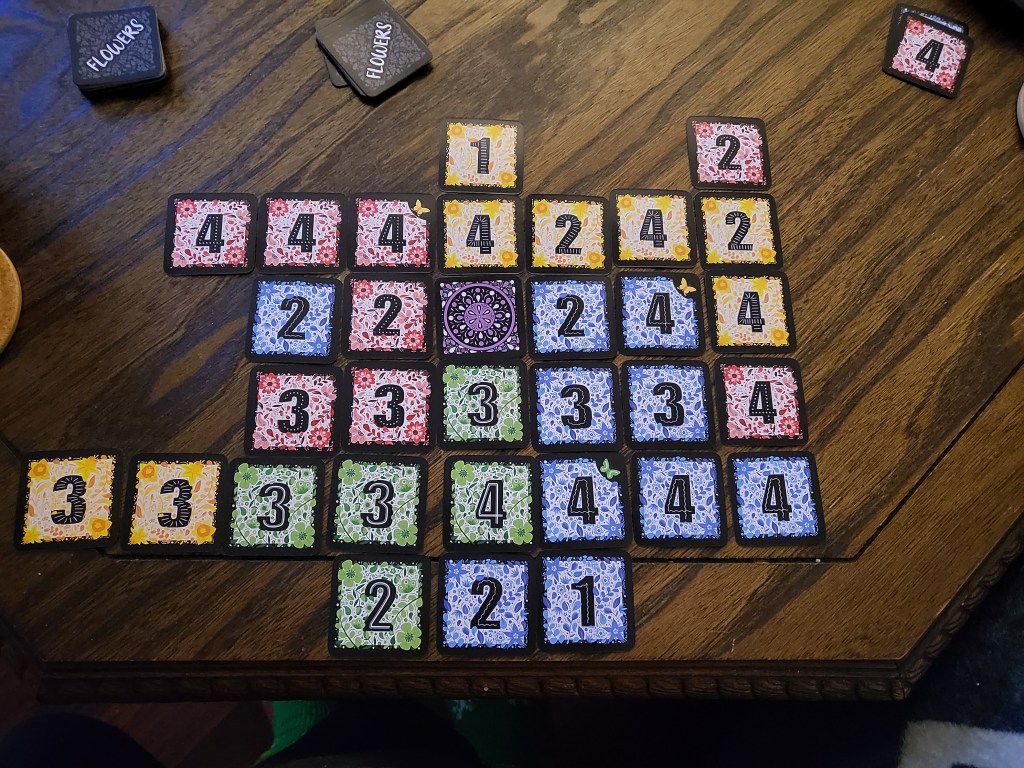
There is a second variant included in the box that’s so simple yet so effective. In the summer variant, rather than starting with a random card from the deck, each player begins with a matching purple card. At the end of the game, any field you wish to score must be adjacent to the purple card. While this doesn’t seem like it would make the game very different, it really does! It increases the challenge level just enough to add another layer of complexity and puzzliness. Because you must ensure each color touches the purple card if you want to try to score all four possible fields, each card adjacent to that purple card has to be a different color. I’m very impressed that this small change in design creates significant impacts on the game play.
This isn’t really a negative, but I didn’t find the included templates for making the stacks of cards particularly useful. It’s possible I’m just dumb and completely misunderstood how to use them, or maybe they’re not particularly applicable to the solo game (at least that’s what I’m going to tell myself), but they’ve gone unused. That said, I appreciate their inclusion if they actually help with the set up of the game.
As you can see, I highly recommend this game to anyone who likes an enjoyable and thinky game that plays quickly, doesn’t take up much space on the table or shelf, and is very reasonably priced. I genuinely can’t think of a reason not to give this one a try, unless you just don’t like colors, butterflies, and flowers, which would just be sad. So, don’t be lame, go get this game!
 The Adventures of Yogi Bear and Delaware
Leave a comment