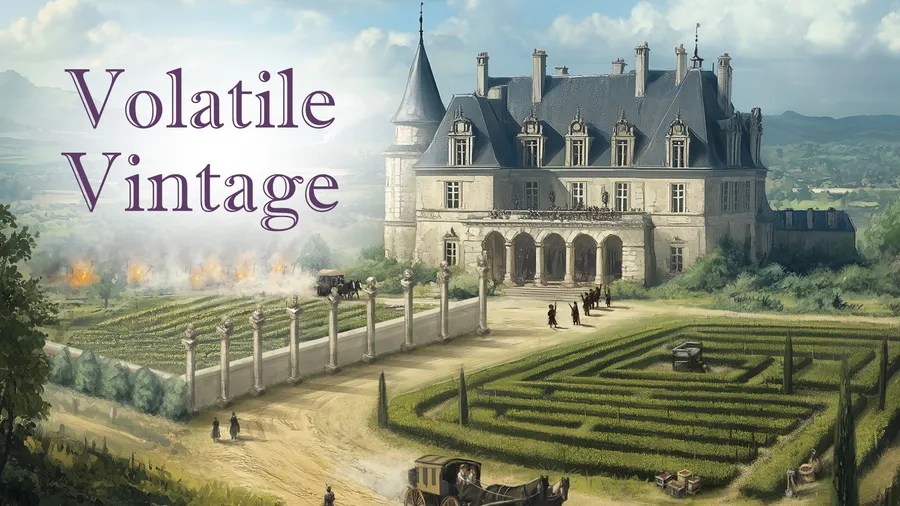
Image taken from https://boardgamegeek.com/image/8453037/volatile-vintage
Designer: Zach Sullivan
Publisher: Grazing Bear Games
Artist: Diego Sanchez
Volatile Vintage is a print-and-play light engine builder where you are working to produce the most wine barrels while also running your vineyard and fending off mob attacks. Besides the player sheet, all you need is a writing utensil and a standard deck of playing cards, so the footprint on the table is small, it’s easily portable, and it plays in roughly 30 minutes. While I love the theme, I didn’t particularly care for the mechanics as a solo game. I could see it working very well as a multiplayer game, though, so don’t let this deter you from checking it out!
Each “round”, two cards are drawn from the deck and each player must select one to use that turn. Each of the four suits have associated tracks on the player sheet, so the value and the suit of the two available cards are what drive the decision making.
Hearts are associated with your employee limit, which dictates how far on each track you can move regardless of how high the value is on your selected card. For example, at the beginning of the game, you have three employees. Even if you flip a four and a five for your two cards, you can only check off a maximum of three spaces since you only have three employees. This creates an interesting dynamic because you need to increase your employee limit early if you can, but you also need to work on other tracks where necessary.
Clubs are related to your mob defenses. Each time an ace and/or a jack is drawn, you get attacked by a mob (and either ignore the other card or perform two mob attacks if both cards are jacks or aces). The mob attack value increases as the game progresses but your mob defenses help protect against damage. For example, the first mob attack has a value of four, so the track for whatever suit is associated with the jack or ace gets decreased by four marks (you erase them from your sheet). If you have your mob defense track up to three, though, then you only have to erase one mark since you prevented three of those attack points.
The spades track is associated with accords, which are contracts you can make with nearby villages to unlock special abilities and bonuses to assist you throughout the game.
Diamonds are representative of your wine barrels. In the multiplayer game, the player with the most wine barrels at the conclusion of the game is the winner, but in the solo game, these barrels aren’t as important. This is actually part of the reason I don’t care for this game solo very much. There’s not a lot of incentive to increase your total barrels, so I don’t feel there is a main goal to work towards. That said, I do appreciate that there are some solo achievements and challenges to strive for, but, unfortunately, they aren’t interesting enough for me to want to keep playing.
One very important and impressive part of this game, though, is that the player sheet is very well designed. The tracks are well marked with the corresponding suit, the rules are well laid out, and it’s very pleasing to the eye. Overall, the game isn’t for me solo, but I could see this being easy to get to the table and enjoyable with multiple players.
 The Adventures of Yogi Bear and Delaware
Leave a comment