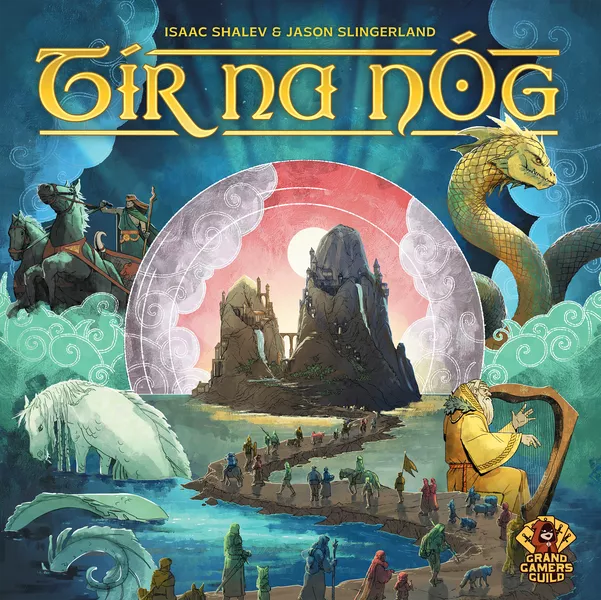
Image taken from https://boardgamegeek.com/image/8402314/tir-na-nog
Designers: Isaac Shalev and Jason Slingerland
Publisher: Grand Gamers Guild
Artists: Marlies Barends and Brigette Indelicato
Tir na nÓg is a competitive game focused on hand management, set collection, and tableau building. There are five rounds, and at the start of each round, a specific layout of cards is created (dependent on player count) in the middle of the table. Over the course of the game, you collect cards from the center and add them to your own tableau which typically ends with three rows and five columns. The player with the most points at the end of the game is the winner.
To set up, the central card area (called the Otherworld) is arranged and then three Geas cards are selected. Since your personal grid will have three rows, you assign each Geas card to a particular row depending on the Geas placement rules.
Each of the five rounds is broken into three phases: the journey phase, the saga phase, and the cleanup phase. In the journey phase, each player deploys their three Storytellers into spaces between any two cards (called Encounter cards) in the Otherworld. Once all Storytellers are placed, the saga phase begins, which is where the bulk of the gameplay occurs.
In the saga phase, each player selects a card one of their Storytellers is on/adjacent to and adds it to their hand. Then, one card from the player’s hand gets played to their tableau. This continues until all placed Storytellers have been used. At the start of the game, each player is dealt five cards, so in the first round, you have six cards to select from each time you are playing a card (because you picked one up). After each round, though, one card gets discarded, so by the end of the game, you shouldn’t have any cards left in your hand.
The cleanup phase involves removing any leftover cards from the Otherworld and then creating a new Otherworld as previously.
Once the fifth round is complete, final scoring occurs. Players score points from their Geas cards (each one has a unique stipulation and varying points) as well as Regions. Card Regions (or Regions of Tir na nÓg) are based on the number of congruently colored cards that are adjacent to one another in your tableau. There are four colors, and each gets scored individually, as players compete for the higher point value associated with having the most of that color card. At higher player counts, there are points for second, third, etc. but in the two-player game, the dominant player in each color receives eight points, and if the other player has at least two of that color adjacent, they get two points.
While playing, there are a few considerations when selecting cards from the Otherworld and placing them in your tableau. Of course, the Geas cards are probably the most important focus as they often provide high point value scoring opportunities. The color of the card is also important for the Regions bonus. Additionally, some cards have text that allows a specific ability to be utilized during the game, so those could be appealing as well. Lastly, each player’s tableau is open information (each hand is closed information), so it’s possible to strategically draft your cards to block your opponent.
The solo game plays quite similarly to a two-player game. The AI opponent is dubbed Balor, and they collect cards like you do in the journey phase, but there is no tableau to maintain for them. In general, the facilitation is actually quite easy, which I appreciate. At the end of the game, Balor scores Geas cards based on a specific value on each card. Then, you can choose a difficulty level which determines how many of their cards get discarded from their “tableau”. This is actually really fascinating. It gives the player the power to control the outcome of certain Regions based on your tableau and what Balor has. This aspect makes the solo experience slightly more unique and interesting than the multiplayer game (in my opinion).
In summary, here are some things I appreciate about Tir na nÓg:
- The theme is well done, and they researched specific aspects of Celtic culture to bring this world to life. There is also a card reference and pronunciation section at the end of the rulebook which is necessary and helps with the cultural incorporation. That said, the theme isn’t mechanically integrated into the game at all.
- The components are well made. The cards are quality, and the Storyteller pieces are thick screen-printed wood.
- It’s a fun game that has a nice player count range (1-5) and plays in a fair amount of time.
- The relationships in the strategy in placing your Storytellers and gaining cards and then placing them into your tableau is intriguing. The interconnectedness adds a lot to the strategic side of the game.
- It’s just a smooth, relatively simple while still being thinky, enjoyable, well-designed game. The solo also runs easily while still being quite challenging.
And here are other things that drag this game down a bit:
- For me, there’s no real wow factor. Nothing in the mechanics or any other aspect of the game play (besides maybe the Storytellers partially) is particularly unique or innovative.
- This box is unnecessarily big. It’s a pretty small box to begin with, but there are very few pieces, so the box could be about half the size.
- I wish the theme was more integrated into the actual game play, but I do appreciate the attempt at making the game decently thematic overall.
All in all, if you like tableau builders and/or the theme intrigues you, this is definitely one to check out! 😊 Just don’t go in thinking it’s going to be something groundbreaking.
 The Adventures of Yogi Bear and Delaware
Leave a comment